Skip to content
What Is a FRED? Fast Recovery Epitaxial Diodes and Their Selection Trade-Offs
Last Updated: 2026-09-23
Quick Answer
A fast recovery epitaxial diode, or FRED, is a silicon power-diode technology designed to manage reverse recovery using an epitaxial structure and associated process choices. It belongs within the broader recovery-rectifier discussion, rather than forming a universal performance grade. Compare specific devices for recovery, conduction, temperature and circuit compatibility.
A purchasing list may describe one part as “fast recovery,” another as “ultrafast,” and a third as “FRED.” Those labels are related, but they do not describe precisely the same thing. Understanding the distinction helps buyers request meaningful comparisons without assuming that the longest technology name identifies the best replacement.
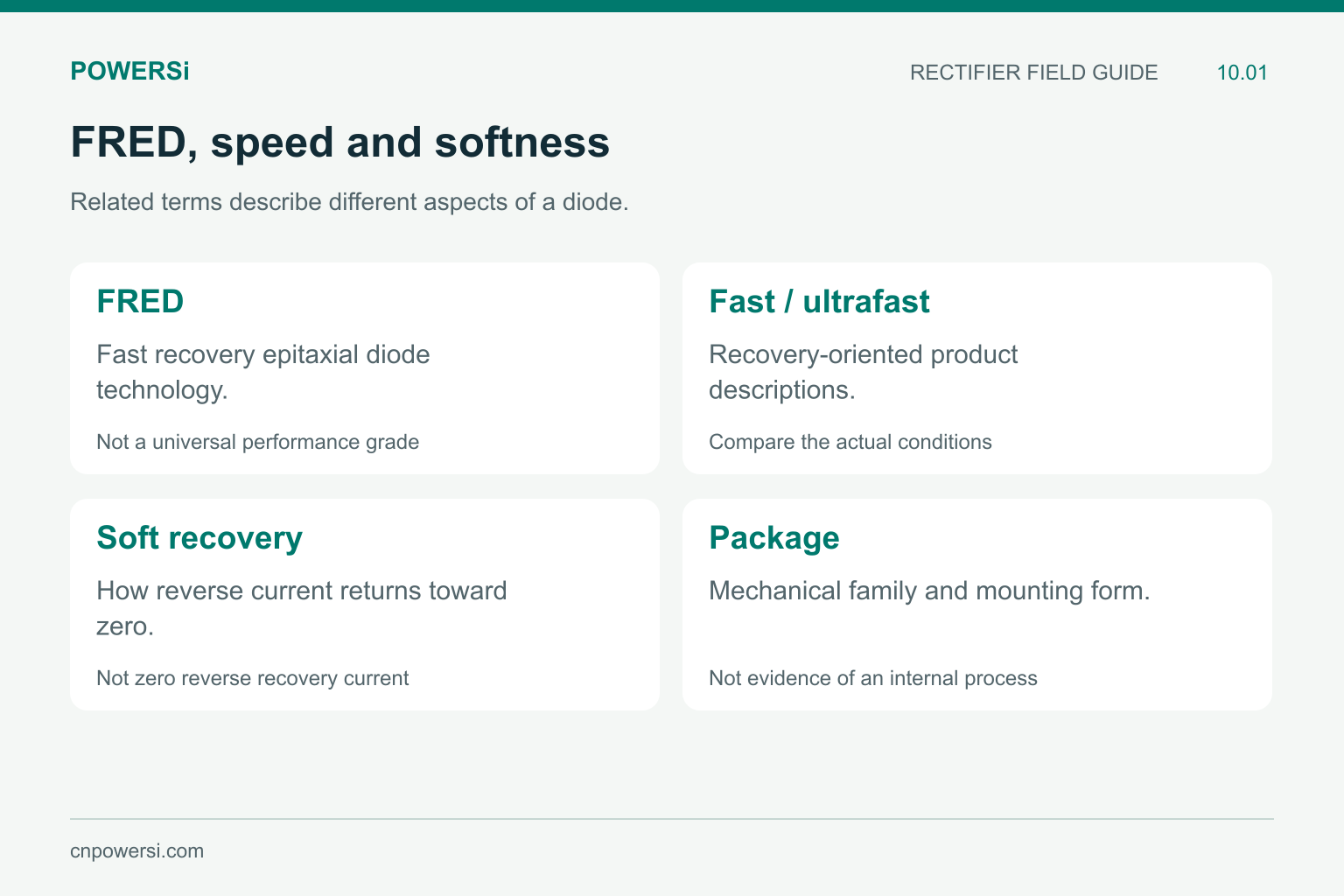
A technology label does not replace a device specification.
Separate Technology From Performance Descriptions
“Epitaxial” refers to a semiconductor manufacturing approach in which a crystalline layer is grown on a substrate. In power-diode design, the structure and process can be used to control characteristics involved in blocking and switching.
“Fast” and “ultrafast” describe recovery-oriented product classes. “Soft recovery” describes how the reverse current returns toward zero. A FRED can also be described as fast, ultrafast or soft-recovery, depending on the particular device. These terms should not be treated as mutually exclusive bins.
| Term | What it tells the buyer | What it does not establish alone |
|---|---|---|
| FRED | Fast recovery epitaxial diode technology | A universal loss or speed limit |
| Fast / ultrafast | Recovery-oriented product description | A complete comparison under matched conditions |
| Soft recovery | A characteristic of the recovery waveform | Zero reverse current or zero switching loss |
| Package code | Mechanical family and mounting form | Internal fabrication or dynamic performance |
Manufacturer-specific technology names also need care. For example, Vishay’s FRED Pt family is a specific branded implementation. Its process claims should not be transferred to an unrelated supplier’s device simply because both are recovery rectifiers.
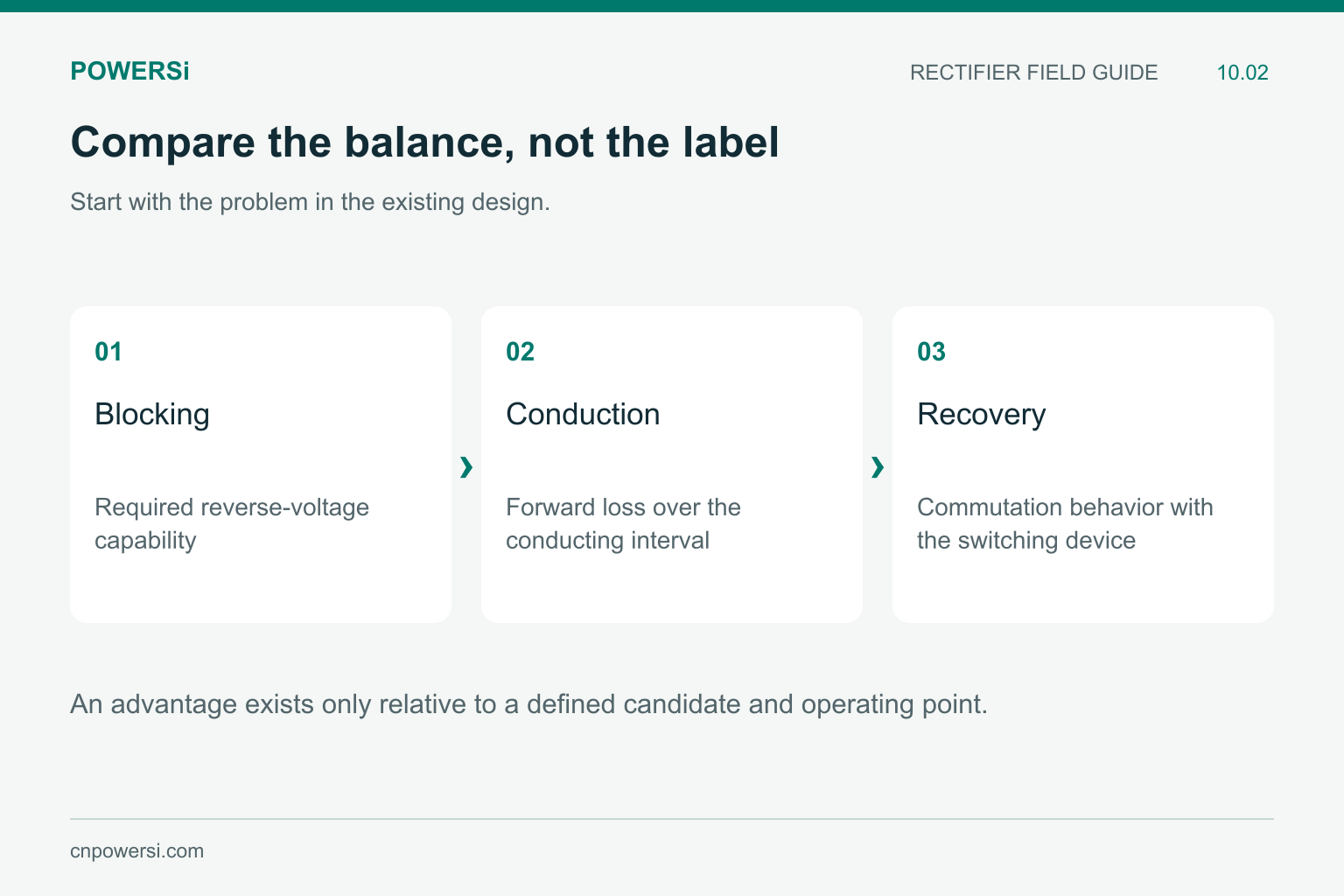
The exact comparison matters more than a broad technology ranking.
Understand the Intended Advantage
FRED development aims to obtain a useful balance of reverse recovery, forward conduction and blocking behavior. Process control can help tune that balance, but there is no single numerical advantage that applies to every FRED against every other fast diode.
The comparison therefore needs an exact baseline. If the existing rectifier creates excessive switching loss at a defined commutation condition, a candidate with more suitable recovery behavior may help. If conduction dominates the loss budget, a different forward-voltage characteristic can change the result. A device optimized for one operating point can be less attractive at another.
The Littelfuse FRED application note discusses how structure and process choices influence these characteristics. That technology background is a starting point for comparison, not a qualification report for a POWERSi component.
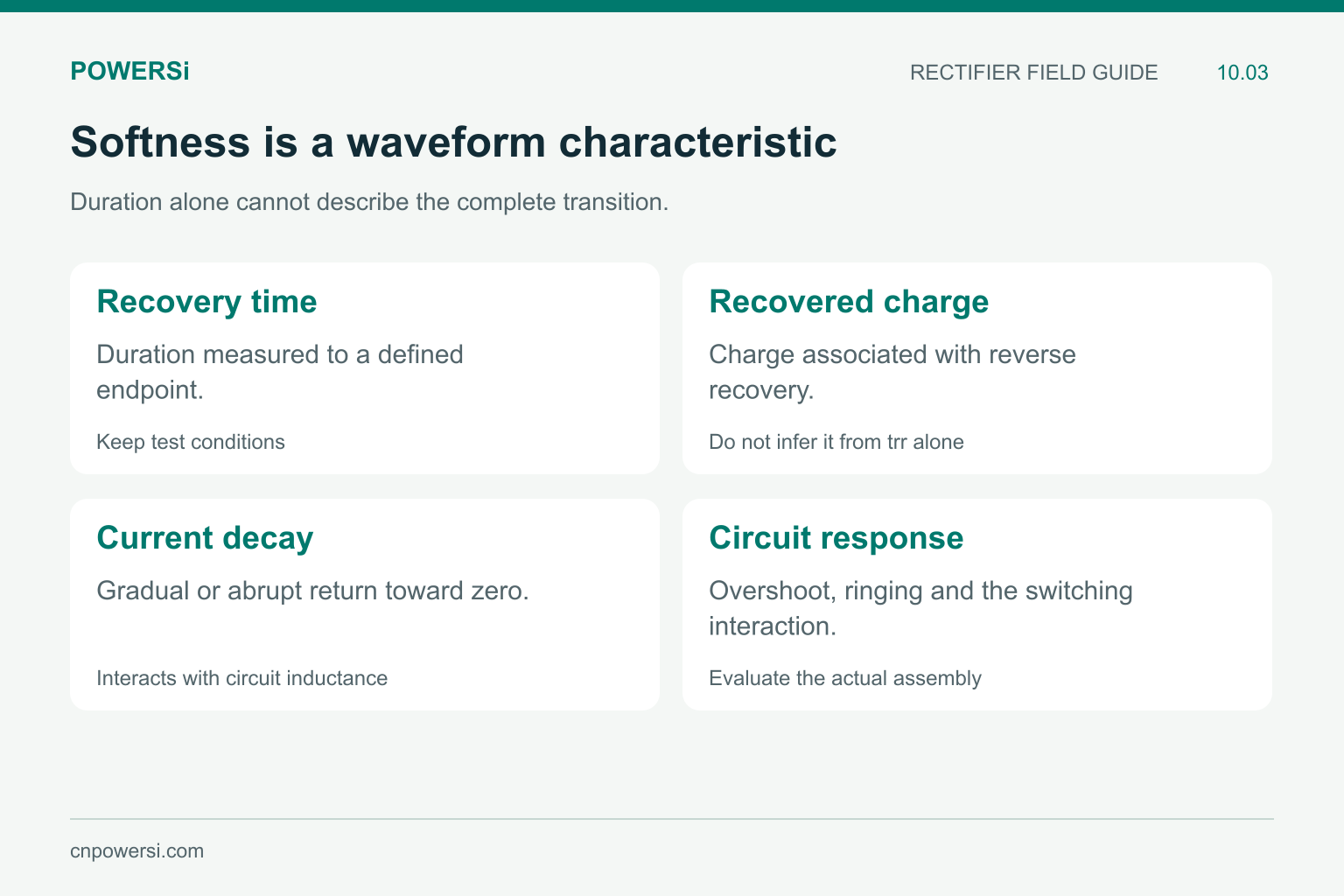
Soft recovery is not a guarantee of zero loss or automatic EMI compliance.
Keep Softness Separate From Recovery Time
Two reverse-current waveforms can have a similar duration and different shapes. An abrupt current change interacts with circuit inductance, while a more gradual recovery can change overshoot and ringing. The result also depends on the commutation loop and switching device.
Softness is therefore a useful part of the discussion when a circuit is sensitive to transients. It is not a guarantee of lower total loss or automatic EMI compliance. The candidate still needs evaluation at the intended current, reverse voltage, temperature and switching conditions.
Do not infer an unavailable Qrr or softness value from a short trr entry. Missing dynamic information should remain distinct from measured or specified behavior in the comparison.
Read a POWERSi Recovery Product as a Specific Device
POWERSi identifies DSEK40S06P as an Ultra Soft Recovery Rectifier in a TO-247AD package. Its repetitive peak reverse-voltage rating is 600 V. Its listed average forward-current values distinguish 40 A per device from 20 A per diode.
Those entries establish useful product-specific facts. They do not make the package itself evidence of an epitaxial process or a complete switching-loss model. A buyer evaluating a recovery device should use the actual product class and characteristics rather than adding an unconfirmed technology label to the BOM.
In this case, the three-lead outline also requires a connection review. A single-diode candidate with a similar body size would not automatically perform the same circuit function. Technology selection cannot bypass that basic compatibility check.
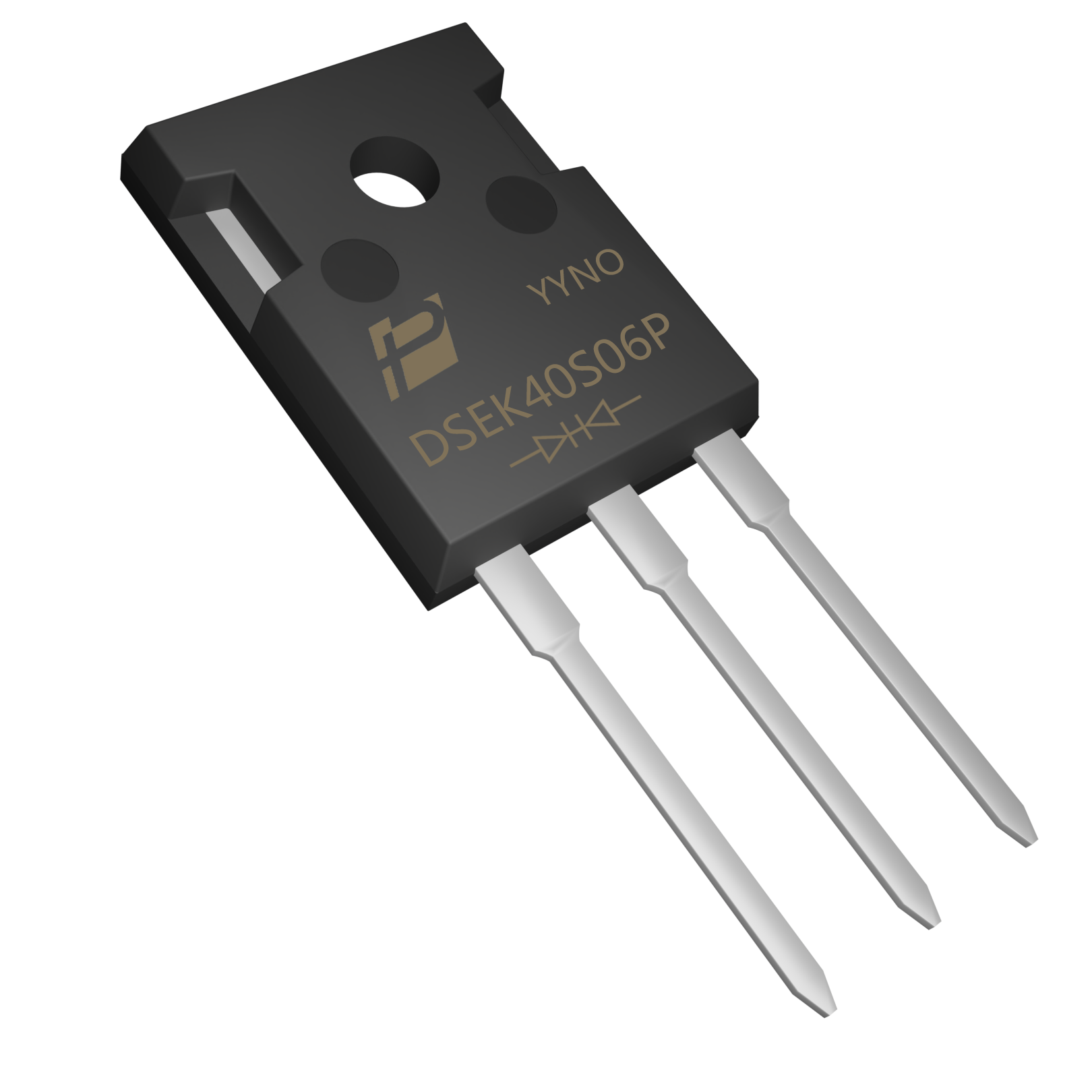
DSEK40S06P is identified by POWERSi as an Ultra Soft Recovery Rectifier in TO-247AD.
Build the Candidate Comparison Around the Design Goal
Start with the problem being solved. For a freewheeling position, the important evidence may include commutation behavior with the existing switch. For a rectification position, conduction duty and forward loss may carry more weight. For either, thermal limits and the mounting arrangement remain part of the decision.
Compare guaranteed values with guaranteed values and typical curves with typical curves under equivalent conditions. Record the operating envelope and the acceptance criterion before samples are evaluated.
If the manufacturer provides only a limited dynamic test point, that point can screen a candidate but may not support a full loss calculation at a different current and temperature. Additional curves or circuit measurements can supply the missing evidence without turning the family name into a performance promise.
Keep Procurement Approval Specific
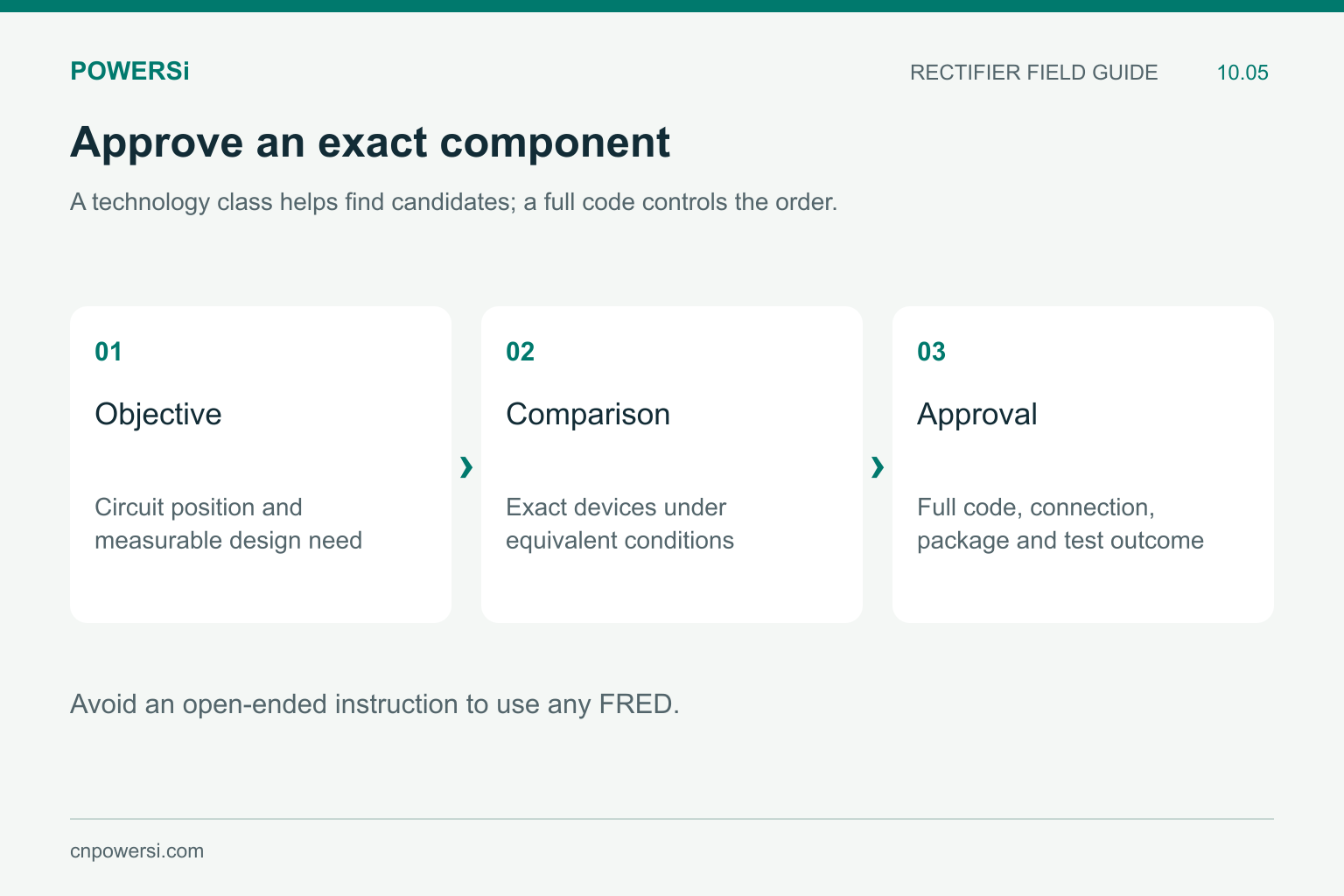
The approved record should identify the exact manufacturer and full ordering code, the circuit position, connection, package and test outcome. Record any limitations that apply to the substitution.
Avoid an open-ended instruction such as “replace with any FRED.” It leaves the current configuration, blocking capability, recovery behavior and mechanical fit undefined. A technology class helps search for candidates; an exact product approval controls the order.
Keep the technology discussion connected to a specific product decision.
Key Takeaways
- FRED identifies technology, while speed and softness describe related performance characteristics.
- Advantages depend on the exact devices and operating conditions being compared.
- Package appearance cannot establish an internal fabrication process.
- Approve the full component identity for a defined circuit and operating envelope.
Conclusion
A fast recovery epitaxial diode can be a useful candidate when its balance of switching and conduction behavior addresses the design need. Evaluate that benefit at the device and circuit level, and keep manufacturing terminology separate from guarantees that belong to a specific part.
Browse the POWERSi product catalog or send your original recovery rectifier, circuit position and improvement target to [email protected].
FAQs
Does FRED mean the fastest available diode?
No. The name does not establish a universal recovery-time or loss ranking across manufacturers and operating conditions.
Are FRED and fast recovery mutually exclusive categories?
No. A FRED is a recovery-diode technology and can also carry fast, ultrafast or soft-recovery descriptions.
Does soft recovery mean no reverse current flows?
No. It describes the recovery waveform, not the absence of reverse recovery current.
Can a package prove that a diode uses epitaxial technology?
No. External geometry does not identify the complete semiconductor fabrication process.
What makes a FRED substitution request actionable?
Provide both exact parts, circuit position, connection, operating conditions and the measurable improvement or requirement to be evaluated.