Skip to content
Diode Part Number Suffixes: Packaging, Compliance and Electrical Options
Last Updated: 2026-09-26
Quick Answer
A diode part number suffix identifies an option within a manufacturer’s ordering system. It may describe shipping format, lead geometry, material compliance or an electrical variant. Its meaning is specific to the product family. Keep the complete order code and verify each changed option before accepting a shortened description or substitute.
Two cartons may carry devices with the same body marking while containing different lead forms. Conversely, an extra letter may select a different electrical connection. Buyers need a controlled description of what changed, not a universal dictionary of suffix letters.
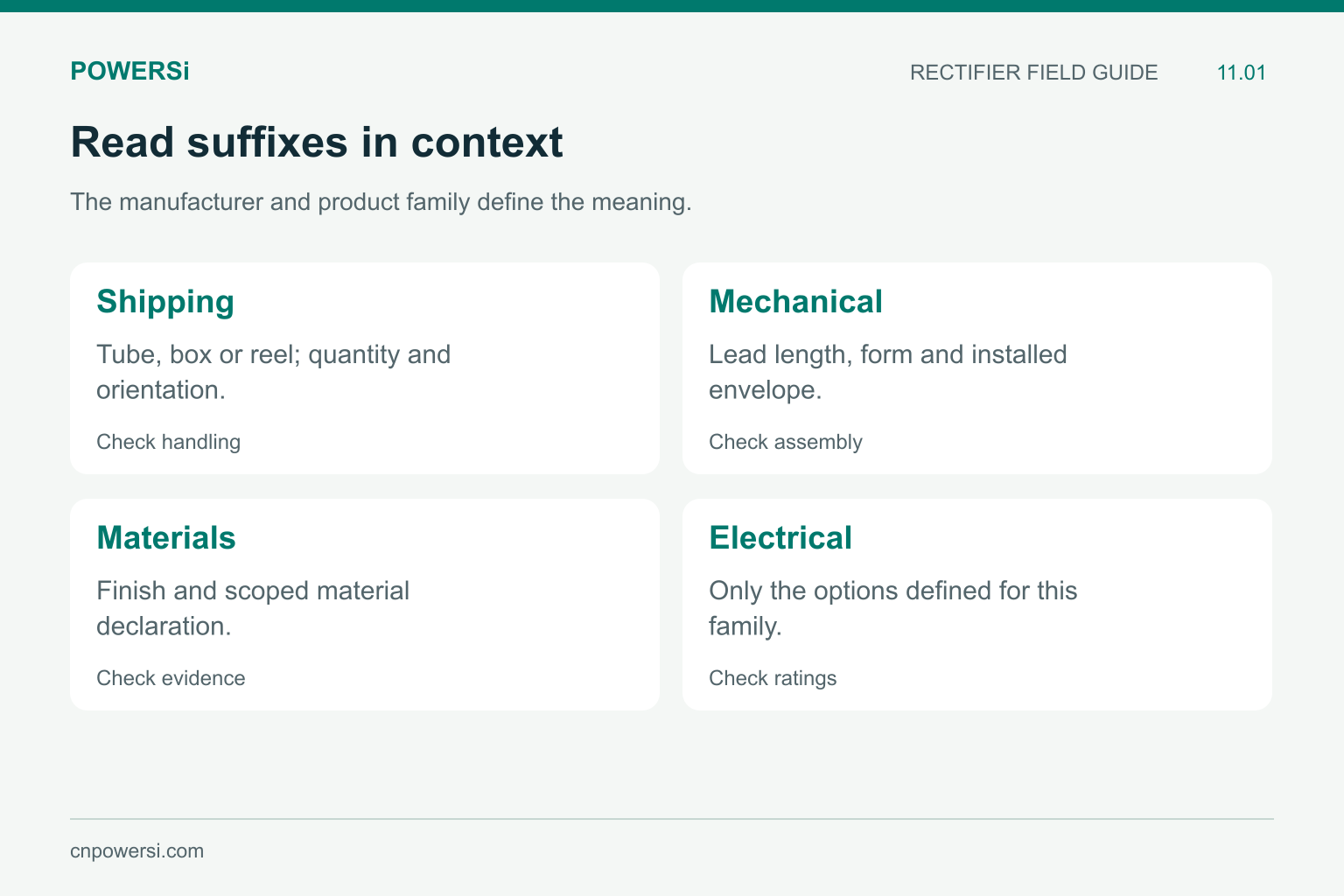
Separate the option categories before assessing a change.
Separate Four Kinds of Options
Shipping packaging describes how parts arrive: for example, tubes, boxes or tape and reel. The component package describes the physical body and terminals. These are different fields. Changing a delivery format may affect feeders or handling without changing the semiconductor, while changing lead length can directly affect insertion and soldering.
Material-compliance options concern a defined material declaration or finish. Electrical options may concern voltage, connection, tolerance or another specified characteristic. A suffix should be assigned to one of these categories only after its meaning is established for that exact series. Never transfer a convention from one supplier to another.
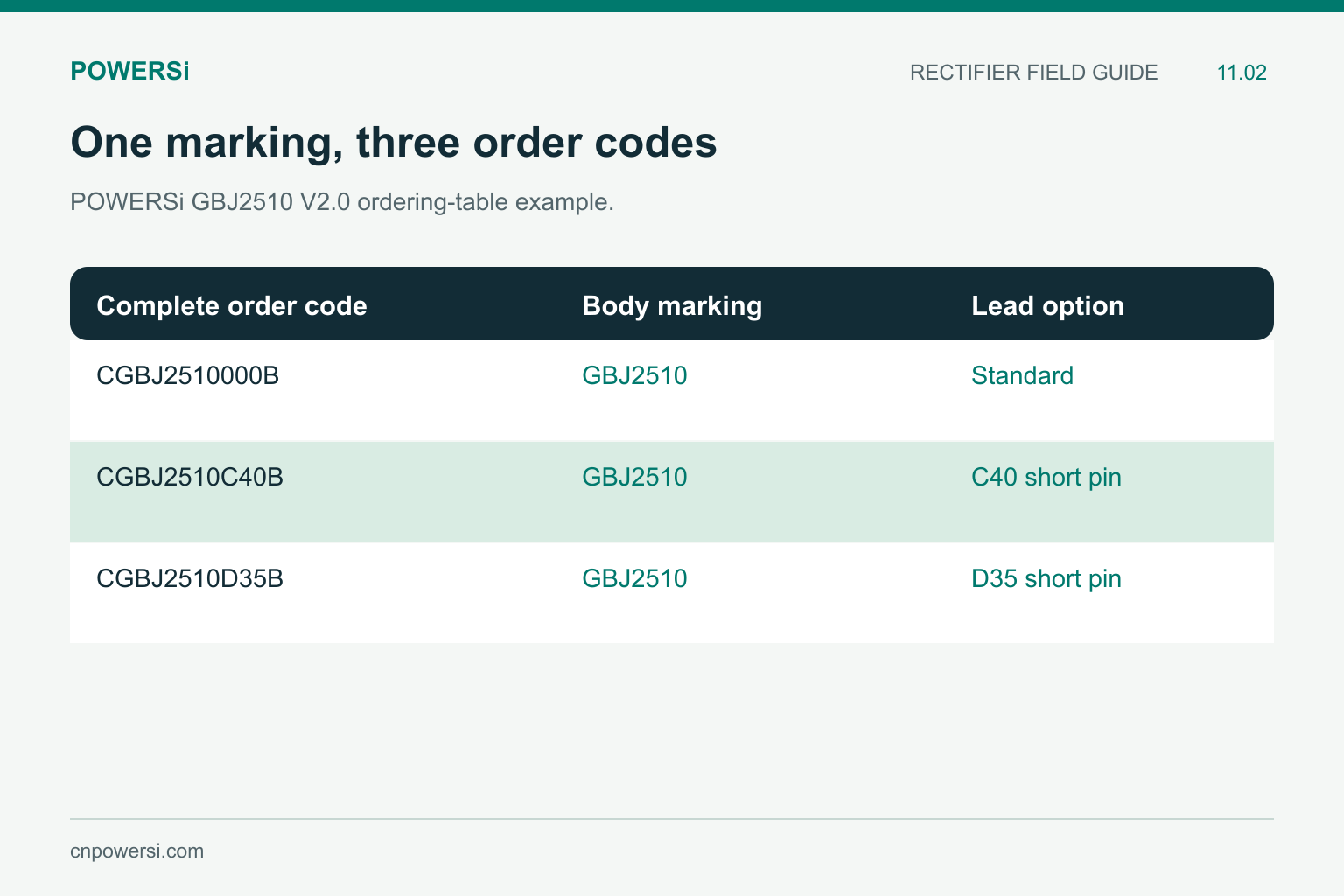
Shared markings do not establish identical lead geometry.
A POWERSi Example: Same Marking, Different Lead Options
The POWERSi GBJ2510 V2.0 ordering table lists CGBJ2510000B, CGBJ2510C40B and CGBJ2510D35B. All three rows use the marking GBJ2510. The document identifies C40 and D35 as short-pin options and provides separate outline drawings. They therefore need separate mechanical acceptance records even though the visible model marking is shared.
The standard GBJ2510 image below establishes the model’s appearance. It is not an illustration of every short-pin option. A receiving team should compare the delivered option with the approved drawing and order label rather than infer lead length from the model text alone.
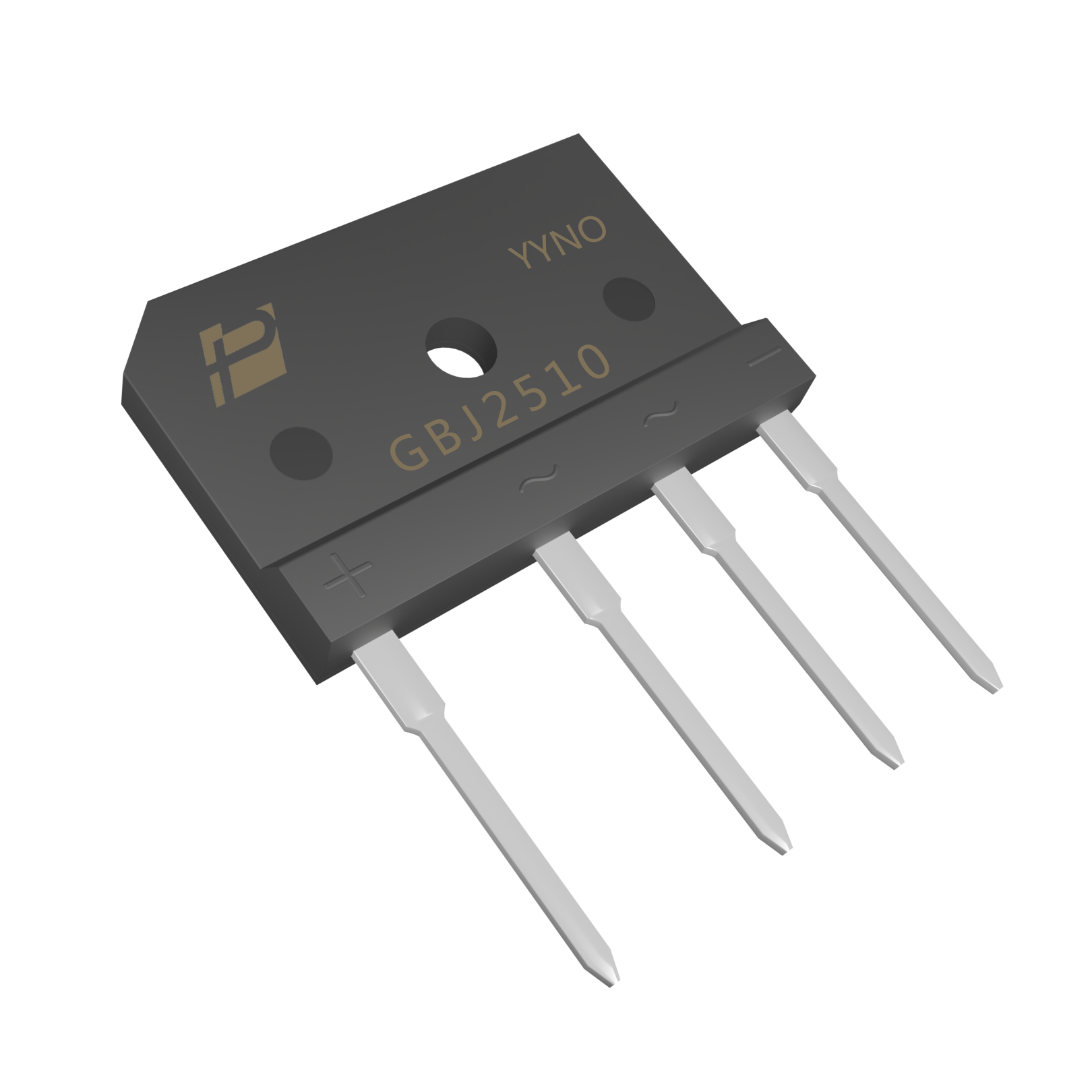
Standard GBJ2510 reference appearance; not a depiction of its short-pin variants.
Does a Suffix Change Voltage or Compliance?
Sometimes an ordering option changes an electrical requirement; sometimes it does not. In this GBJ2510 example, the identified C40 and D35 options describe lead form. Their appearance in the code does not establish a higher voltage class. Keep VRRM as an explicit approved value rather than deriving it from an unfamiliar suffix.
Likewise, a lead-free finish is not a complete statement about every restricted substance. Request a declaration tied to the supplied order code and applicable product revision. A short code on a quotation should not replace that evidence. Avoid treating a material symbol, an internal stock code and a manufacturer ordering option as interchangeable identifiers.
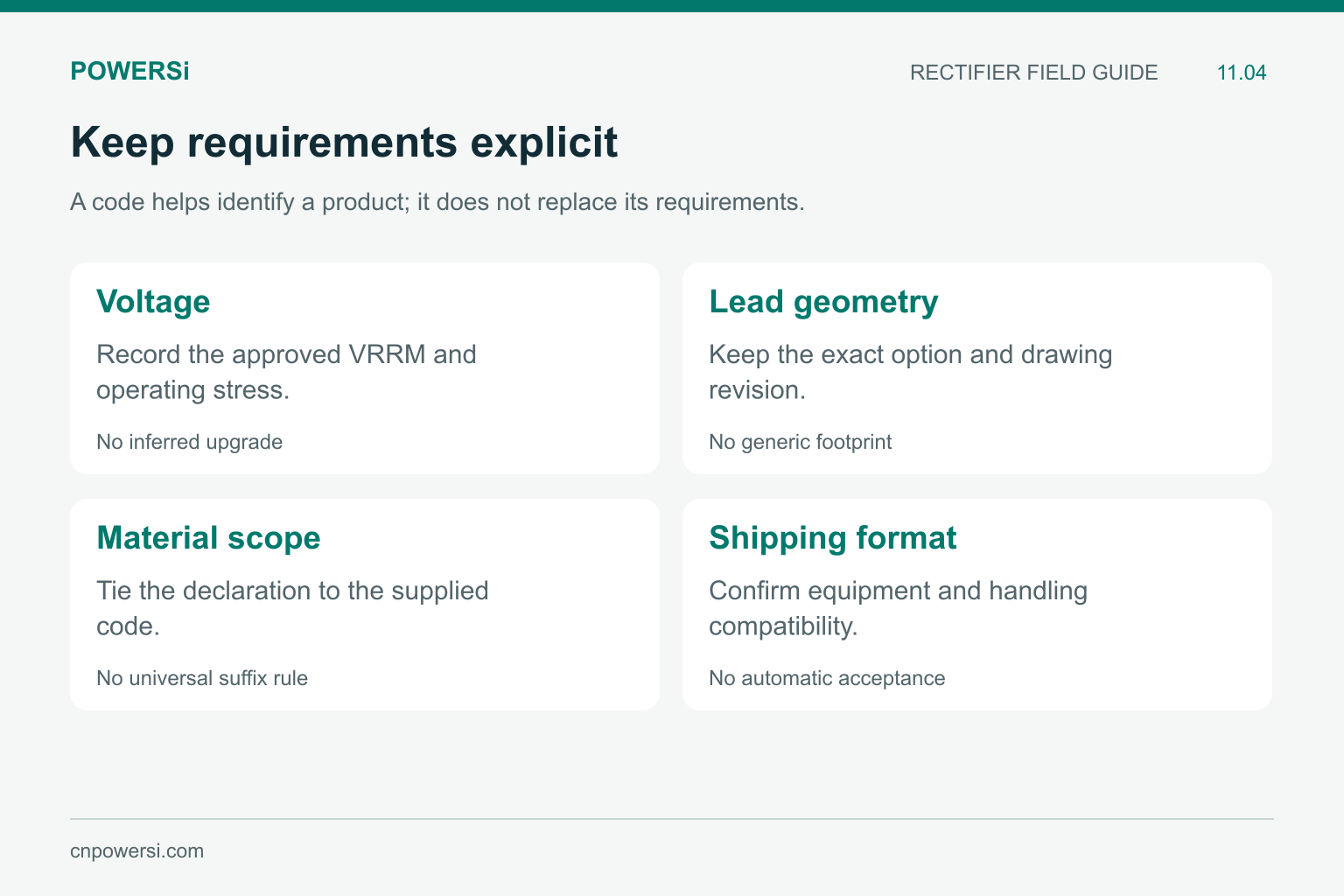
A suffix change needs a scoped comparison.
Evaluate the Change Before Releasing the Purchase Order
For a shipping-only change, check delivery quantity, orientation, feeder compatibility and handling. For a mechanical change, check terminal length and section, installed height, hole clearance and forming requirements. For an electrical change, return the candidate to the circuit approval process. A material change also needs the appropriate assembly and compliance evidence.
Record the original code, proposed code, supplier explanation and affected acceptance criteria in one change record. Preserve punctuation and character positions. If an enterprise system strips suffixes to make a shorter internal item number, retain the full manufacturer code in a separate mandatory field.
A useful receiving check reconciles three records: the purchase order, the shipping label and the approved part definition. A matching body mark alone cannot close the check when several ordering options share that mark.
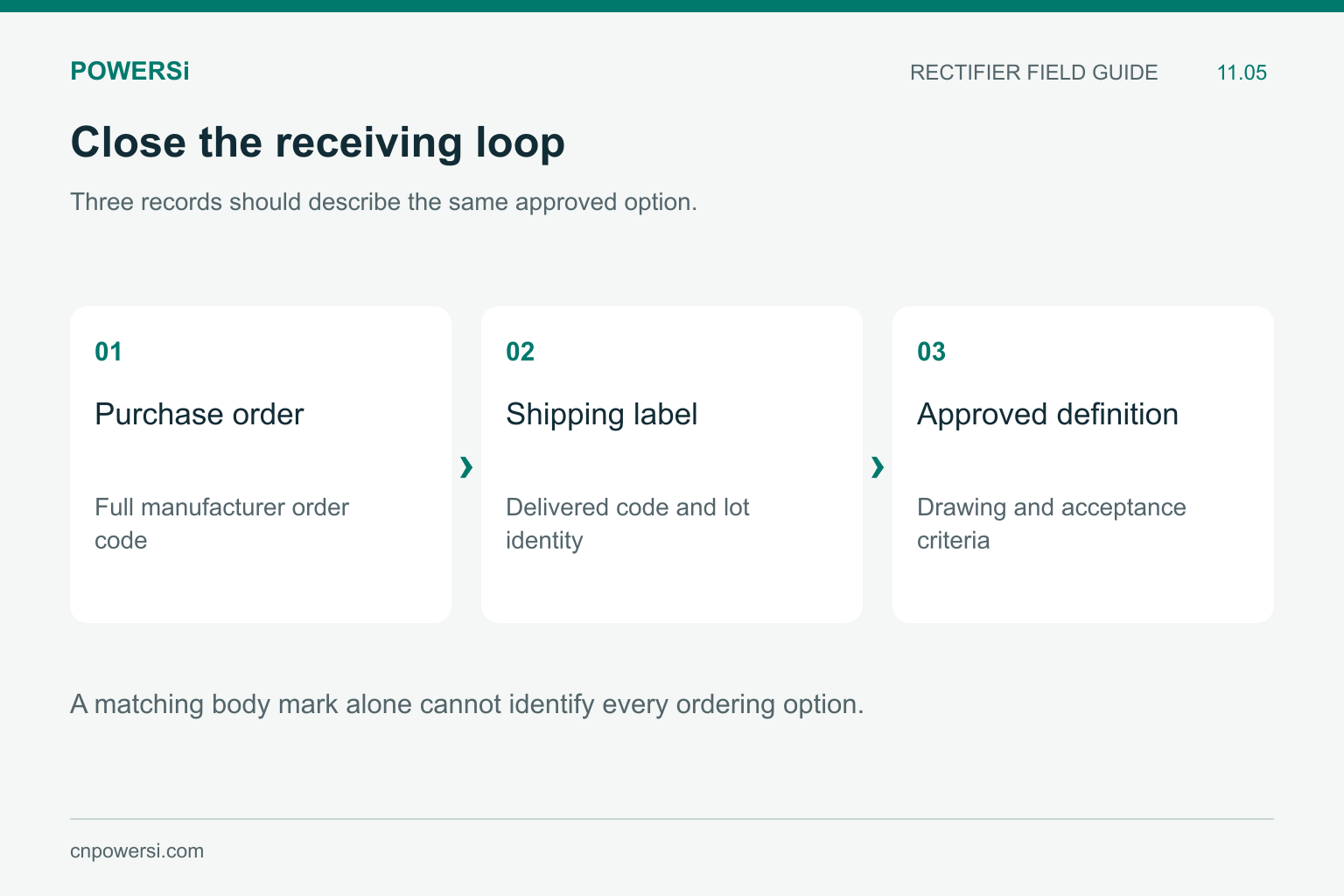
Preserve the complete order identity through receiving.
Key Takeaways
- Interpret suffixes within the exact manufacturer and series.
- Separate shipping packaging from the component’s mechanical package.
- Shared markings do not prove identical lead geometry.
- Keep voltage and material requirements explicit in the approved record.
Conclusion
Suffix control prevents a small purchasing change from becoming an assembly problem. When asking POWERSi about an alternate, include both complete order codes and the affected process requirement. Explore the POWERSi product range and request the ordering option that matches the approved assembly.
FAQs
Does the same suffix always mean the same thing?
No. Meanings depend on the manufacturer and product family, even when the letters look familiar.
Are C40 and D35 voltage upgrades for GBJ2510?
The GBJ2510 V2.0 ordering notes identify them as short-pin options. They should be evaluated as mechanical choices, not assumed voltage upgrades.
Can the body marking omit an ordering option?
Yes. The three cited GBJ2510 order codes share the same model marking, so labels and dimensional records also matter.
Is a shipping change automatically acceptable?
No. The electrical device may be unchanged while feeder, orientation, quantity or handling requirements differ.
What belongs in a suffix-change request?
Include the old and new full codes, the supplier’s option definition, affected drawing or material revision, and the assembly or electrical acceptance criteria.