Skip to content
Rectifier Family Names: A Buyer’s Guide to 1N, FR, UF, SS, MBR and HER
Last Updated: 2026-09-30
Quick Answer
Rectifier family names help buyers locate likely device classes, but they are not a universal code for current, voltage, speed or package. Treat 1N, FR, UF, SS, MBR and HER as starting clues. Identify the manufacturer and complete part number, then confirm the exact function, connection and rating conditions before ordering.
A distributor’s catalogue often groups parts by a few familiar letters. This is useful for navigation, but risky when those letters become the complete purchasing specification. Similar names can conceal different functions, packages and test conditions.
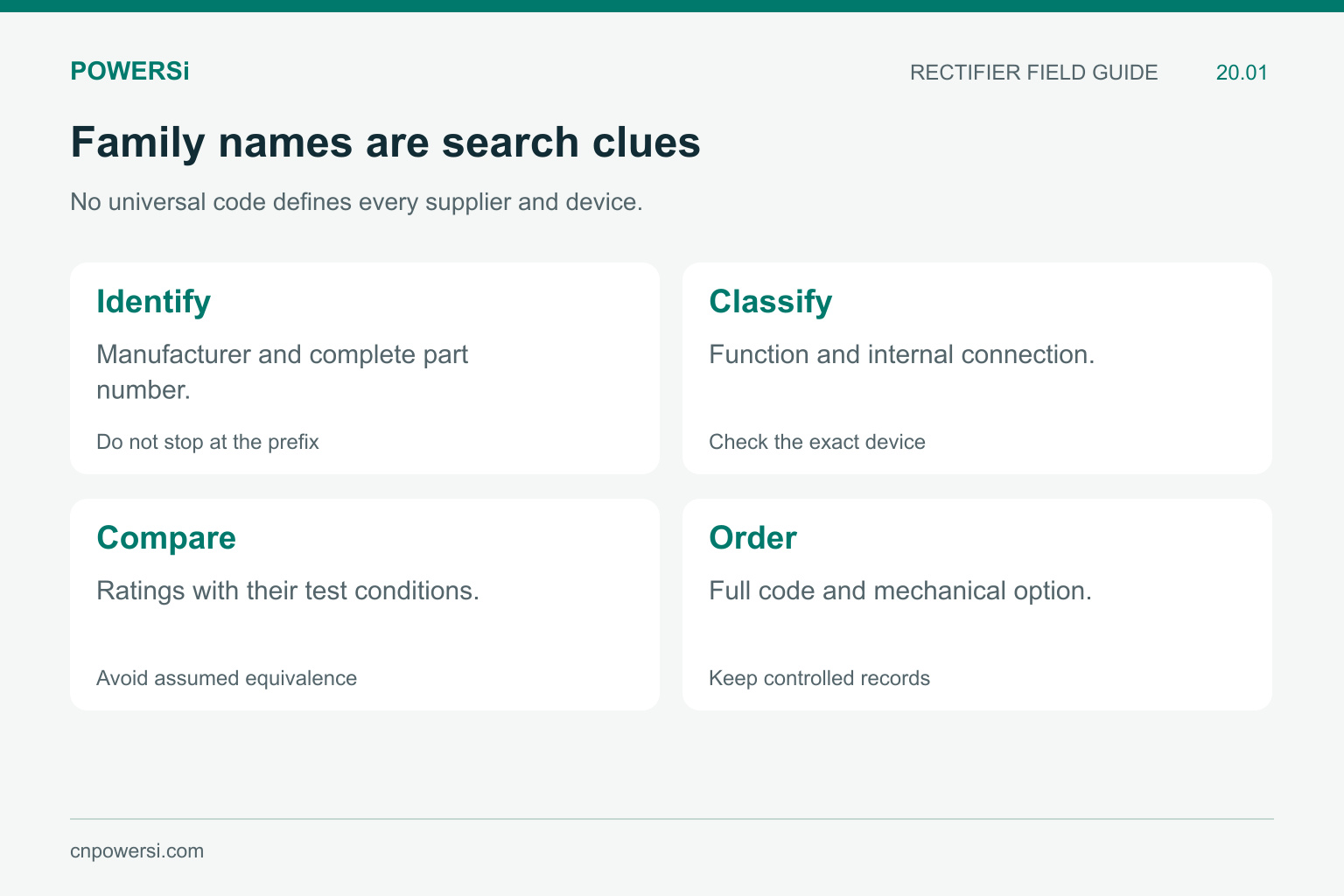
No universal code defines every supplier and device.
Use This Table as a Search Map
The following examples describe identified product families, not a decoding rule that applies to every supplier or every number with the same prefix.
| Name or family | Example interpretation | What it does not establish |
|---|---|---|
| 1N | 1N400x power rectifiers; 1N4148 switching diode | One universal diode technology or power rating |
| FR | FR101–FR107 fast-recovery rectifier family | A fixed recovery time for all FR parts |
| UF | UF4001–UF4007 ultrafast rectifier family | Automatic interchangeability with 1N400x |
| SS | SS12–SS16 surface-mount Schottky family | A universal package or leakage limit |
| MBR | MBR60200PT Schottky example | Single-junction construction or a universal suffix meaning |
| HER | POWERSi HER501–HER508 high-efficiency rectifier family | Guaranteed efficiency in the finished converter |
The FR example is identified in the Kingtronics family listing. Vishay identifies UF400x as an ultrafast rectifier family and SS12–SS16 as surface-mount Schottky rectifiers. These are examples from their respective manufacturers, not equivalent-part recommendations.
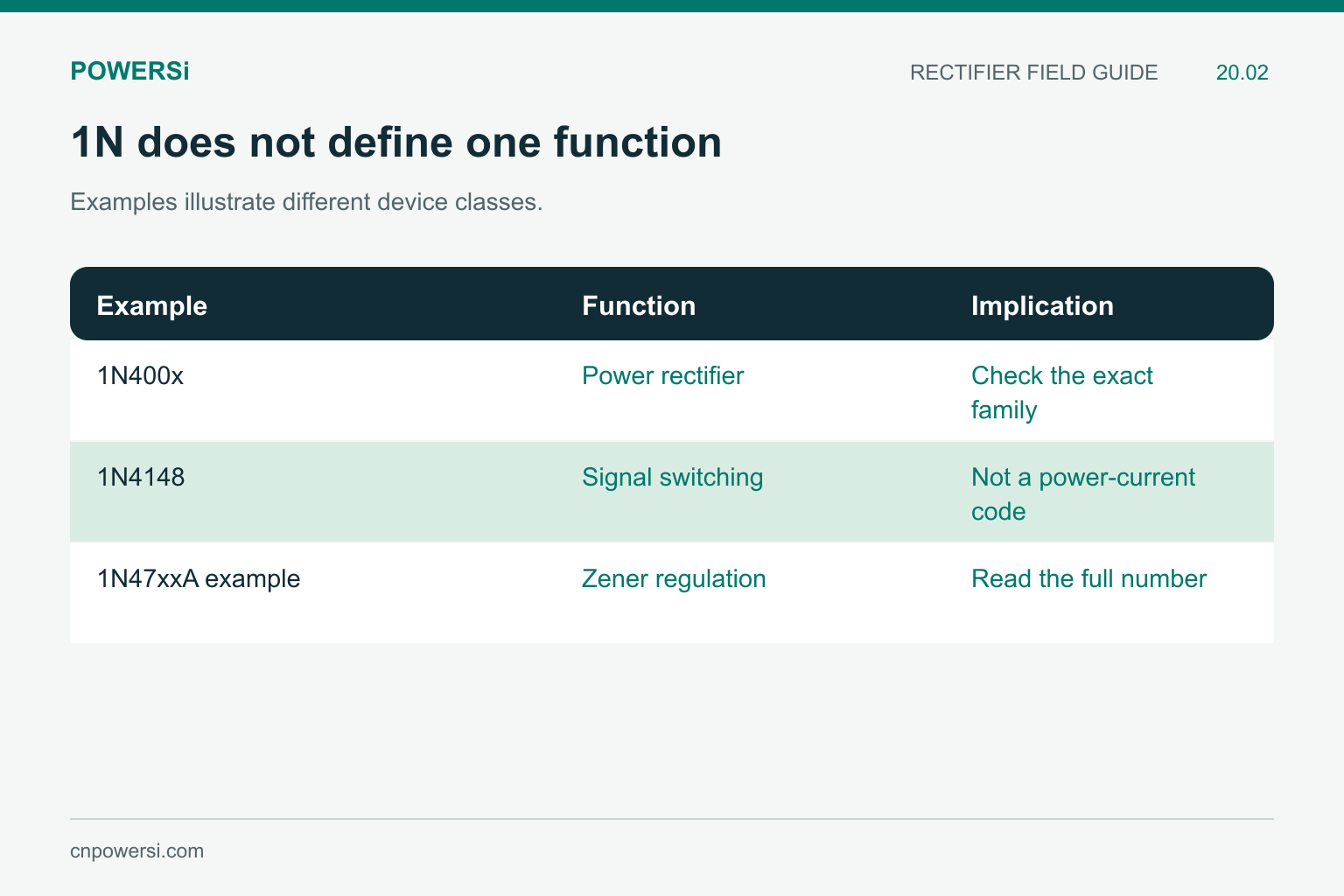
Examples illustrate different device classes.
Why 1N Is Not a Rectifier Speed Class
The POWERSi 1N4001–1N4007 family contains general-purpose rectifiers. However, Vishay’s 1N4148 is a small-signal switching diode. Zener examples also use 1N designations. Therefore, the first two characters do not tell a buyer that a part is a general-purpose power rectifier.
Identify the entire number before selecting a comparison group. Do not substitute a small-signal switching diode for a power rectifier simply because both begin with 1N or carry a cathode band.
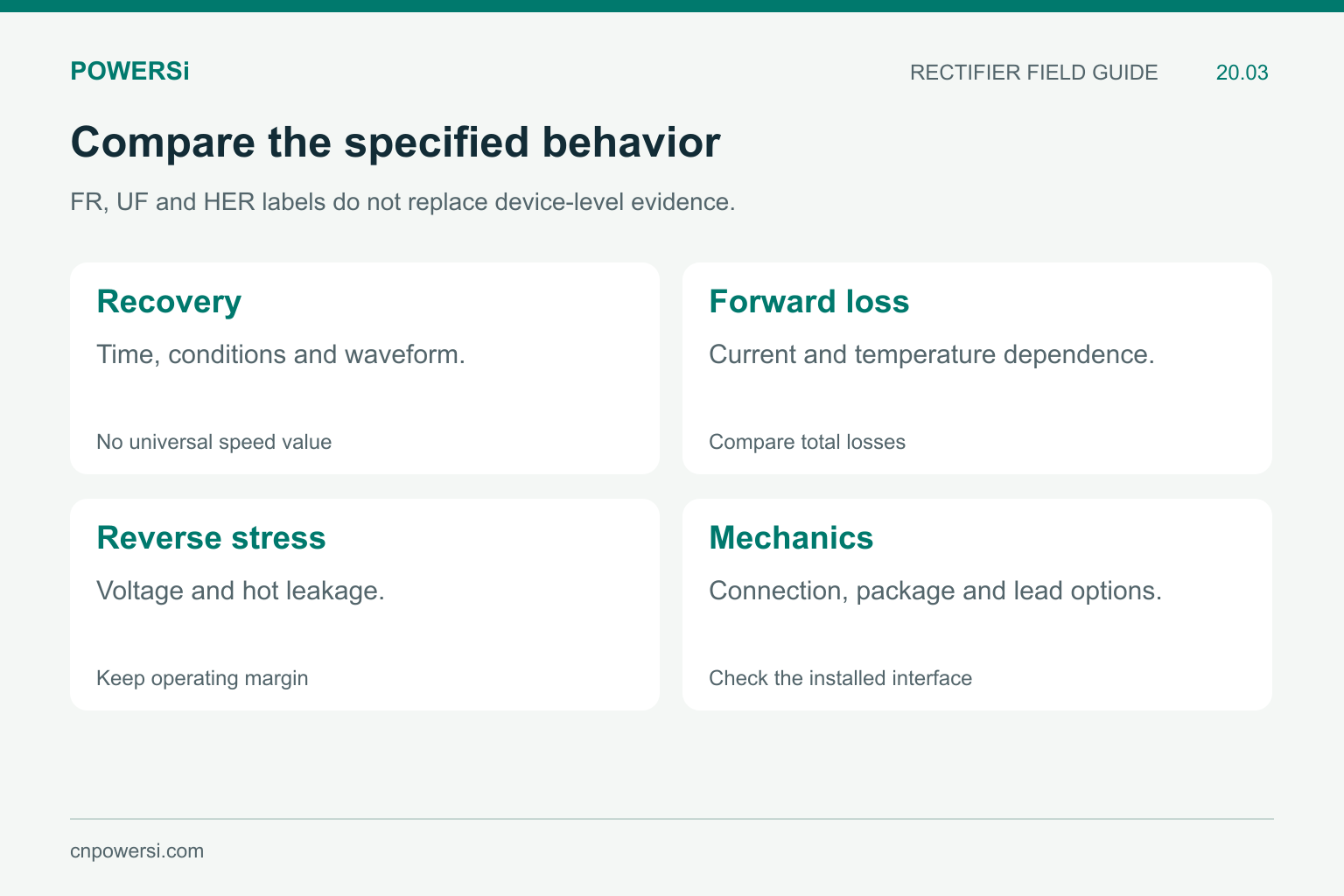
FR, UF and HER labels do not replace device-level evidence.
Speed Labels Still Need Conditions
FR, UF and HER families can help find recovery-oriented candidates. The actual comparison needs recovery time, measurement conditions and the circuit’s commutation requirements. A label such as “high efficiency” does not quantify converter efficiency, and a shorter recovery figure does not establish lower total loss under every load.
The POWERSi HER501–HER508 document identifies a high-efficiency rectifier family and gives reverse-recovery conditions. Use those entries as device information, not a promise of a particular system-level improvement. Keep package, temperature and voltage requirements in the comparison as well.
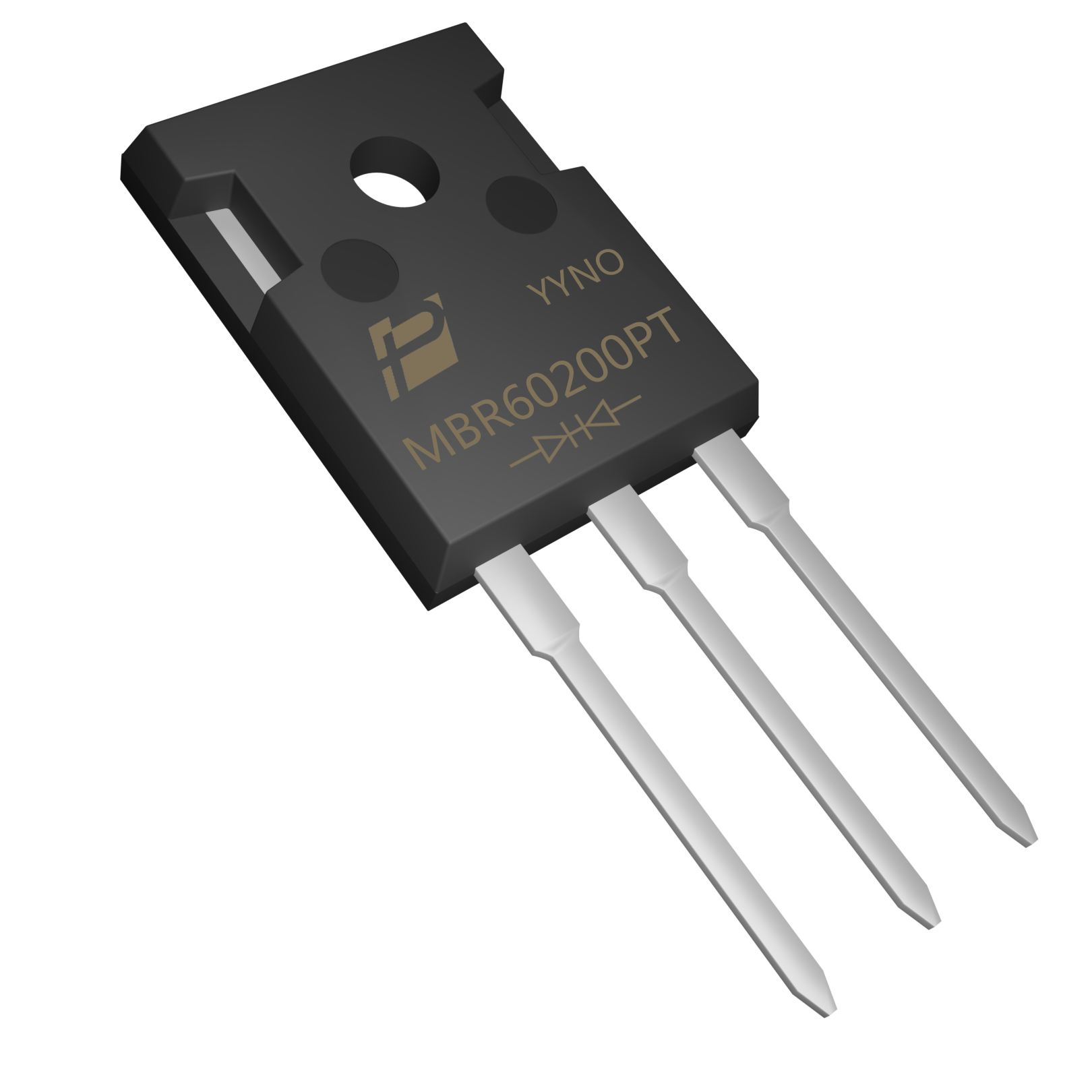
MBR60200PT distinguishes 60 A per device from 30 A per diode; the complete specification sets the scope.
Decode Numbers Only Within a Defined Family
A familiar digit pattern may suggest voltage or current in one series, but it should not become an unverified cross-supplier formula. Even when the numerical value is recognized correctly, its scope may still be misunderstood.
For example, POWERSi MBR60200PT is a Schottky device whose table distinguishes 60 A per device from 30 A per diode. The visible number does not authorize 60 A through one junction. The full device configuration and its thermal conditions matter. Likewise, PT is part of this exact identification; it is not a universal suffix dictionary for every brand.
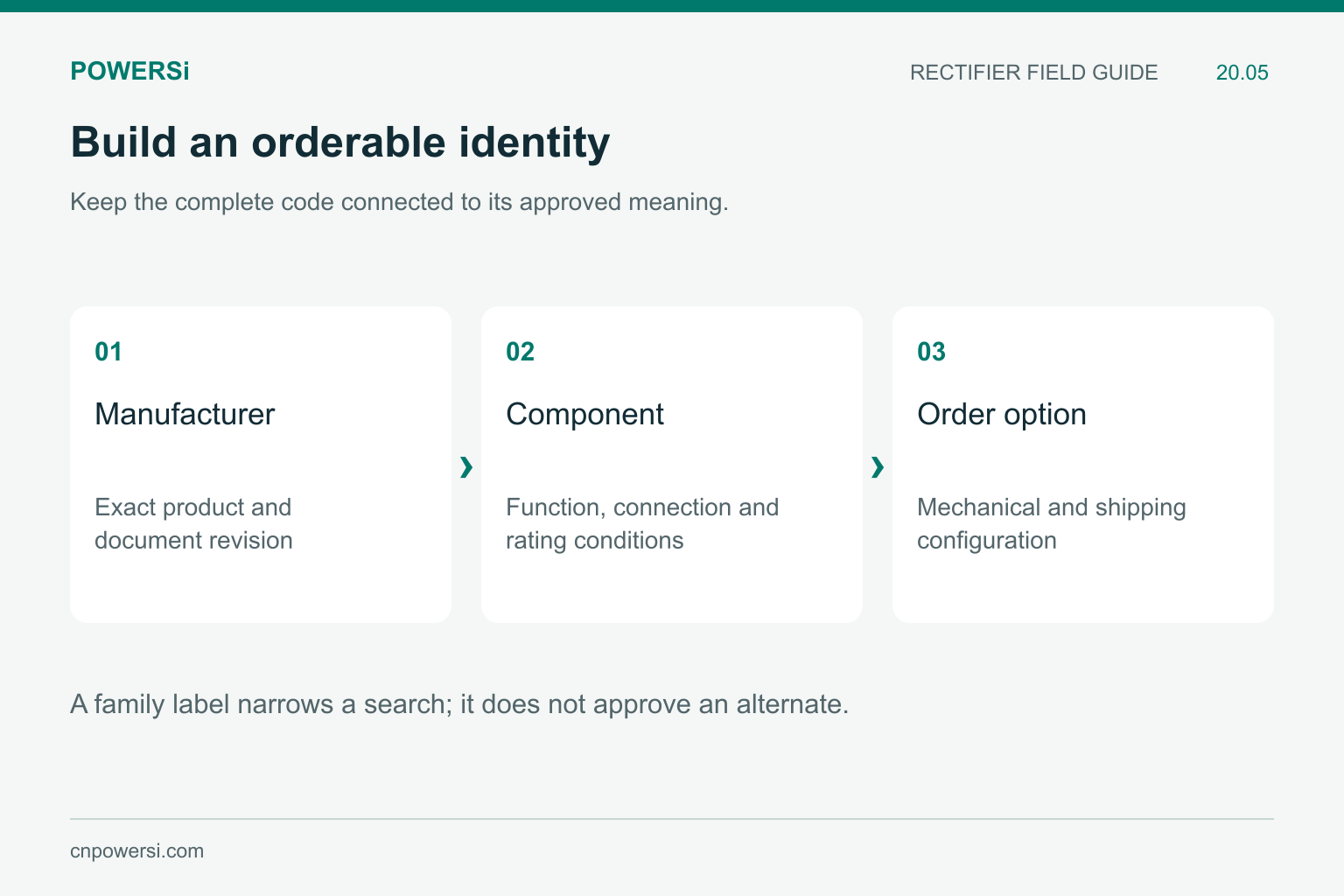
A family label narrows a search; it does not approve an alternate.
Build a Distributor Identification Record
Capture manufacturer, full order code, device function, internal connection, package and mechanical option. Add voltage, current and recovery requirements with their conditions. Keep material and packing options in separate fields so that a shipping change does not silently become a component change.
Link the record to a controlled product document and revision. If a search result, reel label and body marking differ, reconcile the discrepancy before treating them as the same orderable item. A short body mark may be shared by more than one ordering option.
For an alternate request, state the original circuit role and the attributes that must remain compatible. Avoid blanket approvals such as “any UF diode” or “any MBR with the same digits.” A family name narrows the search; an exact comparison supports approval.
Key Takeaways
- Use family names to navigate, not to replace specifications.
- 1N includes devices with different functions.
- Recovery labels do not define one universal performance level.
- Full code, manufacturer and current scope must stay together.
Conclusion
An effective naming reference points buyers toward the right questions. Use the POWERSi product range to identify a candidate, then keep its complete code and operating requirements in the purchasing record.
FAQs
Does every 1N part have the same function?
No. The designation appears in power rectifiers, switching diodes and other diode types.
Does UF automatically replace FR?
No. Compare the complete electrical, recovery, mechanical and thermal requirements of the exact parts.
Does HER guarantee higher converter efficiency?
No. Converter efficiency depends on the circuit and operating point, not just a family description.
Does MBR always mean a single diode?
No. Check the internal connection and whether current ratings apply per device or per junction.
What is the minimum useful identification record?
Include manufacturer, complete order code, function, connection, package, rating conditions and the approved document revision.