Skip to content

Motor Drive Freewheel Diodes: Choose by Current Path
Last Updated: 2026-11-16
Quick Answer
Motor drive freewheel diode selection starts with the inverter technology and current path. Dead time, current direction and switch commutation determine which diode conducts and how it recovers. A FRED can be a useful candidate, but the family name alone does not establish lower loss, compatibility or adequate protection.
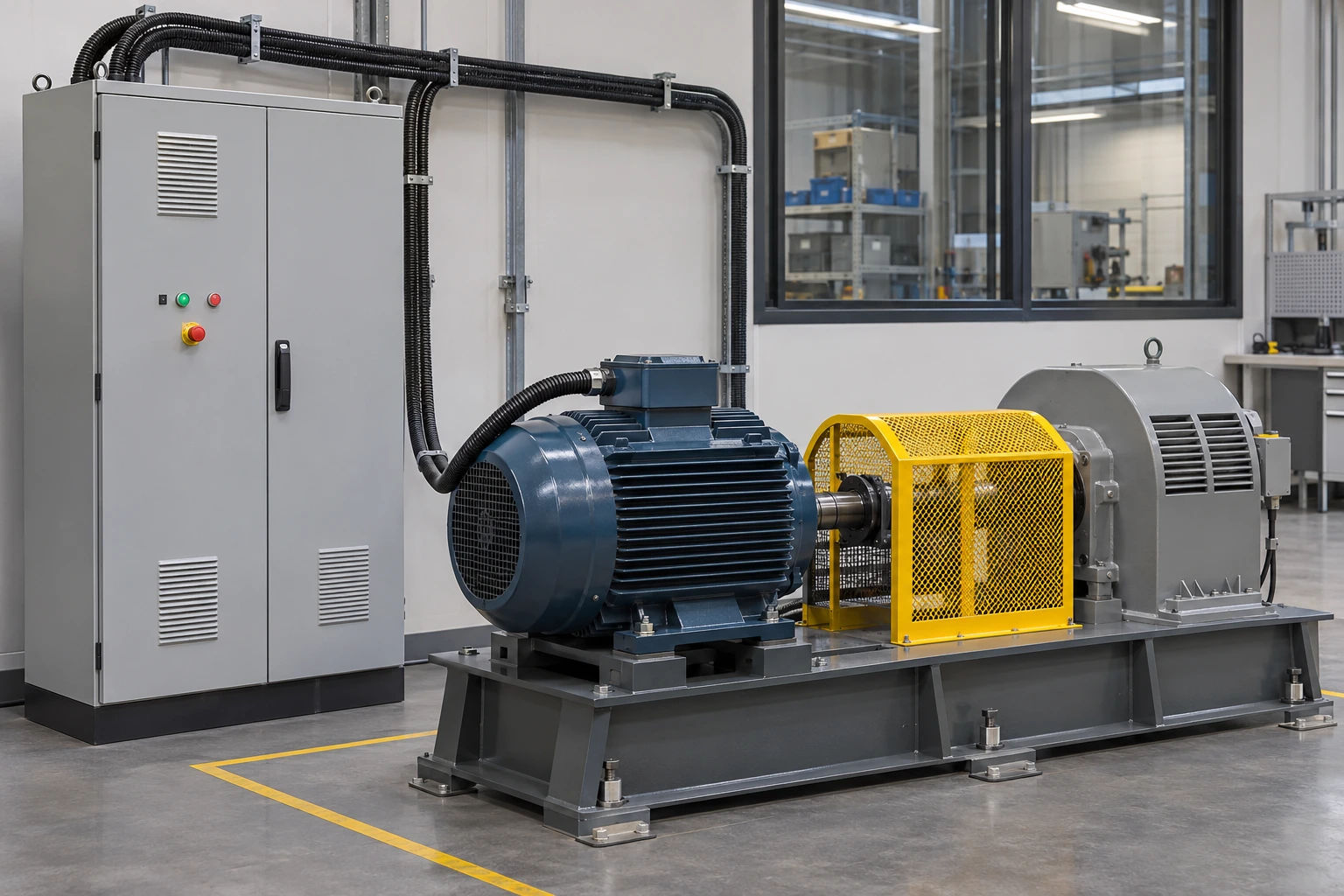
Illustrative motor drive test environment.
Identify What Already Provides Reverse Conduction
An IGBT inverter normally needs an antiparallel diode path, which may already be included in its power module or co-packaged device. A MOSFET stage has an intrinsic body diode and can also conduct reverse current through an enabled channel. These implementations have different trade-offs.
Before adding an external diode, establish whether the existing package already contains the required function. A discrete part connected through a long PCB path may not take over the intended commutation current because of parasitic inductance. A redundant component is not automatically an improvement.
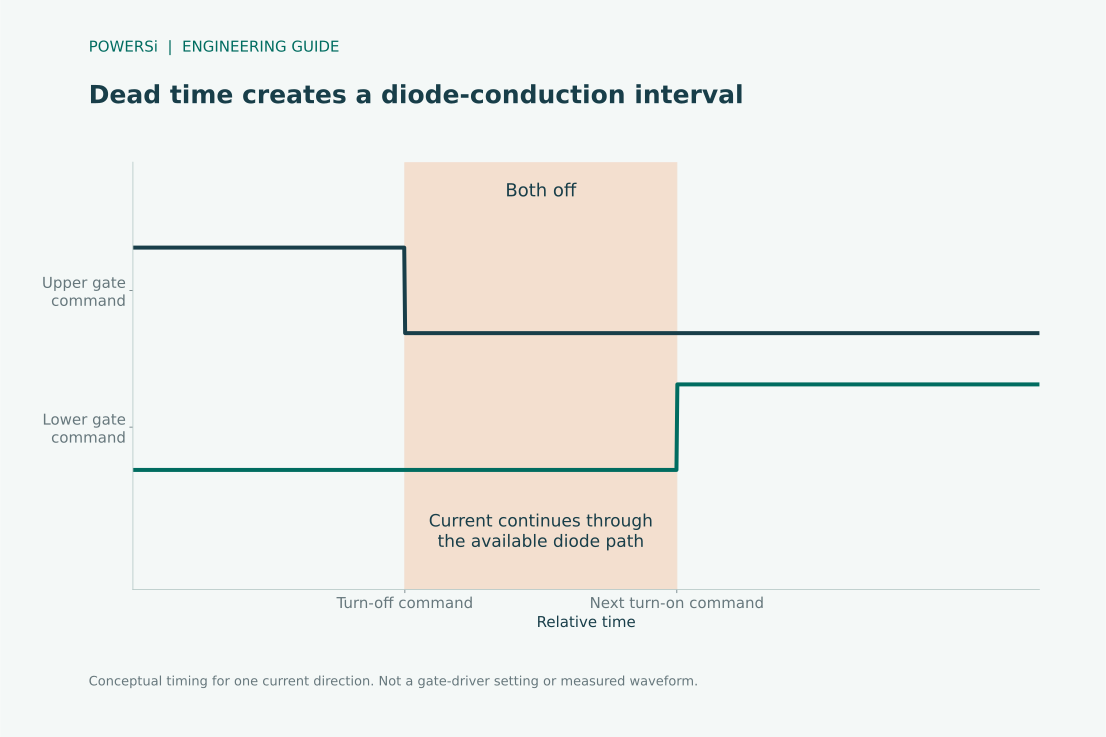
Conceptual timing; not a recommended dead-time setting.
Follow Current Through the Dead-Time Interval
During dead time, both commanded switches in a phase leg are off. The motor current must continue flowing, so its direction determines the available freewheeling path. When a switch turns on again, the current may transfer from a diode, potentially producing reverse recovery.
Infineon’s dead-time application note explains why dead time is needed and how diode conduction influences the output voltage during that interval. A single fixed diode duty ratio cannot represent every motor operating point.
Map positive and negative phase current separately. Include the PWM sequence and modulation strategy; a commanded change of switch state does not always cause the same change of current path.
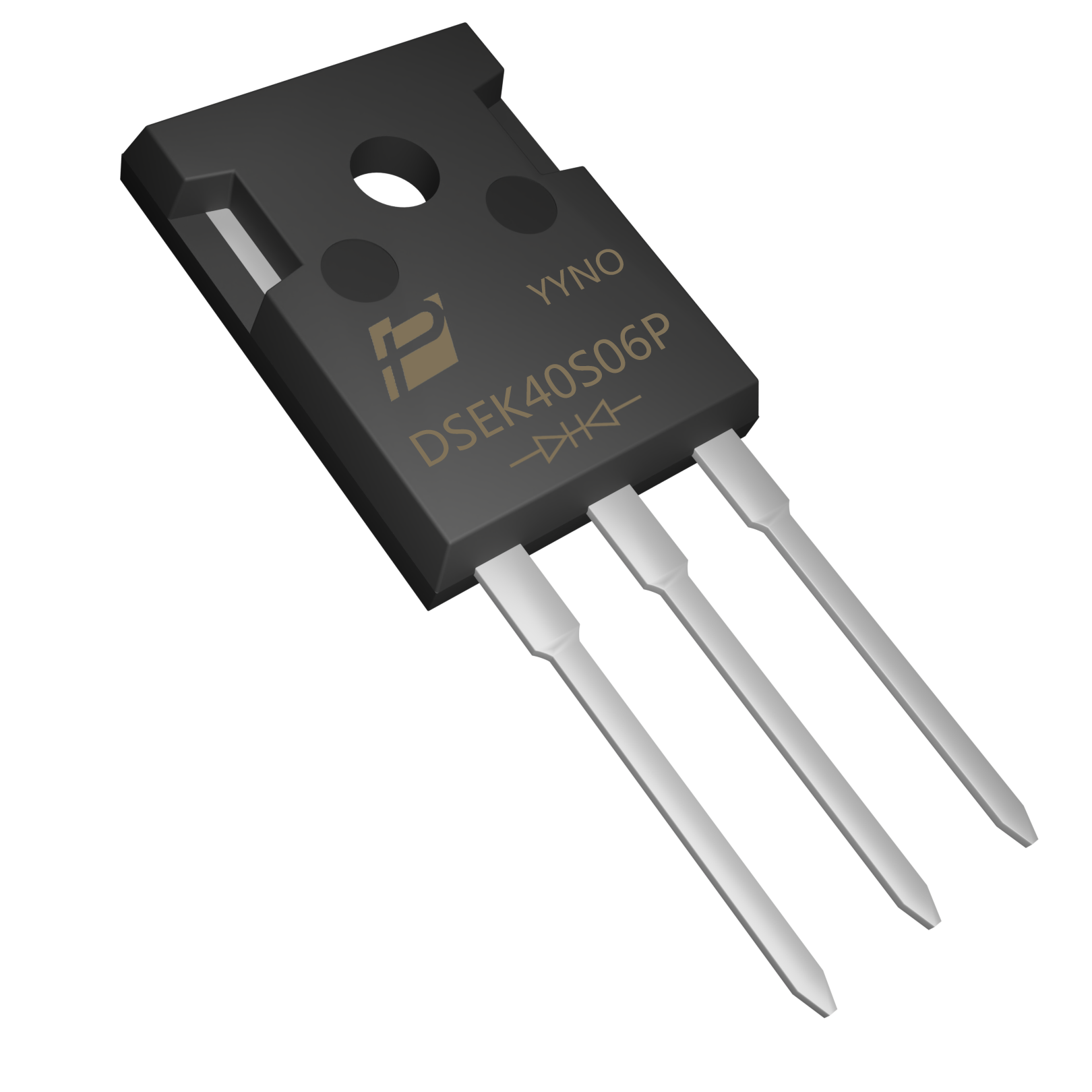
POWERSi DSEK40S06P product example; reconcile the junction connections with the circuit.
Compare FRED Candidates by Their Actual Behavior
FRED commonly means fast-recovery epitaxial diode. The name does not create a universal performance tier above every device sold as fast recovery or ultrafast. Compare the exact forward characteristic, recovered charge, recovery shape, capacitance and rating conditions.
POWERSi DSEK40S06P is shown as a three-lead dual-rectifier candidate. Its common-cathode construction must be reconciled with the actual schematic. A dual rectifier in one package is not automatically a complete antiparallel-diode arrangement for one phase leg. Check junction connections, electrical isolation and mounting before considering a package substitution.
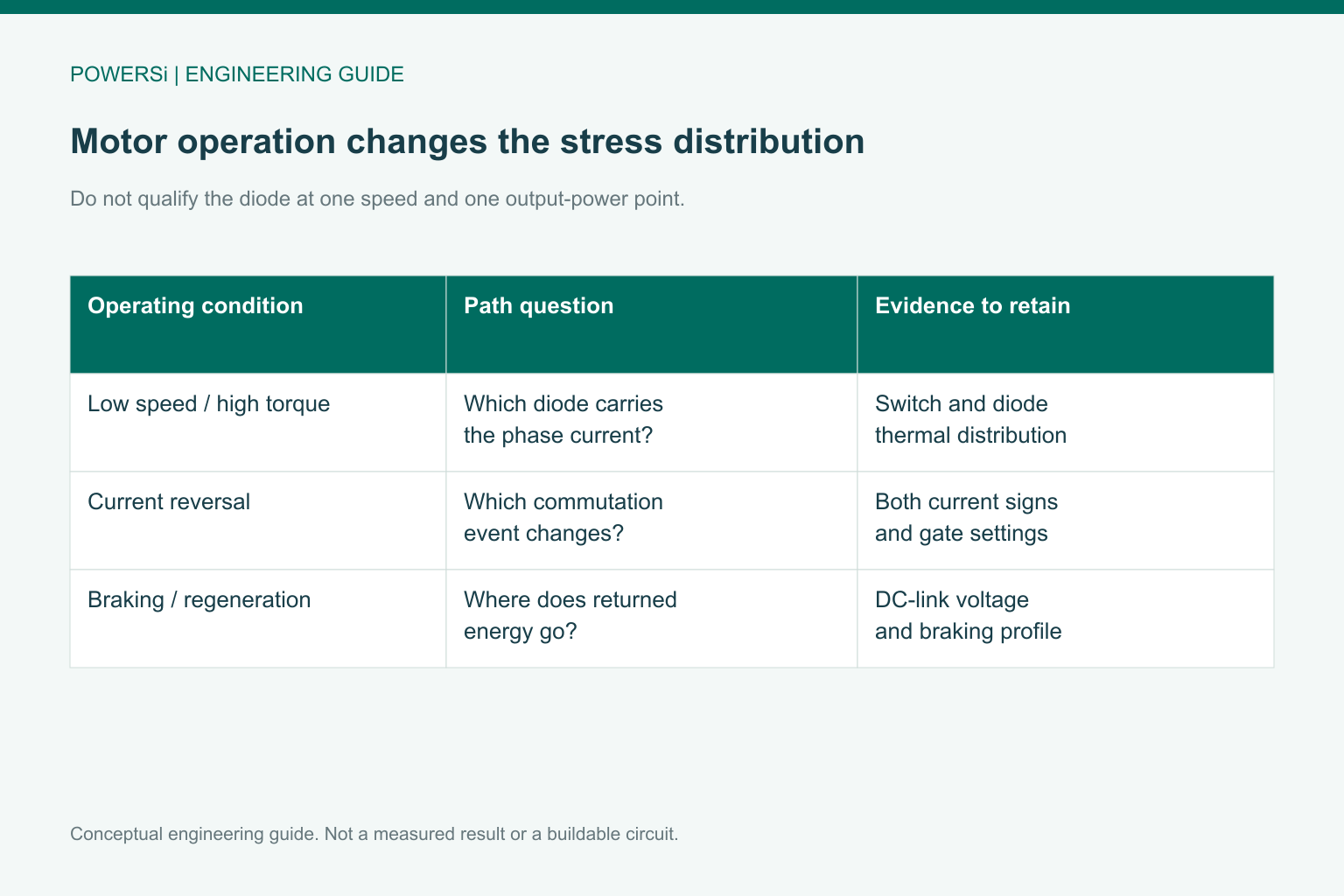
Conceptual engineering guide; no measured performance is shown.
Test Motoring, Braking and Low-Speed Operation
At low speed with high torque, substantial phase current can flow even when mechanical output power is limited. The thermal split between switches and diodes depends on PWM timing and current direction. A test at one nominal speed and power can therefore miss a limiting diode condition.
During regeneration or braking, identify how energy returns to the DC link and how that bus is controlled. A freewheel diode does not, by itself, prevent DC-link overvoltage. Record bus voltage, phase current and temperatures during the specified braking profile.
Use matched bus voltage, gate resistance, current and thermal preparation for switching comparisons. Observe the opposite switch’s turn-on current as well as diode recovery. If the gate setting changes to reduce recovery stress, re-evaluate switching loss and the timing margins that prevent shoot-through.
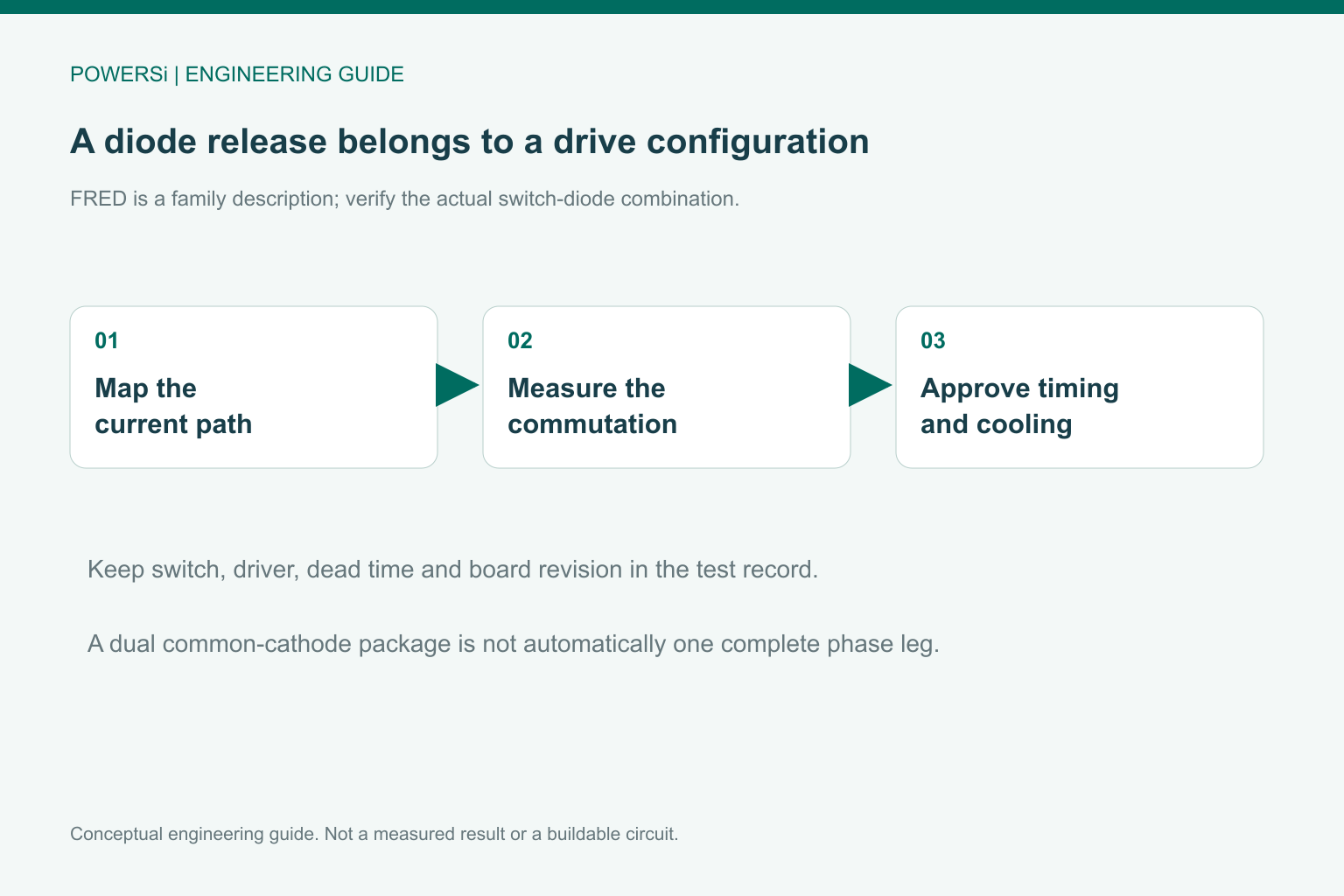
Conceptual engineering guide; no measured performance is shown.
Approve the Drive Configuration, Not Just a Diode Label
The release record should identify the exact switch-diode combination, driver settings, effective dead time, cooling interface and operating envelope. Confirm repetitive voltage stress, junction-temperature margin and stable current sensing. Ringing near a sensing event can affect control even when the power devices remain within their ratings.
Do not increase dead time as a universal cure for recovery. Too little can permit overlap; unnecessarily long intervals increase diode conduction and can worsen output-voltage distortion. The approved setting belongs to the real switch, driver and layout combination. A second-source change that alters that combination needs the affected tests repeated.
Key Takeaways
- Map the existing reverse-conduction path before adding a part.
- Evaluate dead time and commutation for both current directions.
- Keep braking, thermal and control behavior in the qualification envelope.
Conclusion
A reliable freewheel-diode choice matches the current path and the switching system. Send POWERSi the inverter schematic, phase-current envelope, bus transients and package requirements to discuss a suitable discrete rectifier candidate.
FAQs
Is FRED always better than a fast-recovery diode?
No. The labels overlap, and the actual characteristics and test conditions must be compared.
Does every motor drive need extra discrete freewheel diodes?
No. Modules and switches may already provide the required conduction paths.
Why test both current directions?
Different diodes and switch transitions carry the current when its direction changes.
Can a freewheel diode solve regenerative bus overvoltage?
Not by itself. The drive needs a suitable energy-handling and bus-control strategy.
Is longer dead time always safer?
Excessive dead time has loss and distortion penalties; use a verified timing margin.