Skip to content
Industrial Rectifier Bridge Alternatives: Compare the Complete Assembly
Last Updated: 2026-10-08
Quick Answer
An industrial rectifier bridge alternative must match the original circuit function and installed interfaces, not just voltage and current labels. Compare diode or controlled-device topology, terminal mapping, isolation, cooling and surge duty. Treat an IXYS or Infineon reference as an exact ordering-code requirement; a brand-level replacement claim is too broad to validate.
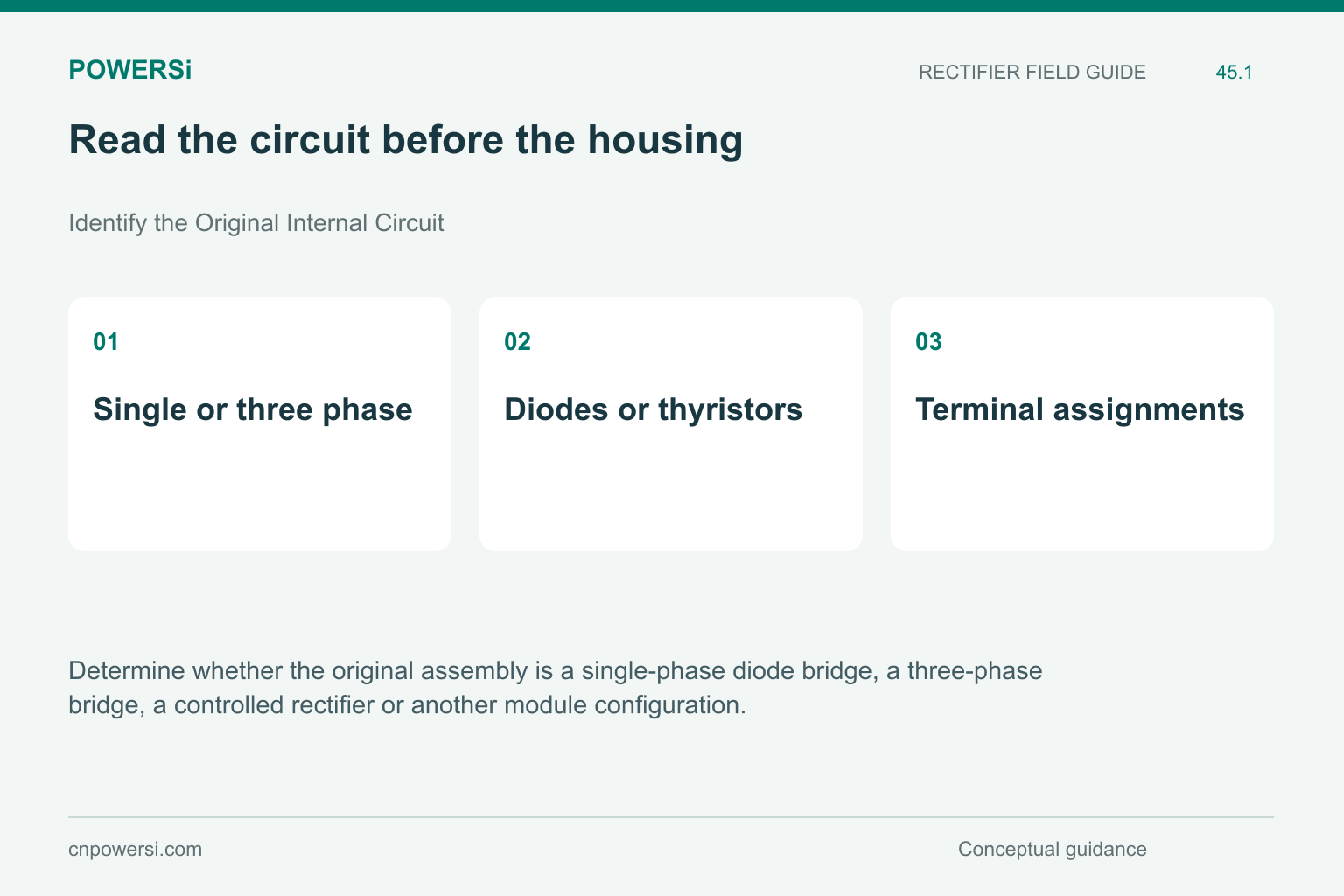
Read the circuit before the housing.
Identify the Original Internal Circuit
Determine whether the original assembly is a single-phase diode bridge, a three-phase bridge, a controlled rectifier or another module configuration. A similar housing can contain different circuits. A diode cannot replace a controllable thyristor function merely because its voltage and current ratings look suitable.
Use the original manufacturer’s exact ordering code and circuit drawing. Record every power and auxiliary terminal. This first step can eliminate an unsuitable candidate before costly mechanical or thermal evaluation begins.
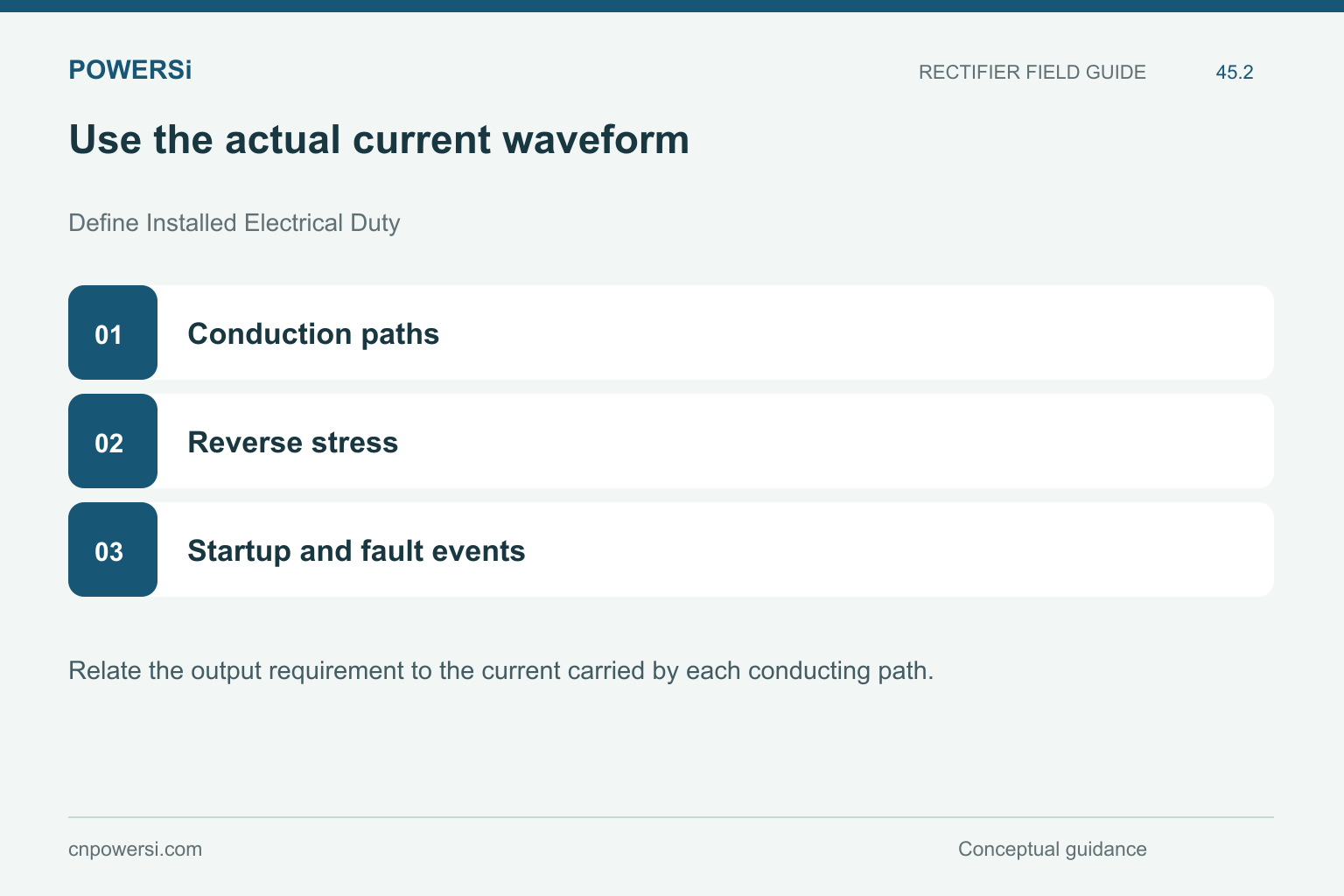
Use the actual current waveform.
Define Installed Electrical Duty
Relate the output requirement to the current carried by each conducting path. Account for the load and input conditions rather than dividing a power figure by a convenient voltage and treating the result as a complete device rating.
Record startup charging, repetitive loading and protection behavior. A nonrepetitive surge rating is not a general permission for repeated overload. Compare the original and candidate rating conditions and determine which application measurements or analyses are needed to close the differences.
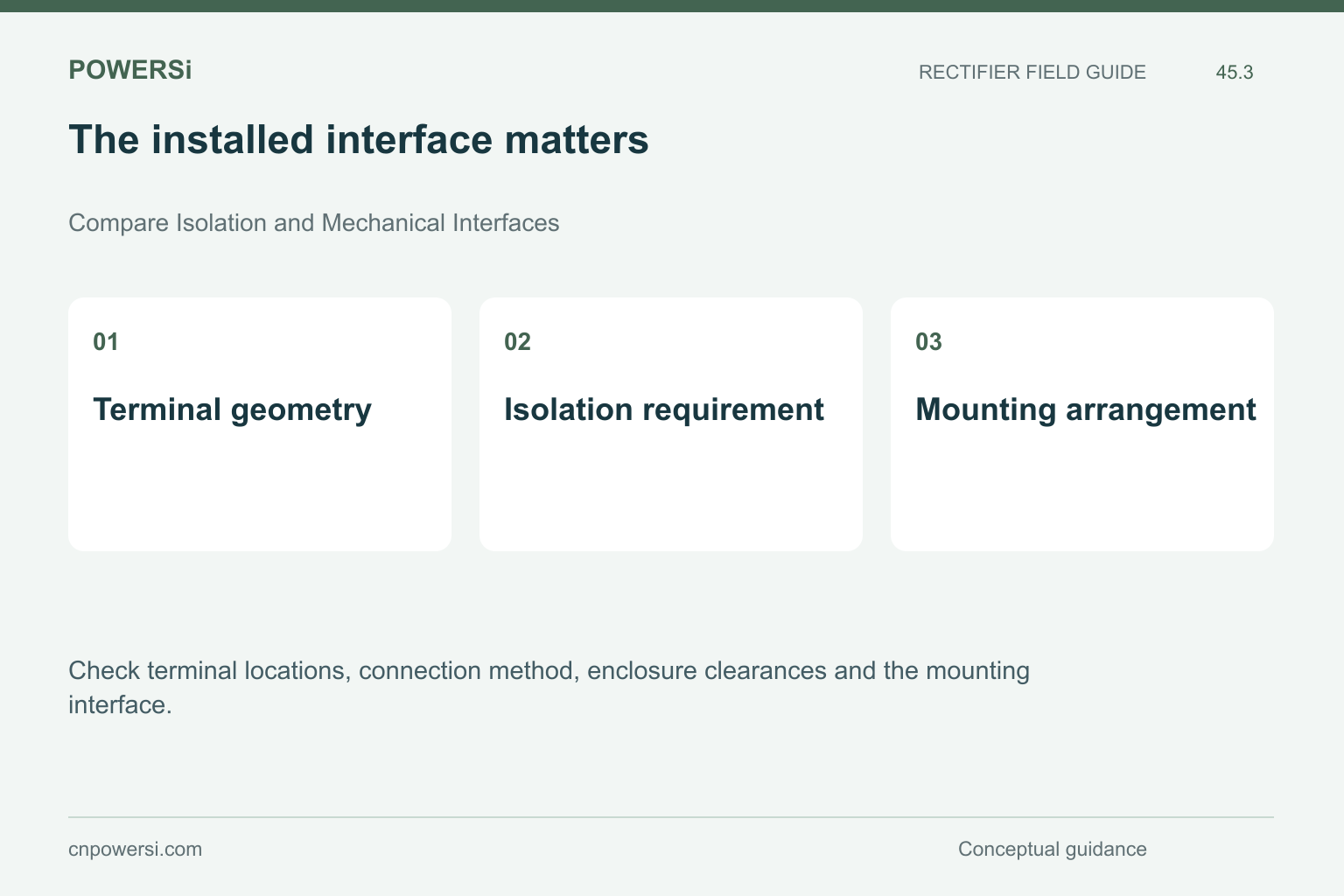
The installed interface matters.
Compare Isolation and Mechanical Interfaces
Check terminal locations, connection method, enclosure clearances and the mounting interface. A replacement that needs rewiring or a new heatsink should be evaluated as an assembly change. Verify isolation requirements from the appropriate product information rather than infer them from appearance.
Review the consequences for creepage, clearance and protective structures under the system’s requirements. Do not transfer an assembly approval to a different housing option because the electrical circuit diagram is the same.
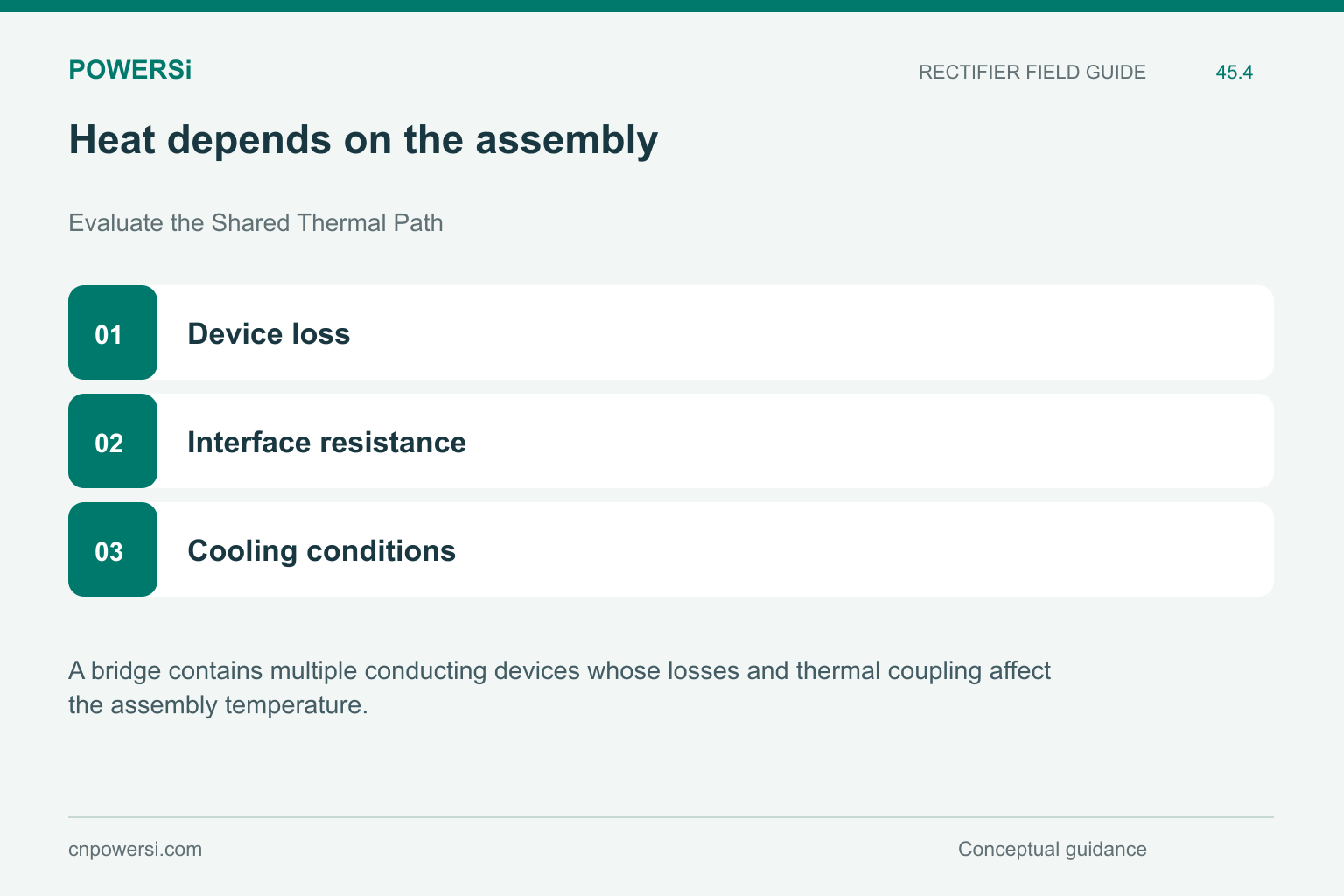
Heat depends on the assembly.
Evaluate the Shared Thermal Path
A bridge contains multiple conducting devices whose losses and thermal coupling affect the assembly temperature. Compare the thermal model and its reference points, then evaluate the actual interface material, mounting conditions and cooling.
Matching a nominal current rating does not establish equal temperature rise. Preserve worst-case operating conditions in the comparison, including reduced airflow or elevated coolant temperature where relevant. Any claimed thermal improvement should be supported by measurements or a validated model for the proposed arrangement.
Release an assembly-specific decision.
Document the Replacement Boundary
The final decision should identify both full codes, the power-supply assembly and all required changes. Distinguish a direct component substitution from a redesign using several discrete parts. The latter may be feasible but has its own layout, interconnection and qualification responsibilities.
Avoid a blanket statement that a domestic bridge replaces an entire IXYS or Infineon range. Submit an evidence-backed comparison for one defined requirement and expand the approved scope only when additional configurations have been evaluated.
Key Takeaways
- Read the circuit before the housing.
- The installed interface matters.
- Release an assembly-specific decision.
Conclusion
Begin with the original circuit and installed interfaces. Send POWERSi the exact bridge requirement to assess suitable candidates without assuming a brand-wide substitution.
FAQs
Can a diode bridge replace a controlled rectifier?
Not without addressing the missing control function and redesigning the system where necessary.
Does equal current rating imply equal temperature?
No. Rating conditions, losses and thermal paths can differ.
Does a matching housing establish isolation?
No. Verify the specified isolation and installed requirements.
Are discrete diodes automatically a module equivalent?
No. A discrete implementation changes assembly and validation responsibilities.
What is needed to compare an imported module?
Its exact code, circuit, drawings, operating conditions and system acceptance requirements.