Skip to content
Automotive vs Industrial Diodes: What AEC-Q101 Qualification Establishes
Last Updated: 2026-09-26
Quick Answer
Automotive and industrial diodes can share electrical ratings while carrying different qualification and supply requirements. AEC-Q101 addresses failure-mechanism-based stress qualification for discrete semiconductors. It does not approve a complete vehicle circuit or guarantee unlimited lifetime. Evaluate the exact component, qualification scope, mission profile, production controls and customer approval requirements together.
A buyer comparing two nominally identical voltage and current ratings may still face a substantial approval difference. The issue is not simply whether one device sounds more rugged. It is whether the evidence supports the intended use and supply arrangement.
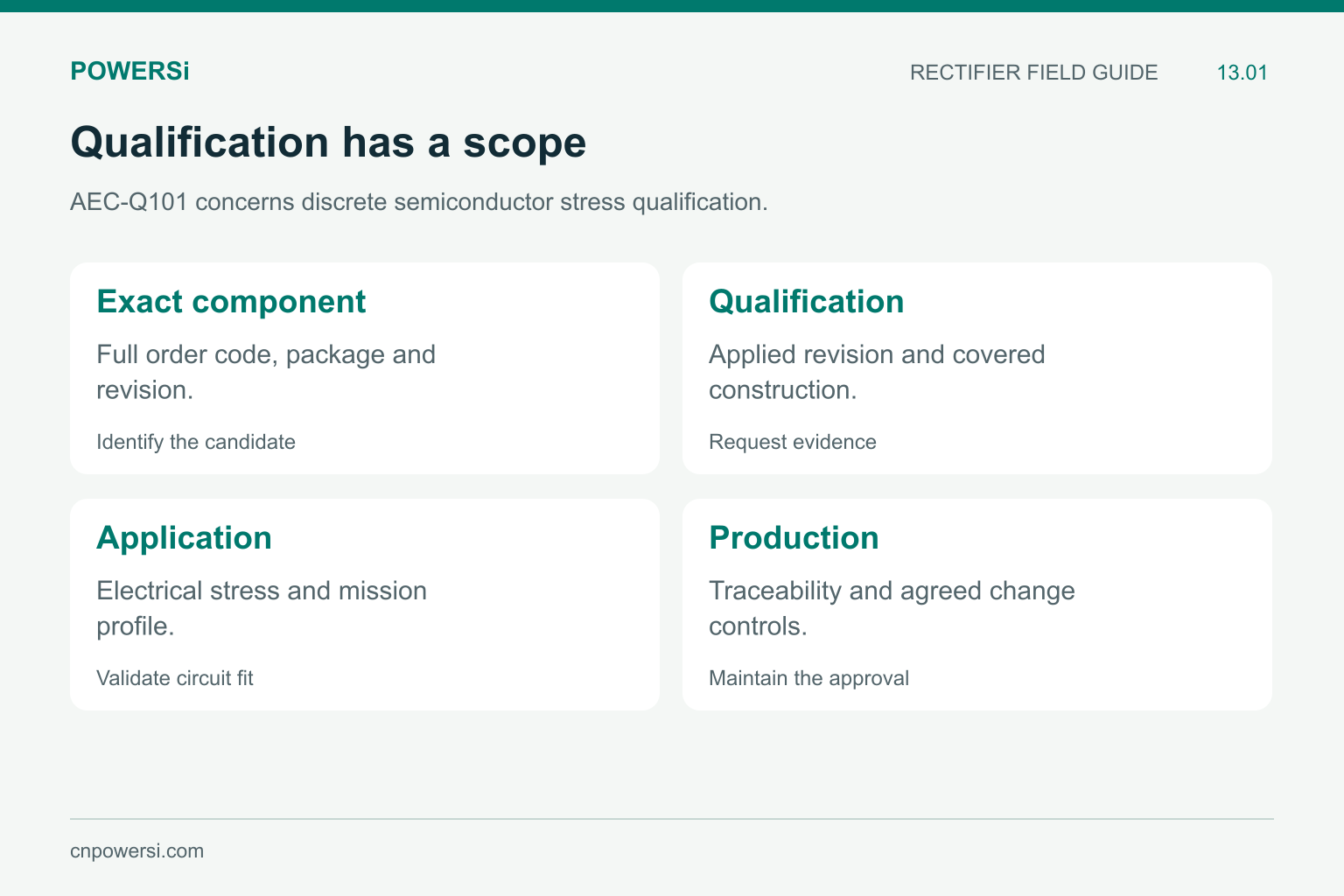
A qualification label does not approve a complete circuit.
What AEC-Q101 Means
AEC-Q101 concerns discrete semiconductor qualification. Use the revision specified by the project and the supplier’s qualification record; do not infer the revision from a marketing label. The AEC’s published Q101 framework also distinguishes qualification from an AEC-run certification service: AEC does not operate a board that certifies each part. AEC-Q101 reference.
An “AEC-Q101 qualified” claim should lead to an identifiable component and a defined evidence package. A statement about one family does not automatically cover every package, manufacturing route or later revision. The qualification record must explain the scope and any applicable use of family data.
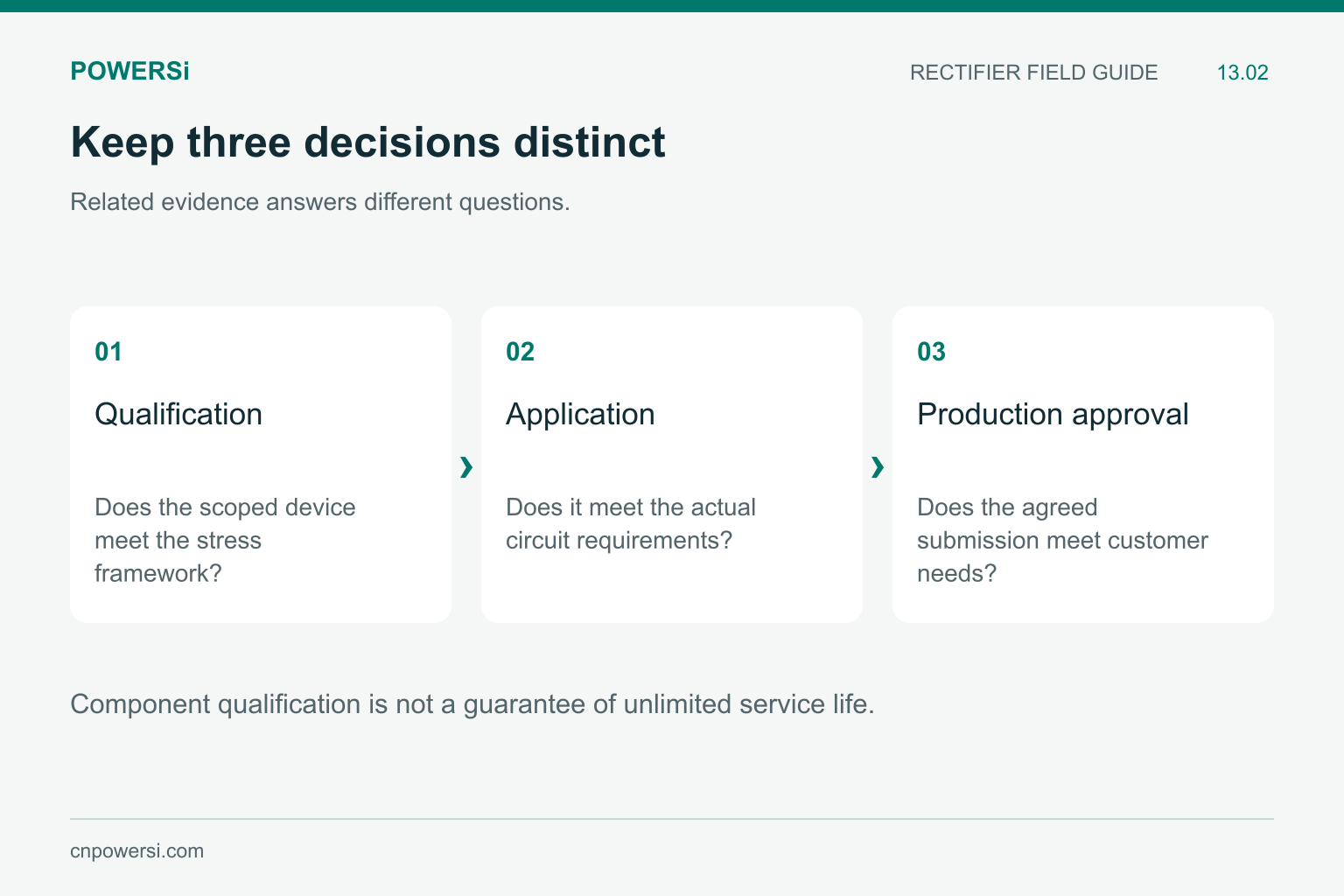
Use the evidence for the question it actually answers.
Keep Component Qualification Separate From Circuit Approval
Qualification exercises a device against defined stress requirements. Circuit approval asks whether that device works in a particular electrical and mechanical environment. A qualified diode can still fail if the application exceeds its voltage, temperature or energy capability.
Define the mission profile: operating temperature distribution, expected service duration, electrical cycles, humidity exposure and transient conditions. Then identify which evidence covers those demands and which needs application testing. An AEC label does not independently establish load-dump capability, surge-energy absorption or compliance of the complete electronic assembly.
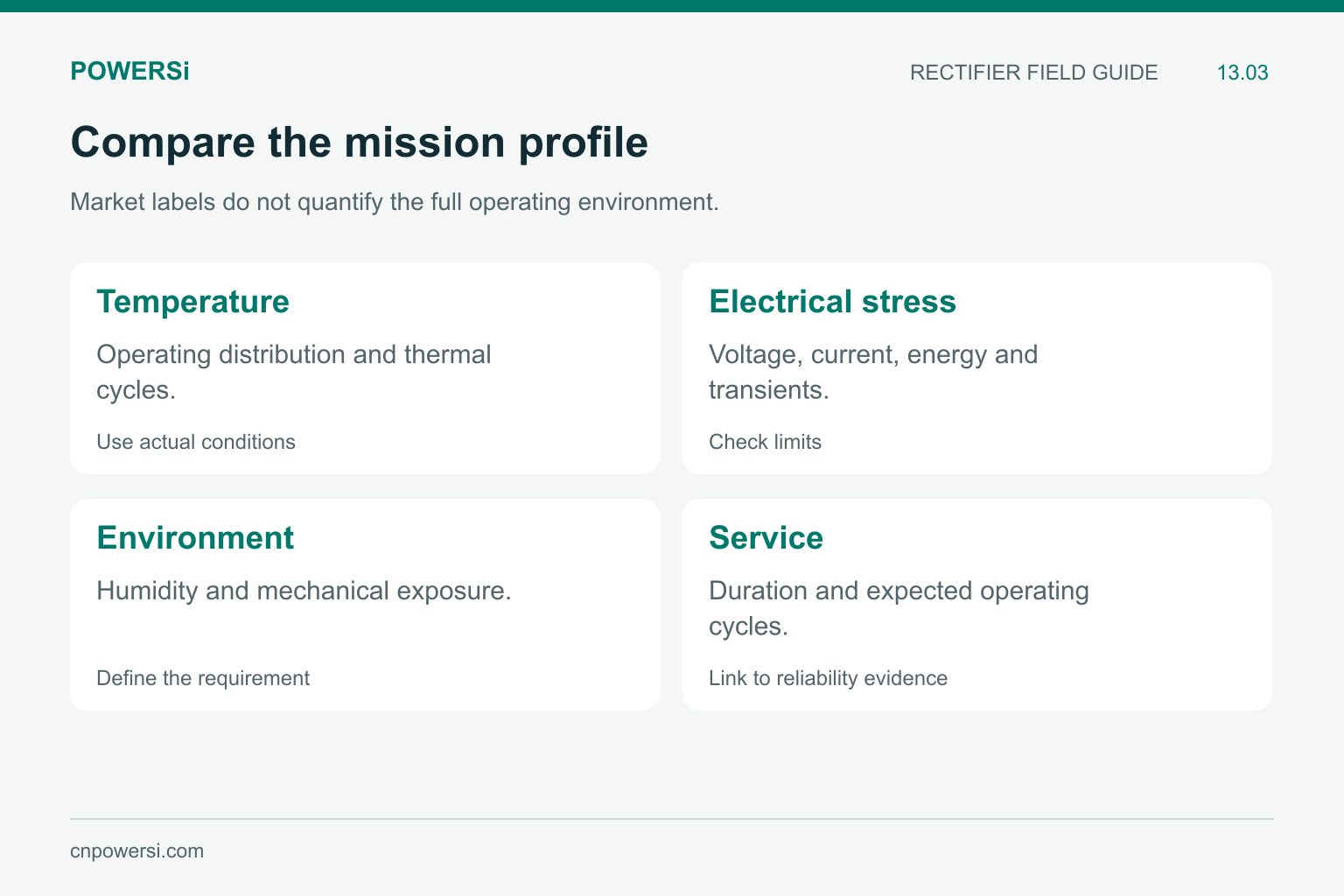
Industrial and automotive applications can impose different demands.
Industrial Grade Is Not a Universal Lower Tier
“Industrial” describes a broad market, not one fixed qualification specification. A continuously operating industrial power converter may place demanding thermal requirements on a diode. An automotive installation may add different environmental stresses and customer-specific controls. Compare the actual requirements instead of ranking parts by their market label.
Automotive-qualified portfolios can be explicitly distinguished from standard products. For example, Nexperia identifies a dedicated AEC-Q100/Q101-qualified portfolio. This illustrates why buyers should identify the exact qualified ordering code; it does not establish qualification for a different manufacturer’s similar device.
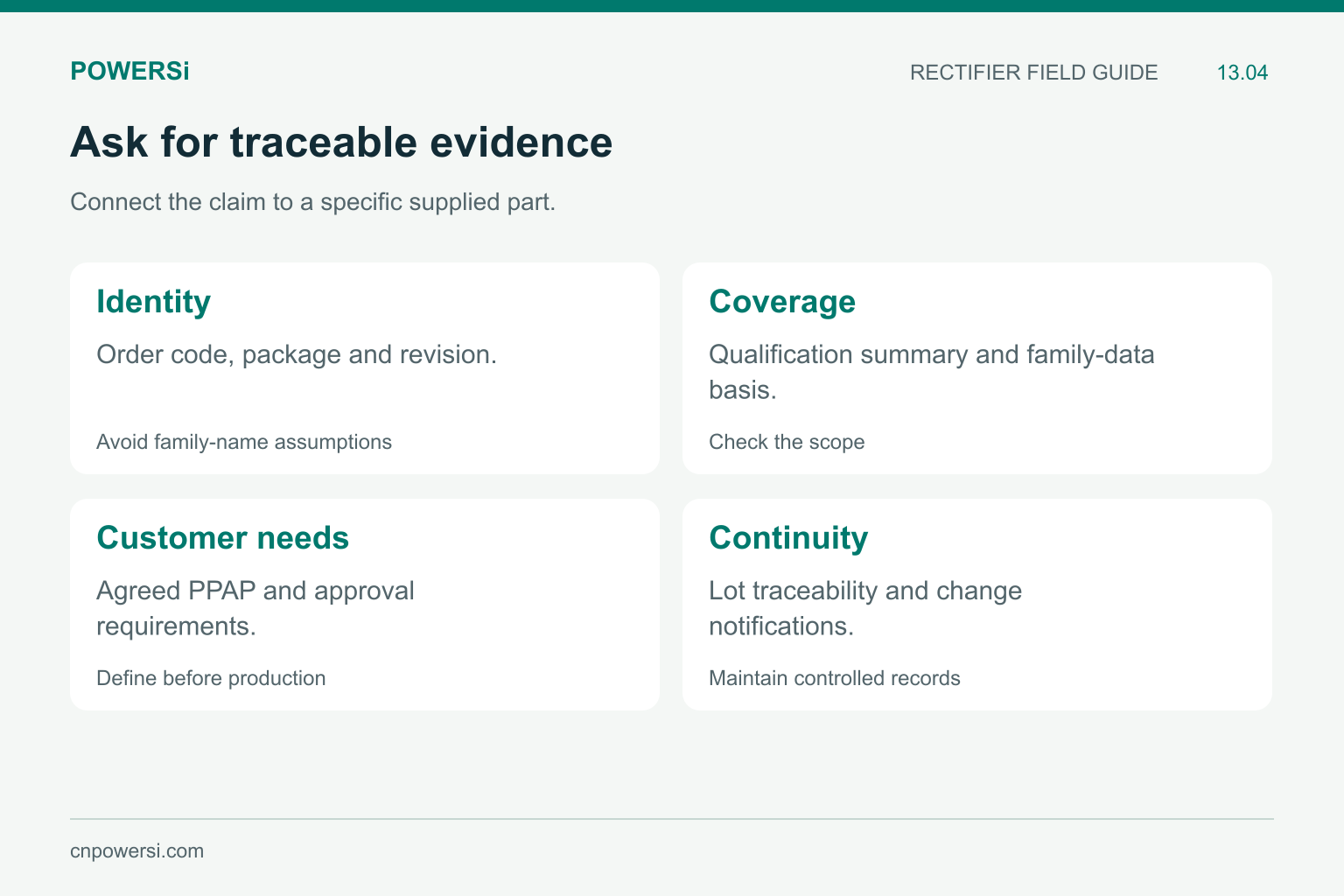
A management-system certificate is not a diode qualification record.
Request a Part-Specific Evidence Package
Start with the complete order code, package, product revision and declared manufacturing scope. Request the qualification summary, the applied AEC-Q101 revision, the basis for any family-data coverage, and the change-notification arrangement. Where the customer requires production part approval process documentation, agree the PPAP submission scope before placing the production order.
Also establish lot traceability, handling requirements and the route for reporting field failures. A quality-management-system certificate addresses an organization’s processes; it is not a replacement for the qualification evidence of the selected diode. Likewise, passing an incoming electrical sample test does not recreate a qualification programme.
Approval belongs to a defined component and scope.
Control Substitution and Subsequent Changes
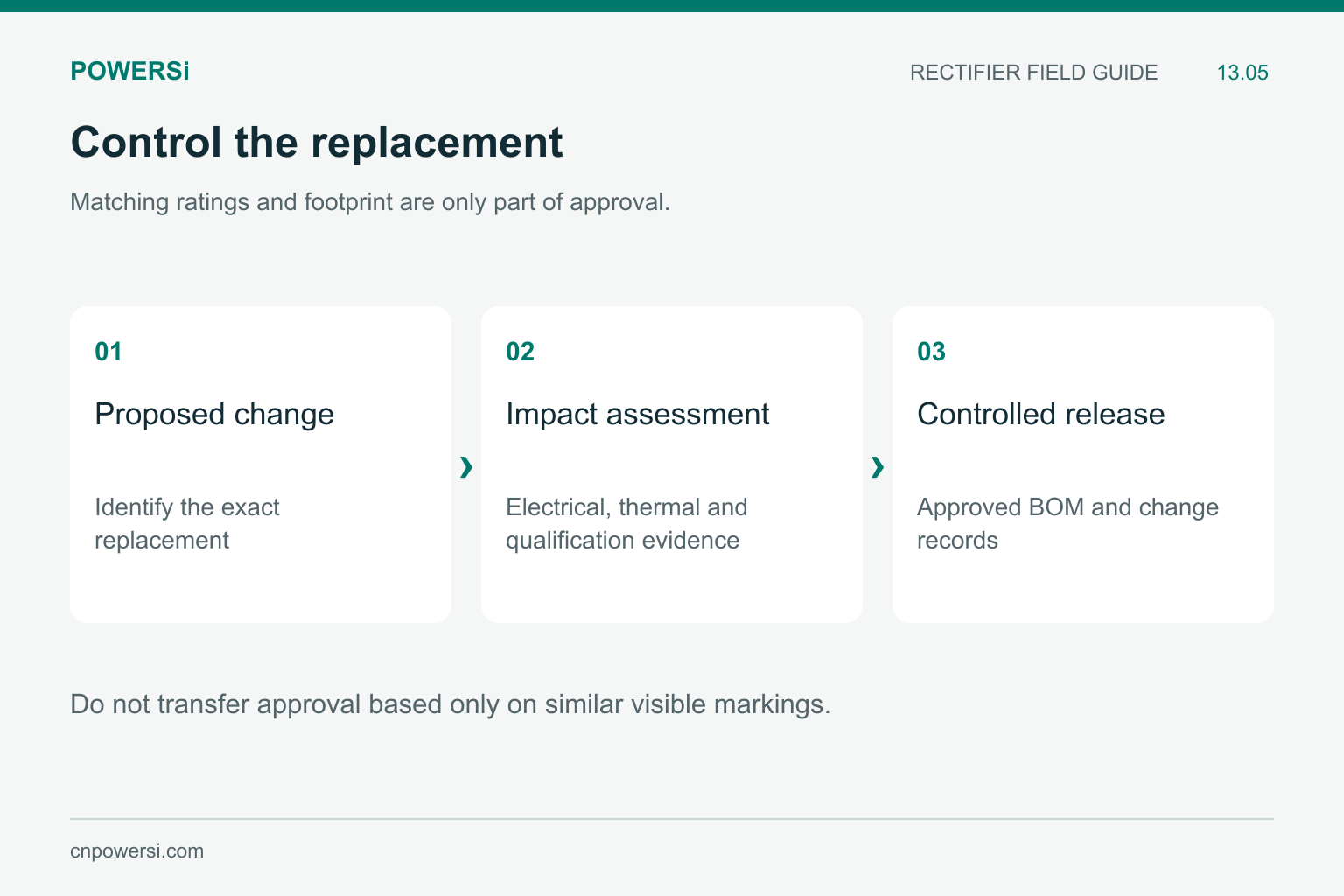
A replacement with the same voltage, current and package still needs a scoped comparison. Check the qualification evidence as well as forward loss, reverse behavior, terminal mapping and thermal performance. Do not copy a predecessor’s approval solely because the substitute fits the footprint.
Once approved, keep the component identity linked to the controlled BOM and evidence revision. Process, site, material or package changes should enter the agreed change-control process. The relevant question is what changed and how its impact is covered, not whether the visible part marking remained the same.
Key Takeaways
- AEC-Q101 is a qualification framework for discrete semiconductors.
- Scope and evidence matter more than an unsupported certificate claim.
- Automotive qualification does not replace application validation.
- Industrial requirements must be assessed on their own mission profile.
Conclusion
Purchase against a defined approval requirement, not a grade label alone. When discussing POWERSi diode options, specify the intended application and required qualification evidence. Require a part-specific declaration before treating any candidate as automotive-qualified.
FAQs
Does AEC issue a certificate for each diode?
AEC publishes qualification requirements and does not operate a part-certification board. Ask the supplier for the scoped qualification evidence.
Does AEC-Q101 guarantee a service lifetime?
No. Lifetime assessment also depends on the mission profile, operating stresses and the relevant reliability evidence.
Are industrial diodes always less reliable?
No. Reliability depends on the device and its conditions of use. The market description alone is not a quantitative comparison.
Is PPAP the same as AEC-Q101?
No. Qualification evidence and a customer-required production approval submission serve related but different purposes.
Can a similar part inherit automotive approval?
Not automatically. The exact device and applicable qualification scope must be linked to the customer’s approval record.