Skip to content
Pin-to-Pin Rectifier Replacement: A Package Tolerance Review
Last Updated: 2026-10-08
Quick Answer
Pin-to-pin rectifier replacement requires agreement between electrical connections, mechanical tolerances and the assembly process. DO-41, SMA, SMB, SMC and KBPC names provide starting categories, not complete interchangeability approvals. Compare controlled drawings and terminal functions, then confirm board fit, mounting clearances and soldering conditions on the intended assembly.
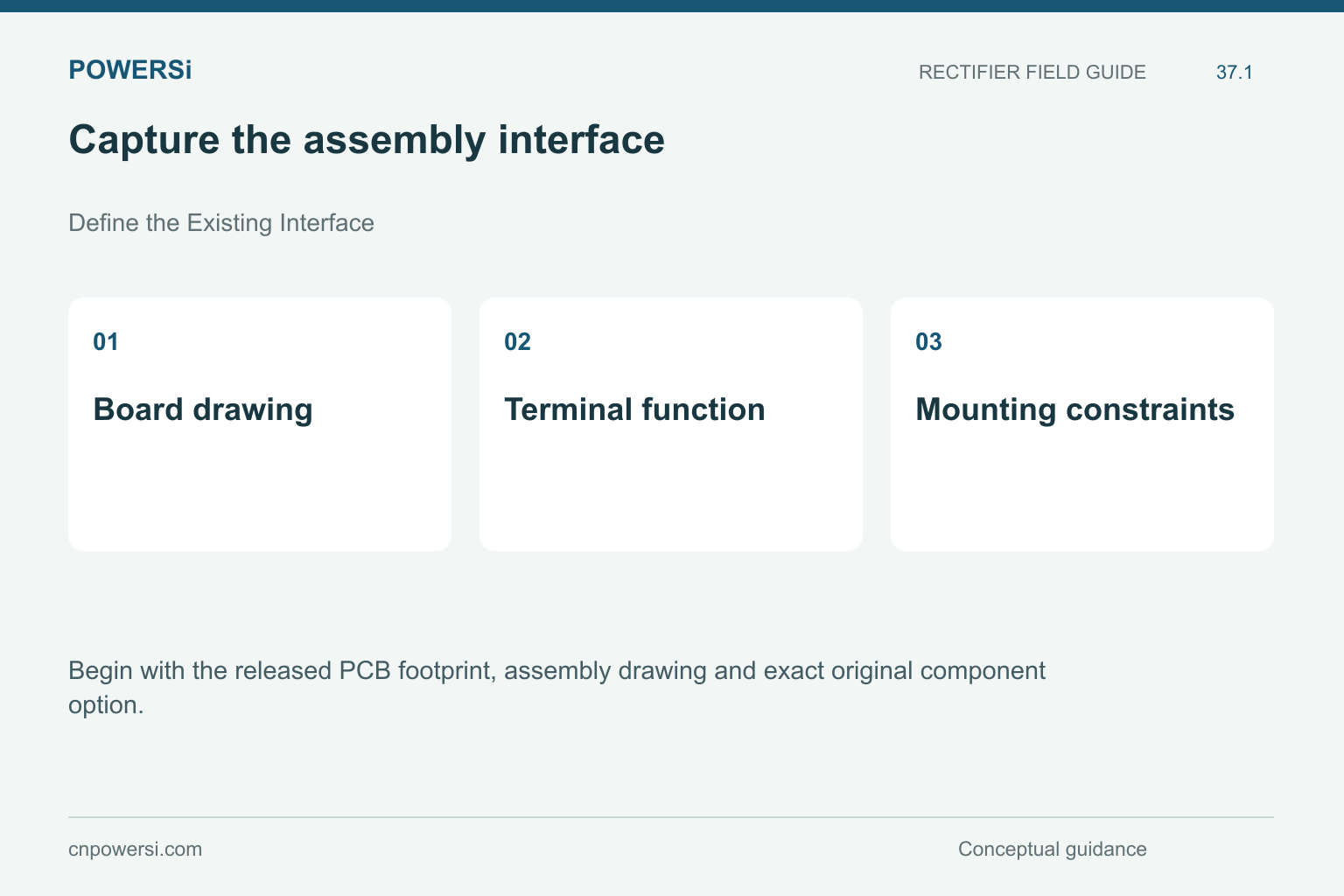
Capture the assembly interface.
Define the Existing Interface
Begin with the released PCB footprint, assembly drawing and exact original component option. Include polarity, internal circuit and any connection between an exposed metal surface and an electrical terminal. A drawing viewed from the bottom can appear mirrored relative to a top-view board layout.
State whether lead forming, heatsink machining or footprint changes are allowed. If changes are necessary, describe the work as a redesign rather than an unchanged pin-to-pin substitution. That distinction prevents purchasing from promising assembly compatibility before the mechanical review is complete.
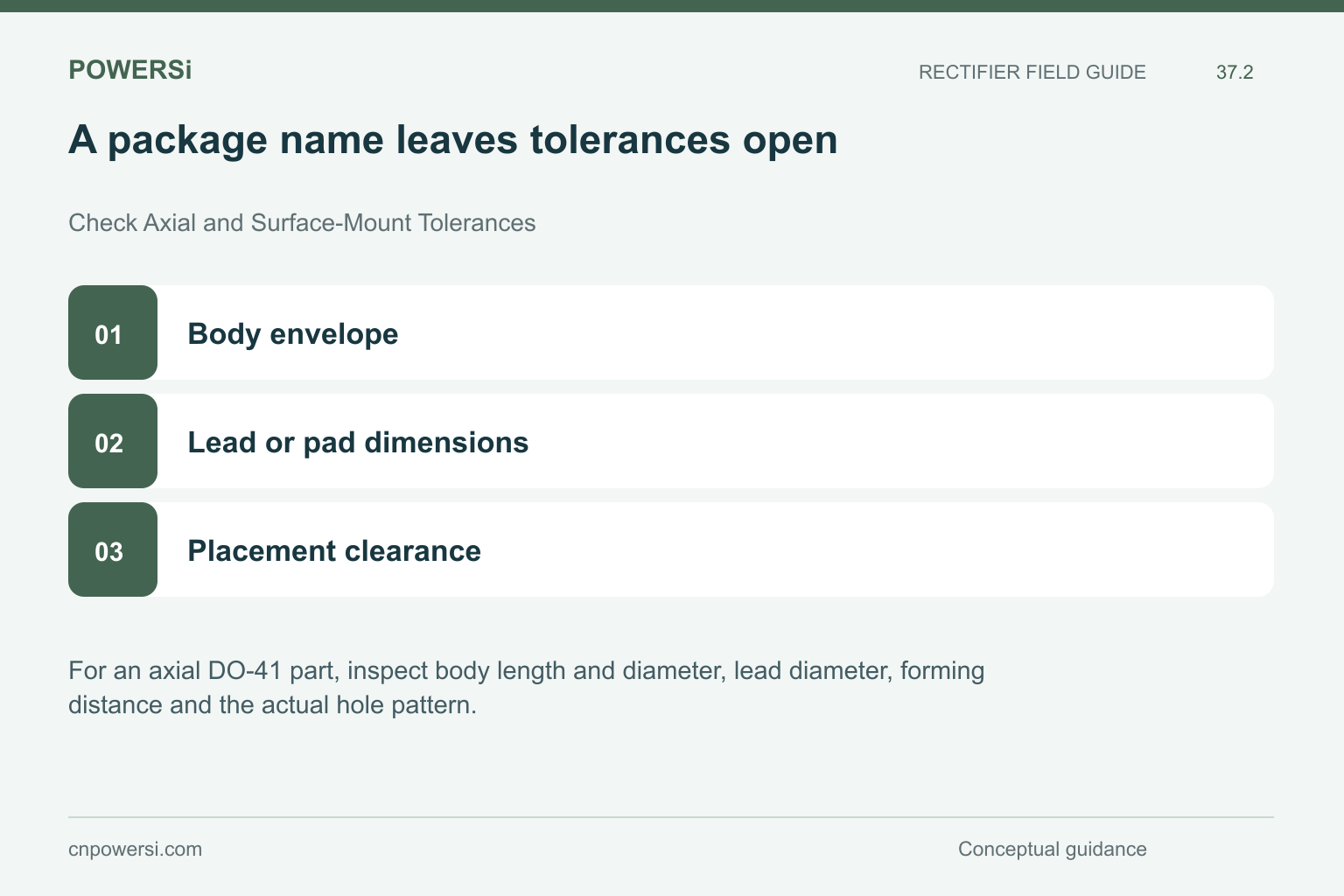
A package name leaves tolerances open.
Check Axial and Surface-Mount Tolerances
For an axial DO-41 part, inspect body length and diameter, lead diameter, forming distance and the actual hole pattern. Nominal pitch after forming is an assembly choice, not simply the diode body dimension.
For SMA, SMB and SMC candidates, compare terminal dimensions, body envelope, height, polarity marking and the recommended land pattern. Use worst-case tolerances to check overlap and clearance. A photograph can reveal a wrong package family but cannot establish dimensional fit or solder-joint geometry.
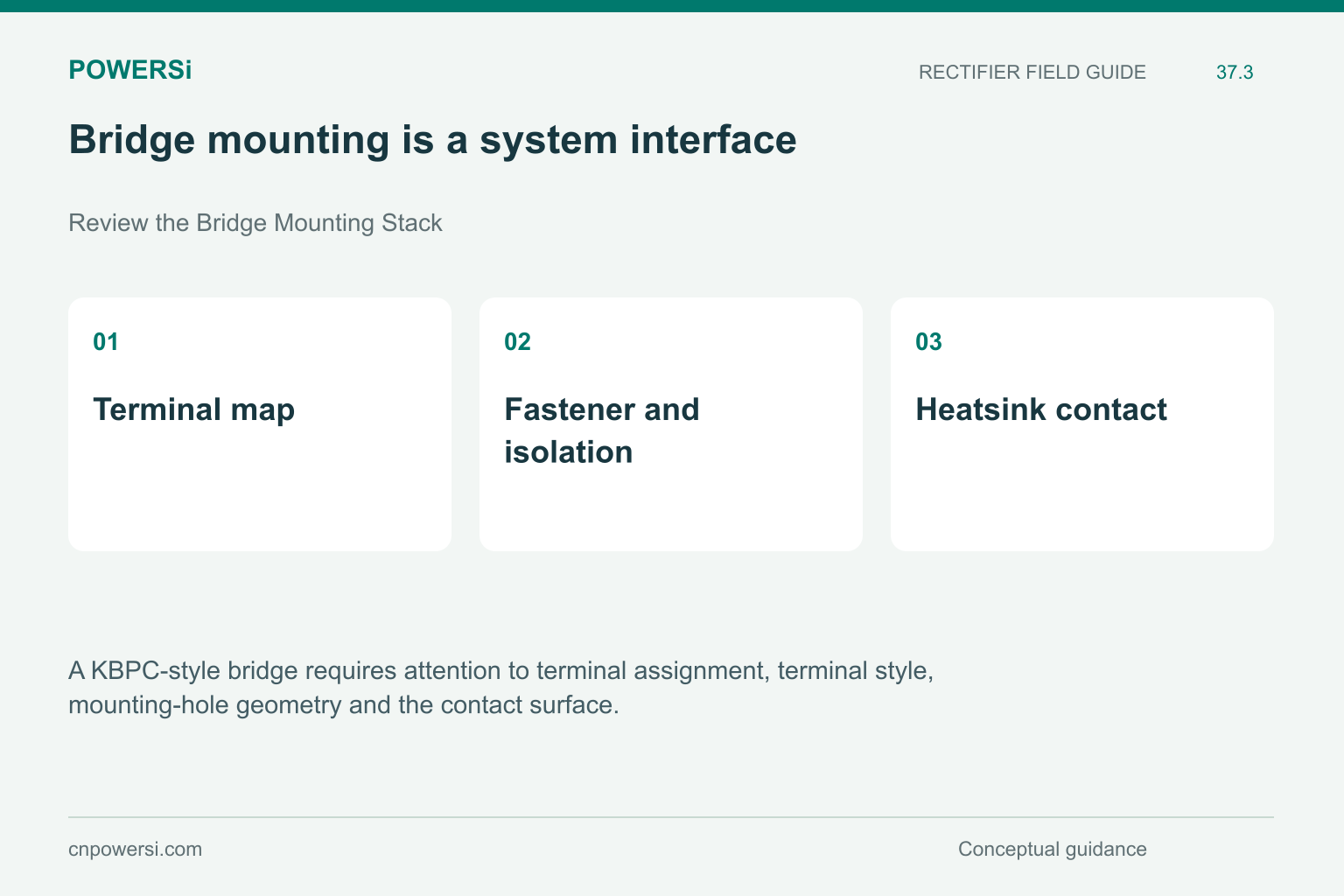
Bridge mounting is a system interface.
Review the Bridge Mounting Stack
A KBPC-style bridge requires attention to terminal assignment, terminal style, mounting-hole geometry and the contact surface. Similar housings can still differ in connections or mounting requirements. Confirm which drawing view defines the AC, positive and negative terminals.
Review the complete mounting stack: fastener, washer, insulating interface where required, contact flatness and permitted mounting conditions. Do not infer isolation from a metal base or black housing. Verify the candidate’s stated isolation and connection details before accepting a shared heatsink arrangement.
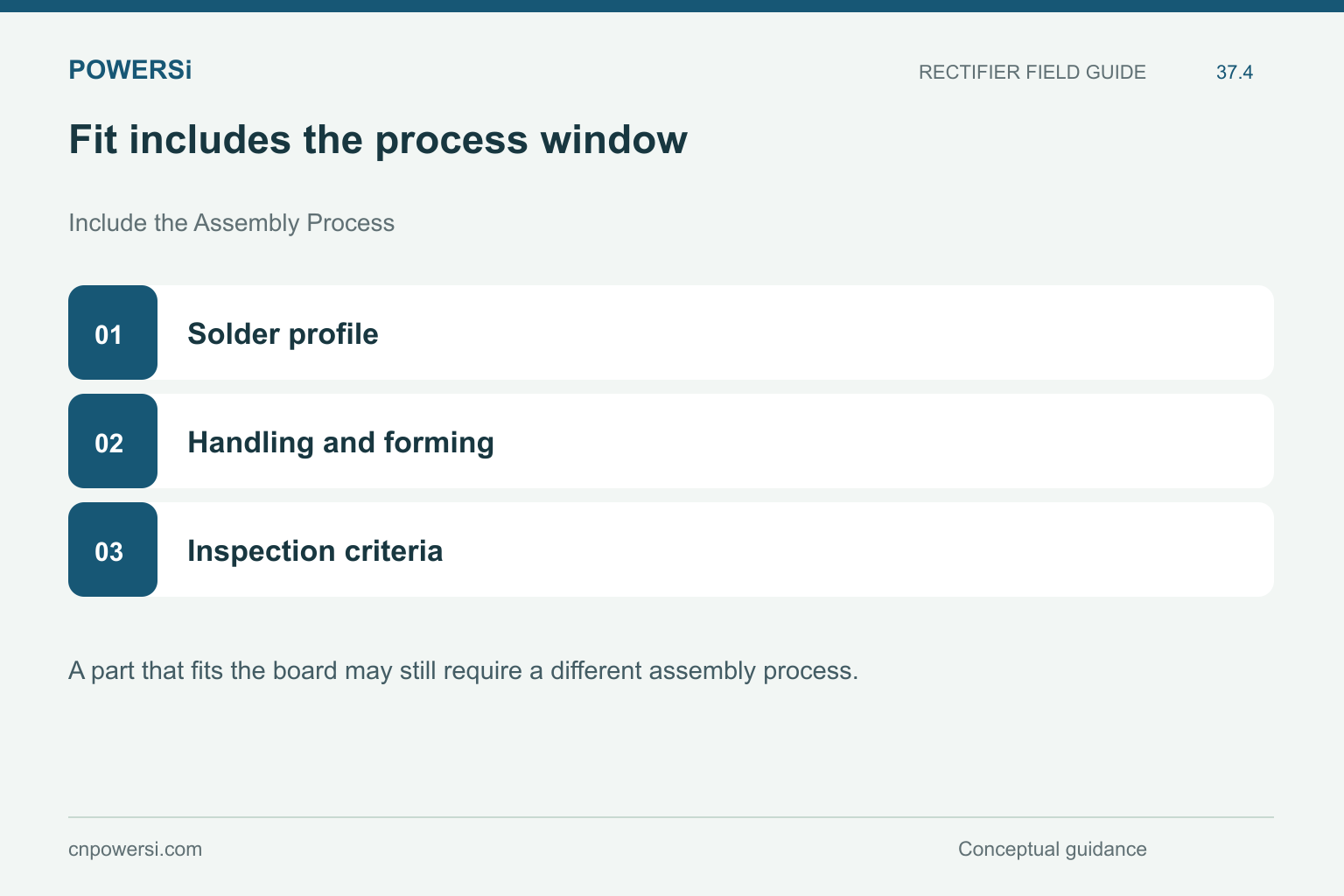
Fit includes the process window.
Include the Assembly Process
A part that fits the board may still require a different assembly process. Compare soldering limits, storage or moisture-handling instructions where applicable, lead-forming constraints and cleaning compatibility. Keep the process comparison tied to the exact package option.
Inspect a pilot build for seating, polarity visibility, solder coverage and clearance to neighboring parts. Establish acceptance criteria before the build so a visual difference is not dismissed simply because the unit powers up. Record any process adjustment as part of the replacement decision.
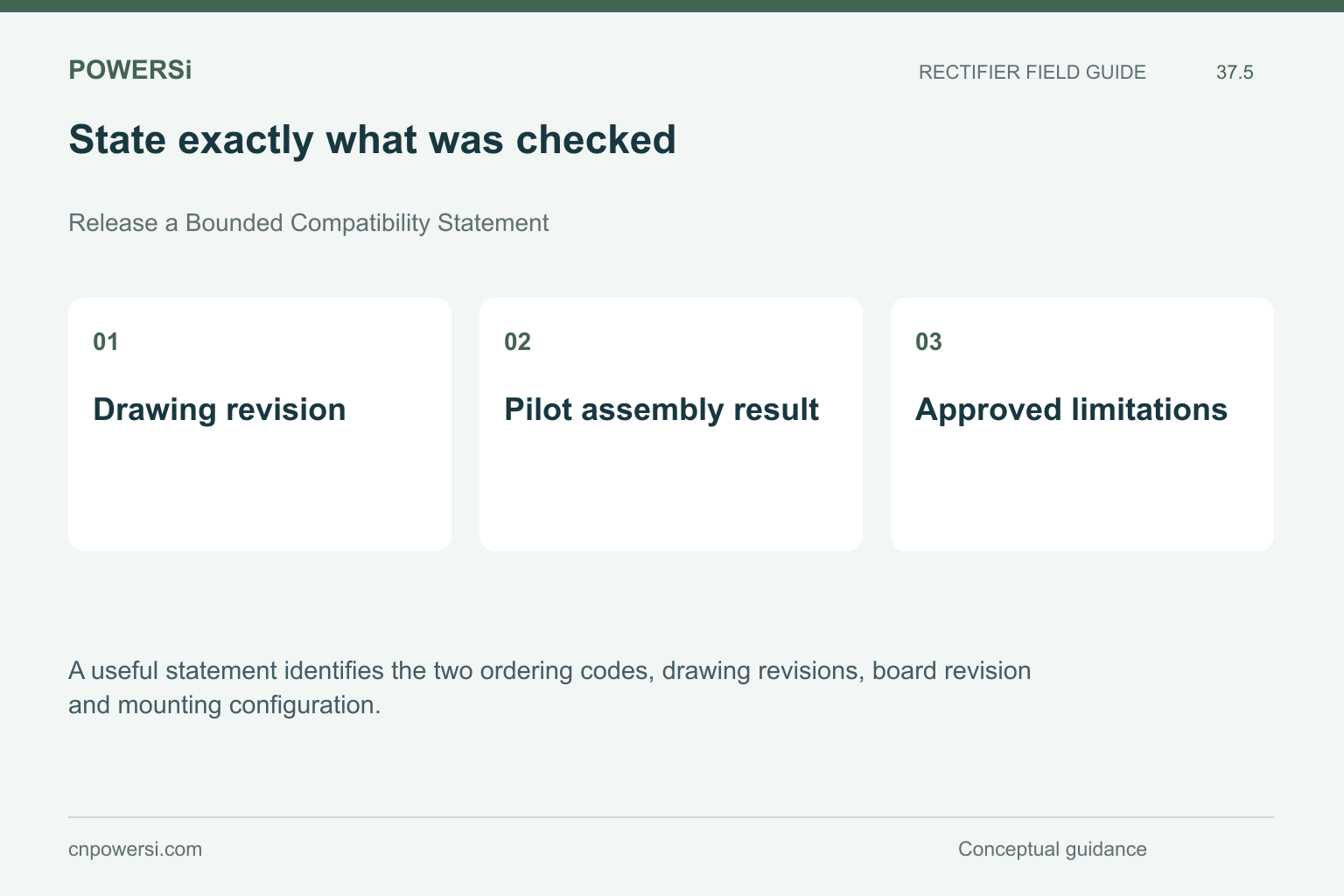
State exactly what was checked.
Release a Bounded Compatibility Statement
A useful statement identifies the two ordering codes, drawing revisions, board revision and mounting configuration. State which interfaces were compared and which tests confirmed the result. Electrical compatibility remains necessary even after the mechanical review passes.
If only nominal dimensions have been compared, do not label the candidate fully interchangeable. Close the tolerance and process questions first. Store the approved candidate separately from a general cross-reference so future purchases cannot silently select another package suffix.
Key Takeaways
- Capture the assembly interface.
- Bridge mounting is a system interface.
- State exactly what was checked.
Conclusion
Release a pin-to-pin claim only for the checked assembly. Send POWERSi the original drawing, footprint and mounting constraints when requesting a candidate.
FAQs
Does DO-41 define formed lead pitch?
No. Confirm the actual forming arrangement and board hole pattern.
Can SMA and SMB be treated as the same footprint?
No. Compare the exact drawings and land patterns rather than family names.
Can a product photo establish tolerance fit?
No. Use controlled dimensions and tolerance limits.
Is bridge terminal order always identical?
Do not assume so; verify the terminal map and drawing view.
Does passing a mechanical review prove electrical suitability?
No. Electrical duty and qualification remain separate requirements.