Skip to content
1、Device Structure and Features
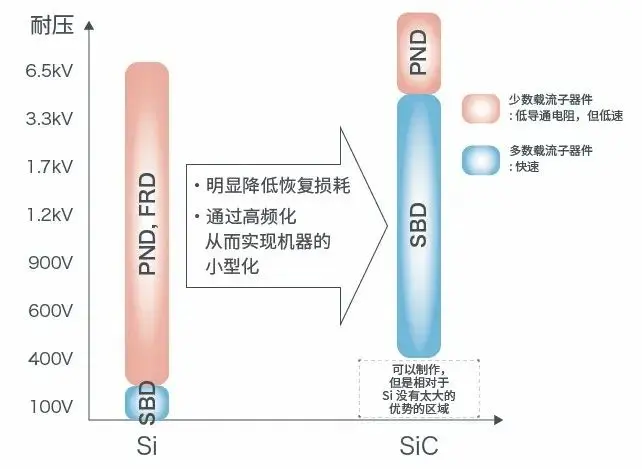
SiC can be used to obtain high-voltage diodes above 600V in the SBD (Schottky barrier diode) structure of high-frequency devices (the highest voltage withstand of Si’s SBD is around 200V).
Therefore, if SiC SBD is used to replace the current mainstream product Fast PN Junction Diode (FRD: Fast Recovery Diode), it can significantly reduce recovery losses.
Beneficial for the high efficiency of power supply, and achieving miniaturization of passive components such as inductors through high-frequency driving, while also reducing noise. Widely used in Power Regulators in air conditioning, power supplies, photovoltaic power generation systems, fast chargers for electric vehicles, and power factor correction circuits (PFC circuits) and rectifier bridge circuits.
2、 Positive characteristics of SiC SBD
The turn-on voltage of SiC SBD is the same as that of Si FRD, less than 1V.
The turn-on voltage is determined by the barrier height of the Schottky barrier. Usually, if the barrier height is designed to be low, the turn-on voltage can also be made lower, but this will also lead to an increase in leakage current during reverse bias.
ROHM’s second-generation SBD successfully maintained the same leakage current and recovery performance as the old product through improved manufacturing processes, while reducing the turn-on voltage by approximately 0.15V.
The temperature dependence of SiC SBD is different from that of Si FRD. The higher the temperature, the higher its conduction impedance will increase, resulting in an increase in VF value. It is not prone to thermal runaway, so it can be used in parallel with peace of mind.

3、 Recovery characteristics of SiC SBD
The fast PN junction diode (FRD: fast recovery diode) of Si generates a large transient current at the moment of switching from forward to reverse, during which it transitions to a reverse bias state, resulting in significant losses.
This is because the minority carriers accumulated in the drift layer during forward conduction continuously conduct electricity until they disappear (this time is also known as the accumulation time).
The larger the forward current or the higher the temperature, the longer the recovery time and current, resulting in greater losses.
On the contrary, SiC SBD is a majority carrier device (unipolar device) that does not use minority carriers for electrical conduction, so in principle, the phenomenon of minority carrier accumulation does not occur. Compared with Si FRD, it can significantly reduce losses due to the small current generated that only discharges the junction capacitance.
Moreover, the transient current remains largely unchanged with temperature and forward current, allowing for stable and rapid recovery in any environment.
In addition, it can also reduce the noise caused by the recovery current, achieving the effect of noise reduction.