Skip to content
Introduction
Most MOSFETs used in power applications are surface mount devices (SMD), including packages such as SO8FL, u8FL, and LFPAK. The reason why these SMDs are usually chosen is that they have good power capability and smaller size, which helps to achieve more compact solutions. Although these devices have good power capabilities, sometimes the heat dissipation effect is not ideal.
Due to the direct soldering of the lead frame (including exposed drain pads) of the device to the copper-clad area, heat is mainly transmitted through the PCB. The rest of the device is enclosed in plastic packaging and can only dissipate heat through air convection. Therefore, the heat transfer efficiency largely depends on the characteristics of the circuit board: the size of the copper coating area, the number of layers, the thickness, and the layout. This situation can occur regardless of whether the circuit board is installed on the heat sink or not. The maximum power capacity of typical devices cannot reach the optimal level because PCBs generally do not have high thermal conductivity and thermal mass. To address this issue and further reduce application size, the industry has developed a new MOSFET package that exposes the MOSFET lead frame (drain) at the top of the package (as shown in Figure1).
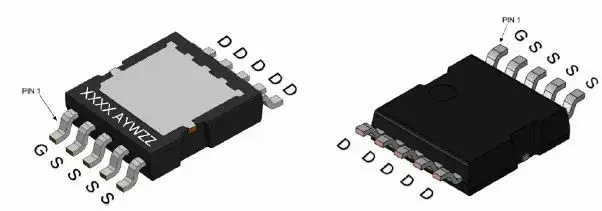
Figure 1 Top heat dissipation package
1、 Layout advantages of top heat dissipation
Although traditional power SMD is advantageous for achieving miniaturization solutions, they require that no other components be placed on the back of the circuit board below it due to heat dissipation considerations. Some space on the circuit board cannot be used, resulting in a larger overall size of the final circuit board. And the top heat sink component can bypass this problem: its heat dissipation is carried out through the top of the device. In this way, components can be placed on the board below the MOSFET.
This space can be used to arrange the following components (but not limited to):
power device
gate drive circuit
Support components (capacitors, buffers, etc.)
Conversely, it can also reduce the size of the circuit board, decrease the path of gate drive signals, and achieve a more ideal solution.

Figure 2 PCB device space
Compared to standard SMD devices, top heat sink components not only provide more layout space but also reduce heat overlap. Most of the heat propagation from the top heat dissipation package directly enters the heat sink, so the PCB bears less heat. Helps to reduce the operating temperature of surrounding devices.
2、 The thermal performance advantage of top heat dissipation
Unlike traditional surface mount MOSFETs, the top heat dissipation package allows the heat sink to be directly connected to the lead frame of the device. Due to the high thermal conductivity of metals, heat sink materials are usually made of metals. For example, most heat sinks are made of aluminum, with a thermal conductivity between 100-210 W/mk. Compared with the conventional method of heat dissipation through PCB, this method of heat dissipation through high thermal conductivity materials greatly reduces thermal resistance. Thermal conductivity and material size are key factors determining thermal resistance. The lower the thermal resistance, the better the thermal response.
R θ=absolute thermal resistance
Δ X=thickness of material parallel to heat flow
A=cross-sectional area perpendicular to the heat flow
K=thermal conductivity
In addition to improving thermal conductivity, heat sinks also provide greater thermal mass – which helps to avoid saturation or provide a larger thermal time constant. This is because the size of the top mounted radiator can be changed. For a certain amount of thermal energy input, the thermal mass or heat capacity is directly proportional to the given temperature change.
Cth=heat capacity, J/K
Q=Thermal energy, J
Δ T=temperature change, K
PCBs often have different layouts, and if the thickness of the copper foil is low, it can lead to lower thermal mass (heat capacity) and poor heat propagation. All these factors make standard surface mount MOSFETs unable to achieve optimal thermal response during use. In theory, the top heat dissipation package has the advantage of directly dissipating heat through a high thermal mass and high thermal conductivity source, so its thermal response (Zth (℃/W)) will be better. Under a certain increase in junction temperature, better thermal response will support higher power input. In this way, for the same MOSFET chip, chips with top heat dissipation packaging will have higher current and power capabilities than chips with standard SMD packaging.

Figure 3 The heat dissipation paths of the top heat dissipation package (top) and SO8FL package (bottom)
3、 Test setup for thermal performance comparison
To demonstrate and validate the thermal performance advantages of top heat dissipation, we conducted tests comparing the chip temperature rise and thermal response of TCPAK57 and SO8FL devices under the same thermal boundary conditions. To ensure effectiveness, two devices were tested under the same electrical conditions and thermal boundaries. The difference is that the heat sink of TCPAK57 is installed above the device, while the heat sink of SO8FL device is installed at the bottom of the PCB, directly below the MOSFET area (Figure 3). This is a reproduction of the usage of the device in field applications. During the testing period, different thicknesses of thermal interface materials (TIMs) were also used to verify which device packaging could be optimized using different thermal boundaries. The overall testing is conducted as follows: a fixed current (therefore a fixed power) is applied to these two devices, and then the change in junction temperature is monitored to determine which device performs better.
4、 Device selection and PCB layout
In terms of device selection, MOSFETs in each package have the same chip size and use the same technology. This is to ensure that each device has the same power consumption at a given current and to ensure consistent thermal response at the package level. In this way, we can be confident that the measured thermal response differences are due to packaging differences. For these reasons, we chose to use TCPAK57 and SO8FL. They use slightly different clamp and lead frame designs, one with leads (TCPAK57) and one without leads (SO8FL). It should be noted that these differences are small and will not have a significant impact on the steady-state thermal response, so they can be ignored. After giving the parameters, the selected devices are as follows:
NVMFS5C410N SO8FL
NVMJST0D9N04CTXG TCPAK57
To further ensure that all other thermal boundaries remain equivalent, we designed two identical PCBs to accommodate SO8FL or TCPAK57 packages. The PCB design consists of 4 layers, each containing 1 ounce of copper. The size is 122 mm x 7 mm. The SO8FL board does not have thermal vias connecting the drain pad to other conductive layers of the circuit board (which is not the best for heat dissipation); In this comparison setting, it can be used as the worst-case heat dissipation scenario.

Figure 5 Each layer of PCB (Layer 1 is displayed in the upper left corner, Layer 2 is displayed in the upper right corner, Layer 3 is displayed in the lower left corner, and Layer 4 is displayed in the lower right corner)
5、 Radiators and Thermal Interface Materials (TIM)
The heat sink used during the testing process is made of aluminum and specifically designed for installation on the PCB. The 107mm × 144mm heat sink is liquid cooled, with a 35mm × 38mm heat dissipation area located directly below the MOSFET position. The liquid passing through the radiator is water. Water is a commonly used coolant in field applications. For all test scenarios, the flow rate is set to a fixed value of 0.5 gpm. Water can provide additional heat capacity, transferring heat from the radiator to the water supply system, which helps to reduce device temperature.

Figure 6 Application Settings
In order to better promote MOSFET interface heat dissipation, thermal gap fillers should be used. This helps to fill potential defects on the interface surface. Air, as a poor thermal conductor, increases thermal resistance with any air gap. The TIM used for testing is Bergquist 4500CVO sealant, with a thermal conductivity of 4.5 W/mK. Use several different thicknesses of this TIM to demonstrate the possibility of thermal response optimization. The fixed thickness is achieved through the use of precision gaskets between the circuit board and the heat sink. The target thickness used is: ~200 µm ~700 µm
6、 Testing circuits and heating/measuring methods
The selected onboard circuit configuration is a half bridge setup, as it represents a universal field application. The proximity of two devices to each other accurately reflects the on-site layout, as shorter wiring helps reduce parasitic effects. Due to thermal overlap between devices, this will play a certain role in thermal response.
In order to perform relevant heating at a lower current value, the current will pass through the body diode of the MOSFET. To ensure this is always the case, short-circuit the gate to source pins. The thermal response of a given device is obtained by first heating the half bridge FET until the steady-state junction temperature (temperature no longer increases), and then monitoring the source drain voltage (Vsd) through a 10 mA small signal source as the junction temperature returns to the cooling state temperature. The time required to reach thermal steady state during the heating process is equal to the time required to return to a state of no electricity. The Vsd of the body diode is linearly related to the junction temperature, so a constant (mV/℃) ratio (determined by characterizing each device) can be used to correlate it with Δ Tj. Then divide the Δ Tj during the entire cooling period by the power consumption at the end of the heating phase to obtain the thermal response (Zth) of the given system.


The measurement of 2A power supply, 10 mA power supply, and Vsd is all processed by T3ster. T3ster is a commercial testing device specifically designed for monitoring thermal response. It uses the method mentioned earlier to calculate the thermal response.

Figure 7 Circuit diagram
7、 Hot comparison results
Measure the thermal response results of each device under two conditions:
200 μm TIM
700 μm TIM
The purpose of these two measurements is to determine which packaging in a given controlled system has better thermal response, and which device’s thermal response can be optimized through external heat dissipation methods. It must be noted that these results are not applicable to all applications, but are specific to the mentioned thermal boundaries.
Comparison of packaging using 200 μ m TIM installed on the heat sink.
For the first testing operation, each device is installed on a water-cooled heat sink using a 200 μ m TIM. Each device receives a 2A pulse until it reaches steady state. T3ster monitors the Vsd during heat dissipation and correlates it in reverse to the thermal response curve of the system. The steady-state thermal response value of top heat dissipation is~4.13 ℃/W, while the value of SO8FL is~25.27 ℃/W. This significant difference is consistent with the expected results, as the top heat dissipation package is directly mounted onto a high thermal conductivity and large heat capacity heat sink, achieving good heat propagation. For SO8FL, due to the poor thermal conductivity of the PCB, the thermal conductivity effect is poor.
To help understand how to leverage these advantages in applications, the thermal response value can be linked to the amount of power each device can withstand. The power required to increase Tj from a coolant temperature of 23 ℃ to a maximum operating temperature of 175 ℃ is calculated as follows:
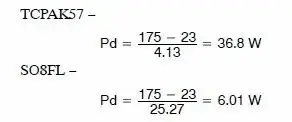
Note: This power difference is expected in this specific thermal system.
In this thermal system, the top heat dissipation unit can handle 6 times the power output of SO8FL. In on-site applications, this can be utilized in several different ways. Here are some of its advantages:
When the required current is constant, due to the improved power capability, a smaller heat sink can be used compared to SO8FL. This may result in cost savings.
For switch mode power supply applications, the switching frequency can be increased while maintaining a similar thermal margin.
Can be used for higher power applications that were originally not suitable for SO8FL.
When the chip size is constant, the top heat sink component will have a higher safety margin compared to SO8FL, and operate at a lower temperature under a given current
demand.
Figure 8 Thermal response curve using 200 μ m TIM

Figure 9 Temperature variation curve using 200 μ m TIM
Comparison of packaging using 700 μ m TIM installed on the heat sink.
Another testing operation was conducted using a TIM thickness of 700 μ m. This is to compare the thermal response changes with 200 μ m TIM testing to verify the impact of external heat dissipation methods on each package. The test operation yielded the following thermal response results: the top heat sink component was 6.51 ℃/W, and SO8FL was 25.57 ℃/W. For top heat dissipation, the difference between two TIM operations is 2.38 ℃/W, while the difference between SO8FL is 0.3 ℃/W. This means that the external heat dissipation method has a significant impact on the top heat sink components, but has little effect on SO8FL. This is also expected, as the thermal response of the top heat dissipation device is mainly based on the thermal resistance of the TIM layer. Compared to heat sinks, TIM has lower thermal conductivity. Therefore, as the thickness increases, the thermal resistance will increase, resulting in a higher Rth.
The SO8FL TIM change occurs between the circuit board and the heat sink. The heat from its components must propagate through the circuit board to reach the TIM and heat sink, so the thickness variation has little effect on the thermal resistance of the main heat path. So, the change in thermal response is very small.
The thermal response changes caused by the thickness variation of TIM demonstrate the overall advantage of top heat dissipation packaging. TCPAK57 has a exposed lead frame at the top of the package, which allows for better control of the thermal resistance of the heat path. For specific applications and heat dissipation methods, this feature can be utilized to optimize thermal response. This in turn will provide more controllable and beneficial power capabilities. SO8FL and similar SMD devices are difficult to dissipate heat through the circuit board they are on, depending on the characteristics of the PCB. This is a non controllable factor, as there are many other variables to consider in PCB design besides heat dissipation.

Figure 10 Temperature variation curve using 700 μ m TIM

Figure 11 Temperature variation curve using 700 μ m TIM
8、 Summary of Key Points
The top heat dissipation package can avoid heat dissipation through PCB, shorten the heat path from the chip to the heat dissipation device, and thus reduce the thermal resistance of the device. Thermal resistance is directly related to the characteristics of heat sinks and thermal interface materials. Low thermal resistance can bring many application advantages, such as:
When the required current is constant, due to the improved power capability, smaller top heat dissipation devices can be used compared to standard SMD. Conversely, this may also result in cost savings.
For switch mode power supply applications, the switching frequency can be increased while maintaining a similar thermal margin.
Can be used for higher power applications where standard SMD is not suitable.
When the chip size is constant, the top heat sink component will have a higher safety margin compared to equivalent SMD devices, and operate at a lower temperature under a given current demand.
Stronger thermal response optimization capability. This is achieved by changing the thermal interface material and/or thickness. The thinner the TIM and/or the better the thermal conductivity, the lower the thermal response. The thermal response can also be altered by changing the characteristics of the heat sink. The top heat dissipation package can reduce heat propagation through the PCB, thereby reducing heat overlap between devices. The top heat dissipation eliminates the need to connect a heat sink to the back of the PCB, allowing for more compact arrangement of components on the PCB.