Skip to content
High-Voltage SiC and FRED Sourcing: Build a Verified Product Matrix
Last Updated: 2026-10-08
Quick Answer
A high-voltage SiC and FRED product matrix should separate voltage classes, recovery technologies, circuit configurations and package options. Populate it only with identifiable products and conditioned specifications. A supplier offering one 1200 V diode has not thereby established coverage at 600 V or 1700 V, or suitability for every high-voltage application.
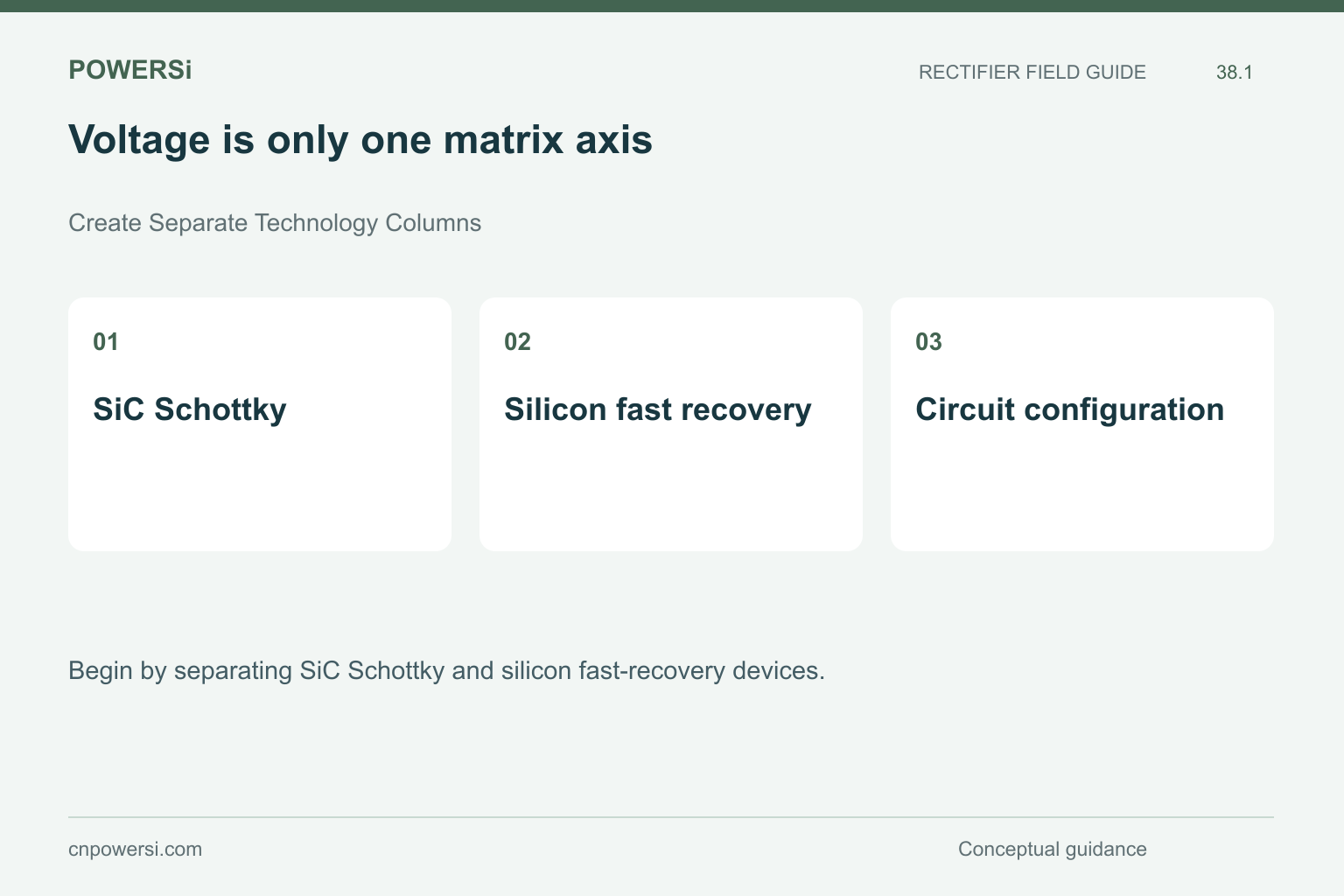
Voltage is only one matrix axis.
Create Separate Technology Columns
Begin by separating SiC Schottky and silicon fast-recovery devices. Their dynamic behavior is not captured by a single recovery-time field. Also distinguish a single diode from dual devices, bridges and modules; current ratings can refer to different internal paths.
For each candidate, record the full ordering code, voltage class, current rating with its temperature condition, package and internal circuit. Leave unsupported entries empty. A supplier’s broad technology description should not be copied into every row as if it documented an available product.
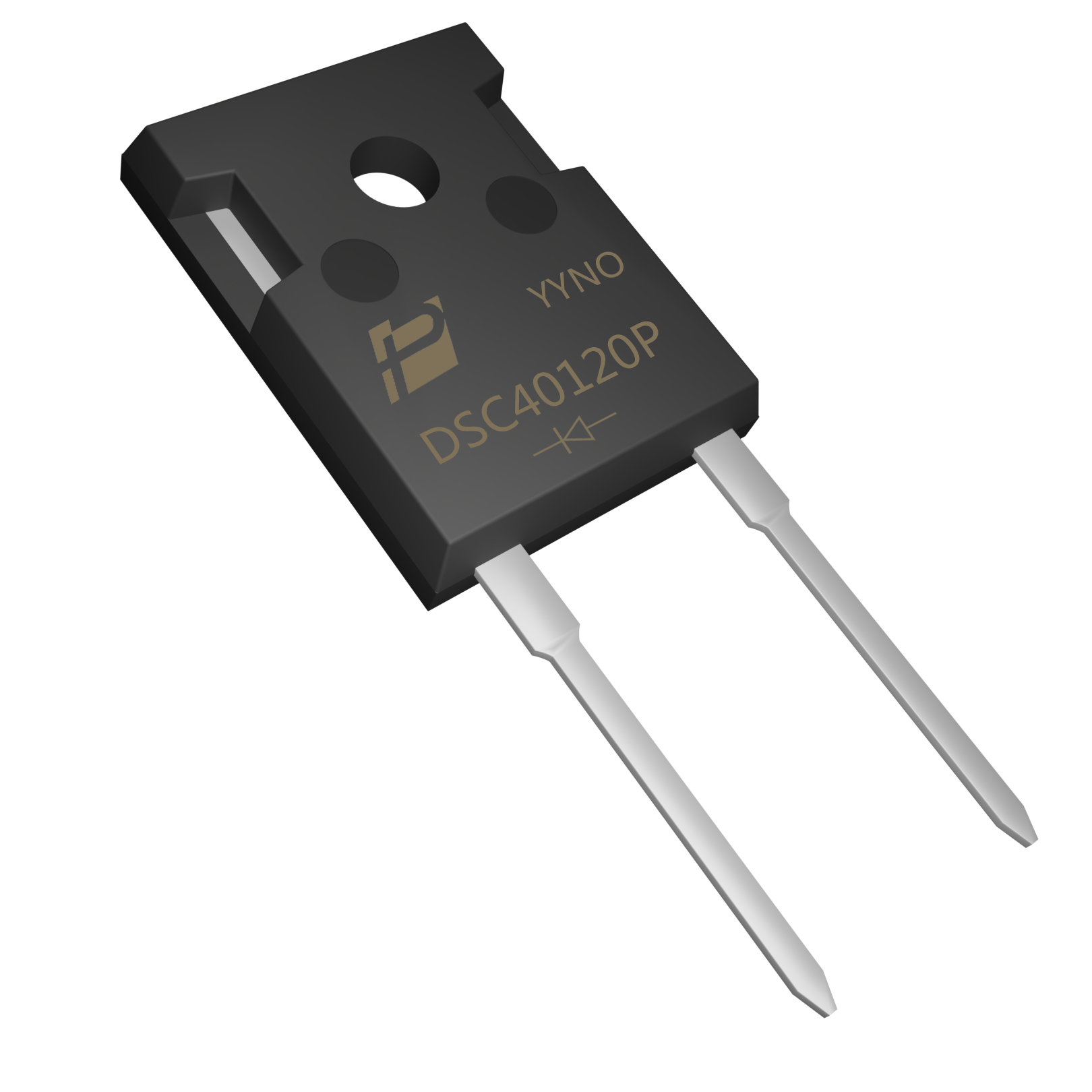
Original DSC40120P product image; model-specific application approval is separate.
Use a Real Entry Without Extrapolation
POWERSi’s DSC40120P documentation identifies a 1200 V SiC Schottky diode in a two-lead TO-247AC package. Its original product image is useful for recognizing the offered model; the electrical document supplies the rating information.
This entry does not establish a 1700 V option, automotive qualification or an equivalent module. Do not create missing products by extending the naming pattern. Request exact ordering codes and documents for other voltage classes before treating those positions in the matrix as covered.
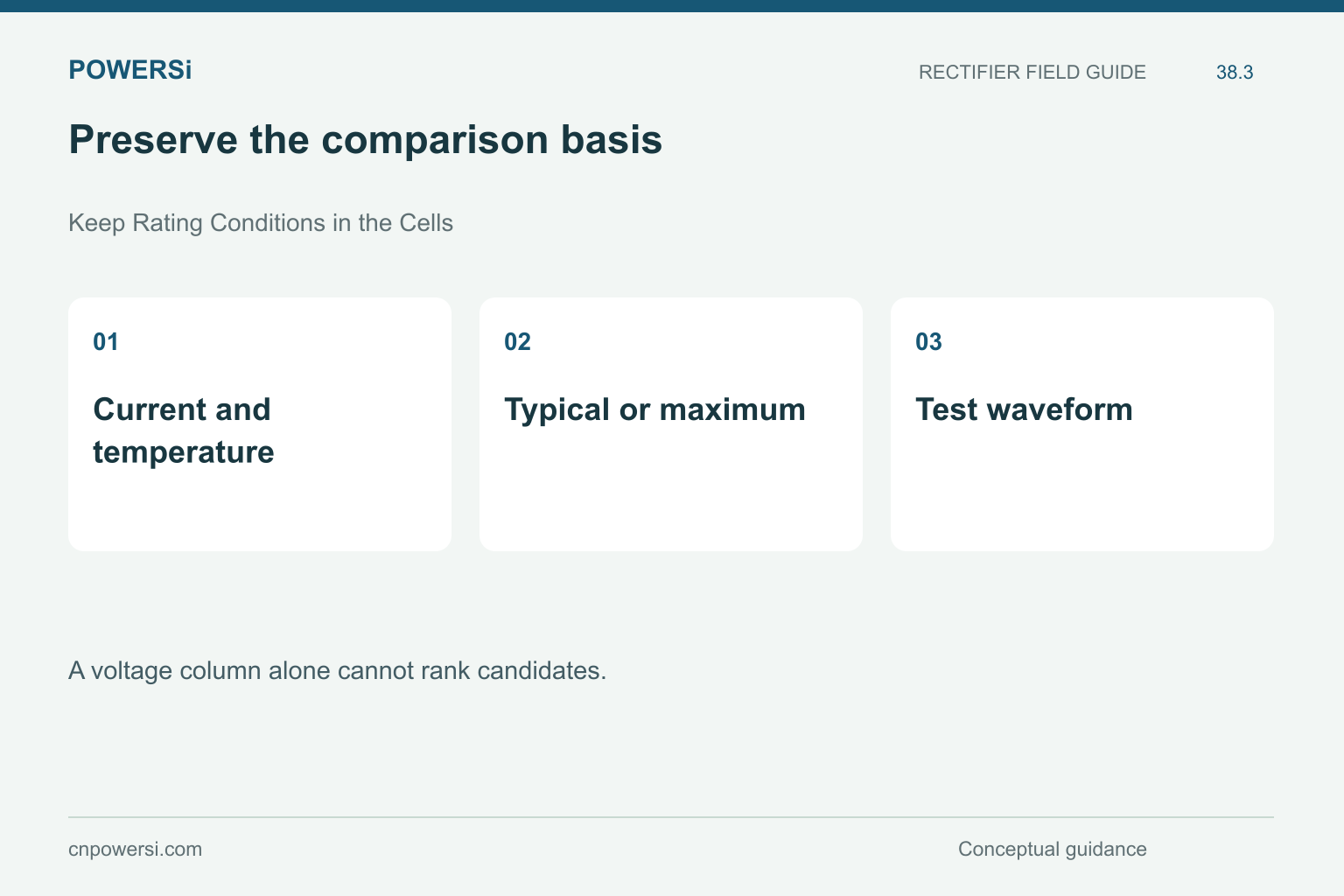
Preserve the comparison basis.
Keep Rating Conditions in the Cells
A voltage column alone cannot rank candidates. A forward-drop value measured at a different current or junction temperature answers a different question. Likewise, a case-temperature current rating should not be presented as an ambient-temperature capability.
Use separate fields for typical and maximum values and retain the test conditions beside them. Where comparable values are absent, mark the comparison unresolved. Avoid calculating a precise loss advantage from isolated headline numbers that do not describe the application’s operating points.
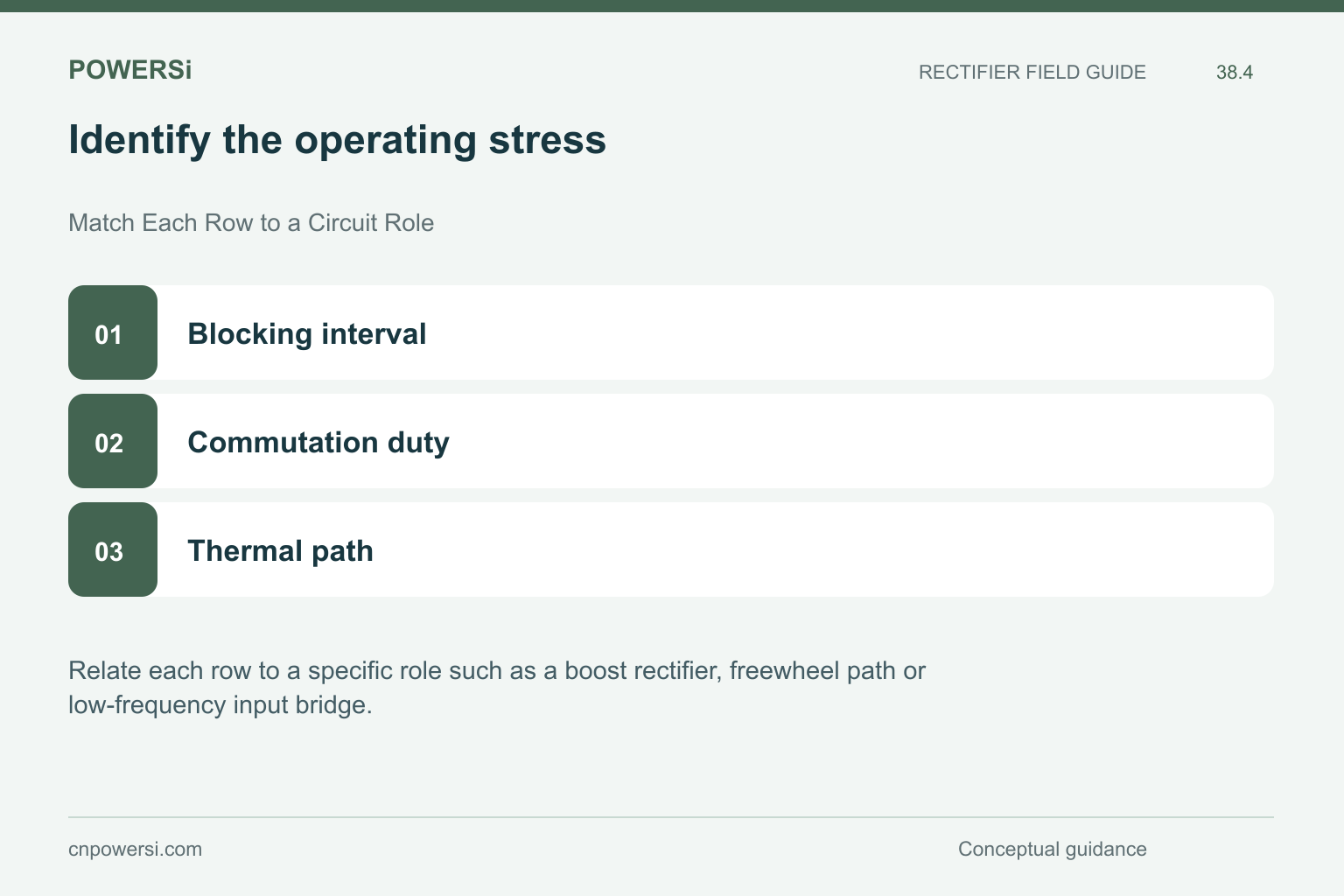
Identify the operating stress.
Match Each Row to a Circuit Role
Relate each row to a specific role such as a boost rectifier, freewheel path or low-frequency input bridge. The same voltage class may experience very different reverse-voltage overshoot and switching duty in those positions.
Define the operating envelope before assigning a preferred technology. Include current waveform, switching conditions, surge events and cooling. A higher voltage label is not automatically the best option: other electrical characteristics and assembly constraints still determine whether the part is suitable.
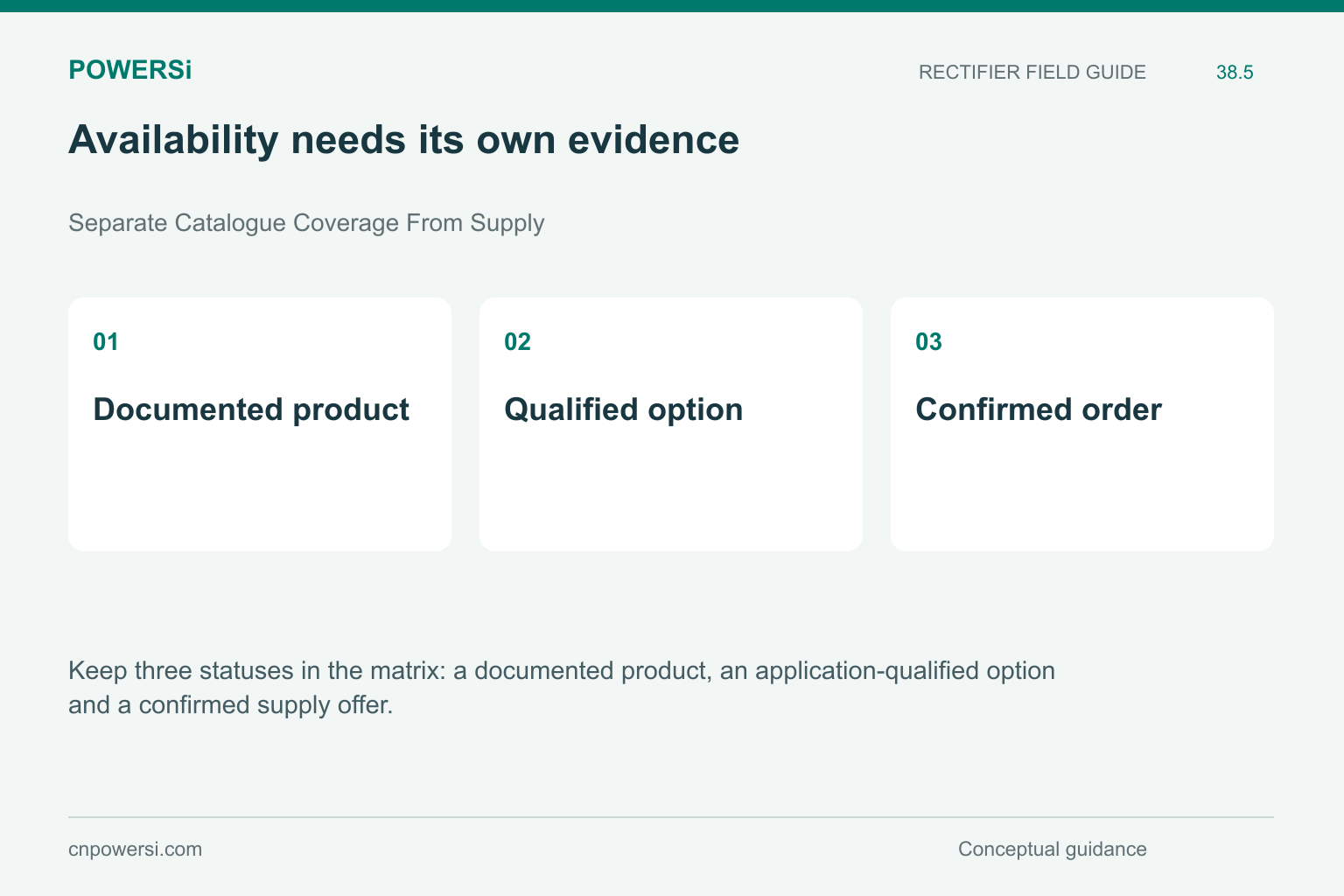
Availability needs its own evidence.
Separate Catalogue Coverage From Supply
Keep three statuses in the matrix: a documented product, an application-qualified option and a confirmed supply offer. A catalogue entry does not establish inventory, price, lead time or capacity for an order.
Date the commercial information and specify quantity, packaging and destination. Revisit the matrix when either the technical requirement or offered construction changes. This creates a useful high-voltage sourcing tool without turning a partial product list into an unsupported claim of complete domestic coverage.
Key Takeaways
- Voltage is only one matrix axis.
- Preserve the comparison basis.
- Availability needs its own evidence.
Conclusion
Use the matrix to expose both supported options and genuine gaps. Ask POWERSi for exact candidates against the required voltage, duty and package.
FAQs
Does 1200 V identify a replacement?
No. Technology, current conditions, circuit and package must also match the requirement.
Can 1700 V coverage be inferred from a 1200 V family?
No. Obtain an identifiable 1700 V product and supporting documents.
Should SiC and FRED share a recovery-time ranking?
No. Compare dynamic behavior using relevant quantities and consistent test conditions.
Does a catalogue entry prove stock?
No. Confirm the exact order separately.
What does the DSC40120P example establish?
A documented 1200 V two-lead SiC diode entry, not a complete voltage or qualification portfolio.