Skip to content

Chinese SiC Diodes: Five Evidence Questions About Performance and Reliability
Last Updated: 2026-10-08
Quick Answer
Evaluating Chinese SiC diodes requires evidence for five separate questions: conduction behavior, switching response, surge capability, lifetime relevance and production quality. Neither material type nor country establishes the answer. Ask for conditioned device data and application-relevant tests, and keep reliability results separate from manufacturing yield or an assumed field-failure rate.
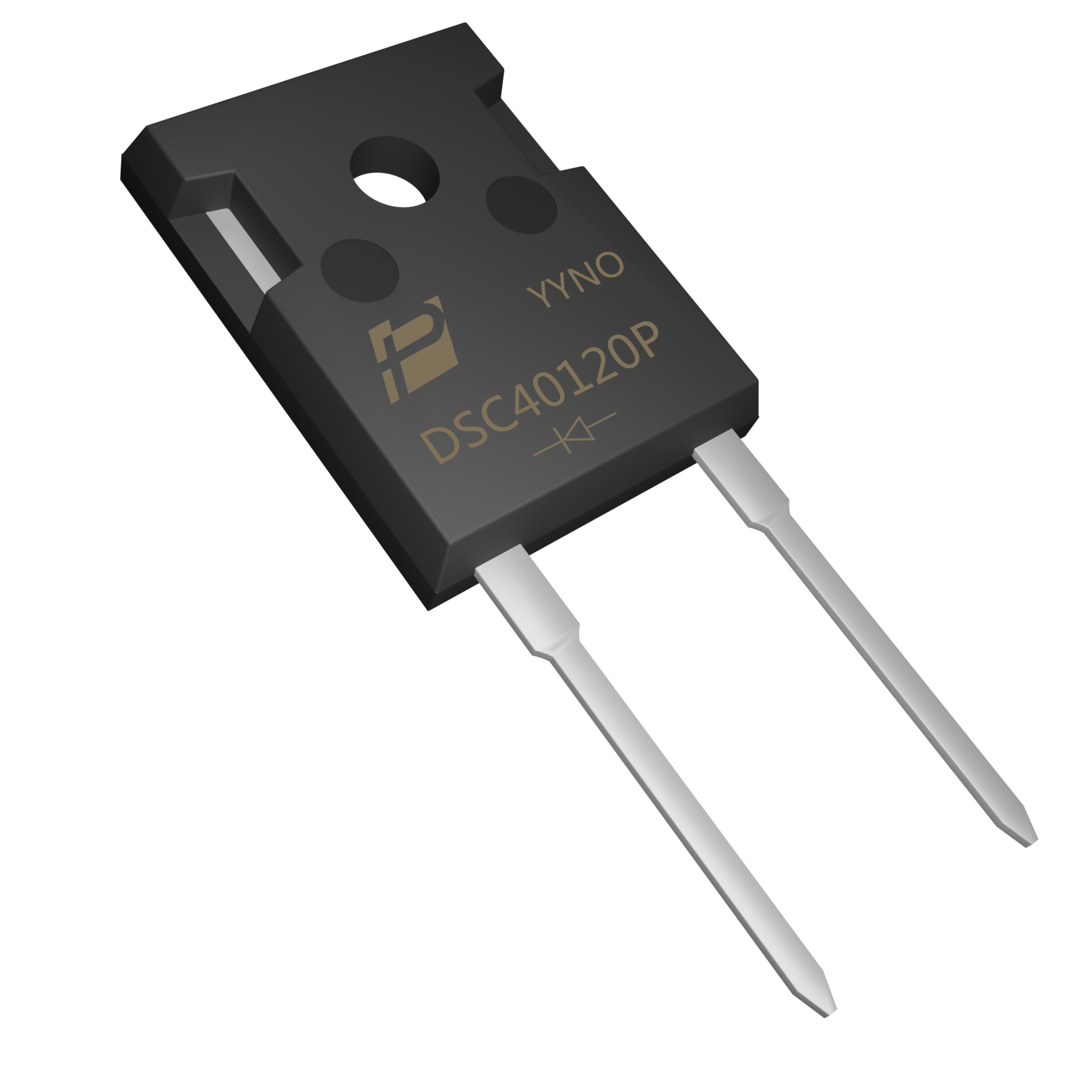
Original DSC40120P product image; model-specific application approval is separate.
How Does It Conduct in the Actual Duty?
Compare forward voltage over the current and temperature range the circuit actually uses. Multiplying one typical forward-drop value by a headline current does not produce a reliable loss estimate for a varying waveform. Use a suitable model or measured voltage-current behavior across the duty.
For a model inquiry, DSC40120P is a concrete POWERSi SiC option to identify by its full code and original two-lead package image. Its existence does not establish suitability for an unspecified circuit. Keep current conditions and cooling requirements in the evaluation.
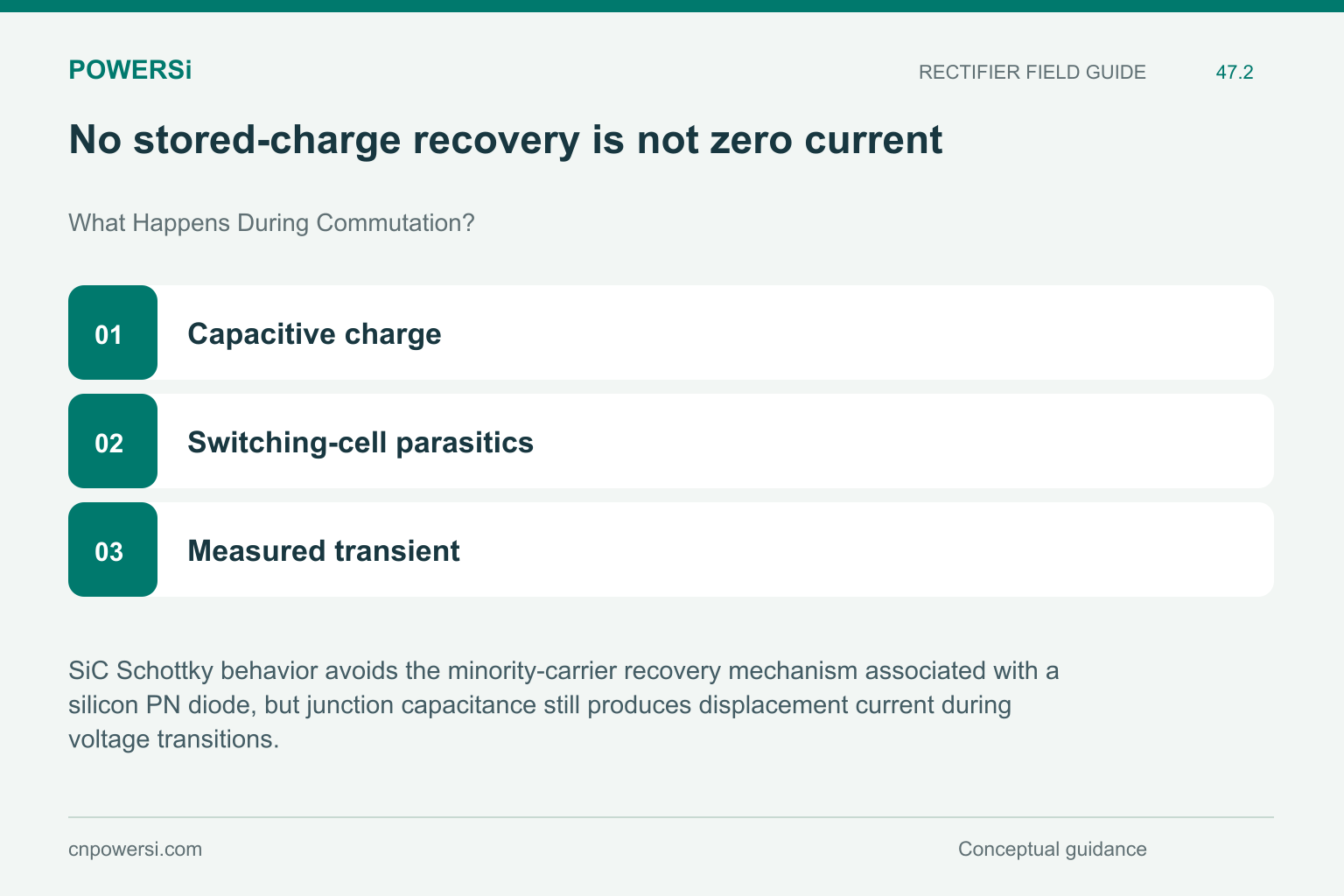
No stored-charge recovery is not zero current.
What Happens During Commutation?
SiC Schottky behavior avoids the minority-carrier recovery mechanism associated with a silicon PN diode, but junction capacitance still produces displacement current during voltage transitions. Evaluate the switching cell rather than assume a zero-loss diode.
The Infineon SiC diode selection guide distinguishes capacitive displacement charge from reverse-recovery charge. This is a technology explanation, not evidence of a measured advantage for any POWERSi candidate. Obtain candidate-specific dynamic information and verify the relevant circuit behavior.
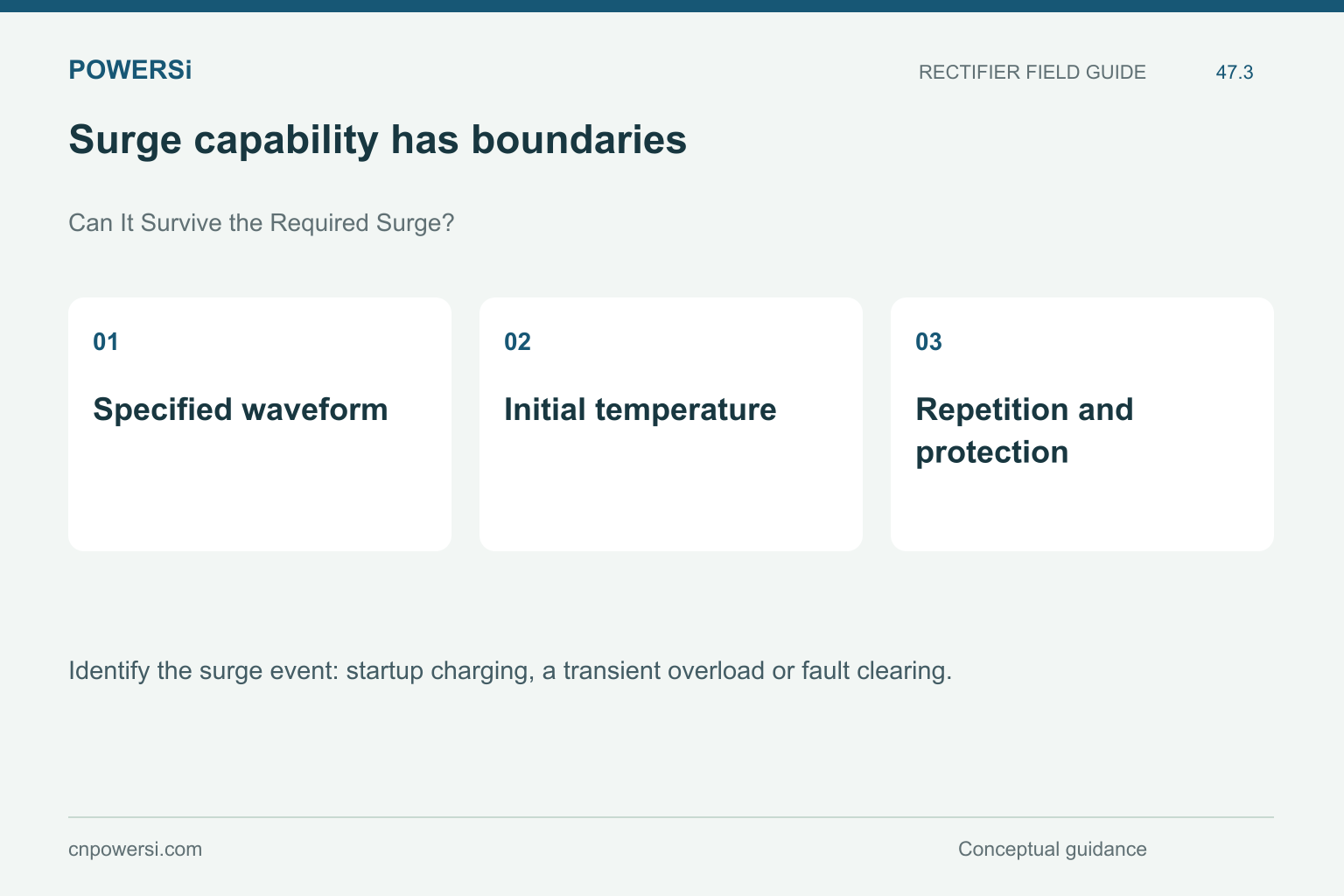
Surge capability has boundaries.
Can It Survive the Required Surge?
Identify the surge event: startup charging, a transient overload or fault clearing. Compare pulse shape, duration, initial temperature and repetition with the candidate’s stated rating. A nonrepetitive surge limit should not become a repetitive operating target.
Check how the surrounding circuit limits current and how protection responds. A device that performs well at steady load can still fail during an exceptional event. Treat changes to protection, startup timing or capacitor values as part of the validation scope.

A lifetime claim needs a mission profile.
What Does the Reliability Evidence Cover?
Request the reliability test conditions, sample population, acceptance criteria and applicable product construction. Stress-test completion does not by itself give a universal service life in years. Relating results to service requires an appropriate failure model and the actual mission profile.
Separate die-related and package-related mechanisms where the evidence allows. Temperature cycling, sustained bias and power cycling do not represent the same exposure. Do not extrapolate a report from a different package or process without a supported relationship.
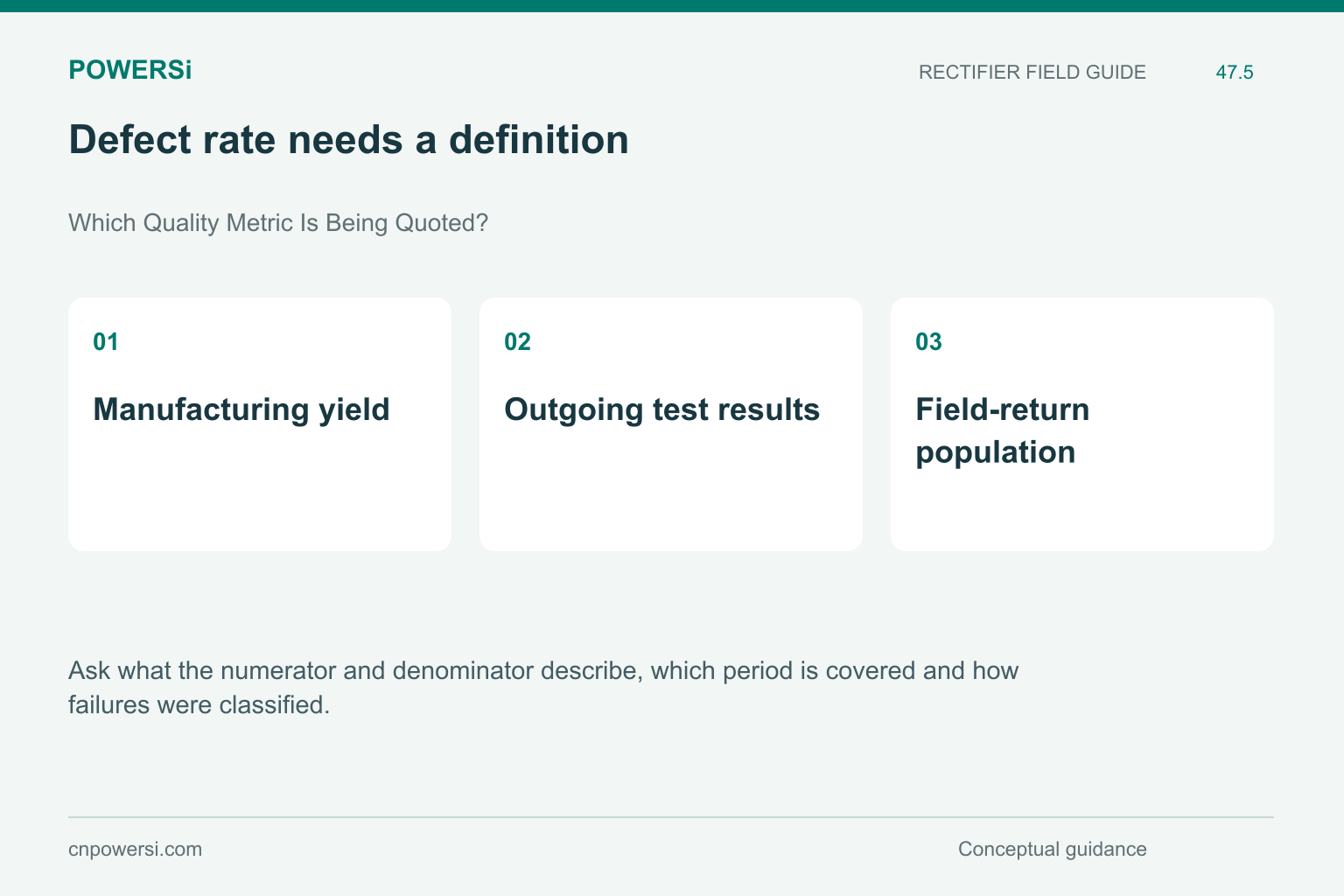
Defect rate needs a definition.
Which Quality Metric Is Being Quoted?
Ask what the numerator and denominator describe, which period is covered and how failures were classified. Wafer yield, final electrical acceptance and field returns answer different questions. None should be silently substituted for the others.
Link quality evidence to traceable product lots and investigate changes in parameter distributions. A zero-failure sample does not prove zero risk in all production. Use the evidence to set a proportionate qualification and monitoring plan rather than invent a national defect-rate comparison.
Key Takeaways
- Conduction needs an operating point.
- Surge capability has boundaries.
- Defect rate needs a definition.
Conclusion
Use five separate evidence requests instead of one broad quality question. Contact POWERSi with the intended SiC duty and exact candidate model.
FAQs
Does SiC guarantee lower total loss?
No. The result depends on conduction duty, commutation, surrounding devices and operating conditions.
Is SiC reverse current always zero?
No. Capacitive displacement current can flow during voltage transitions.
Can a surge rating be used repeatedly?
Only within an explicitly supported repetitive duty; a nonrepetitive limit is not that approval.
Does a reliability test state lifetime in years?
Not without an applicable model and mission profile.
Is final yield a field-failure rate?
No. The populations, exposure and measurement definitions differ.