Skip to content
Industrial vs Consumer Diodes: Compare the Mission Profile, Not Just the Label
Last Updated: 2026-10-07
Quick Answer
Industrial and consumer diode labels do not define one universal difference in silicon quality, temperature range or lifetime. Compare the application’s mission profile and the exact product’s qualification, traceability and change-control commitments. A suitable component must meet its electrical and environmental duties while supporting the purchasing and maintenance requirements of the finished equipment.
A diode that works during a short bench demonstration has answered only a limited question. The finished product may face long operating hours, repeated temperature changes, restricted cooling or difficult servicing. Those conditions need explicit requirements; the word “industrial” cannot supply them by itself.
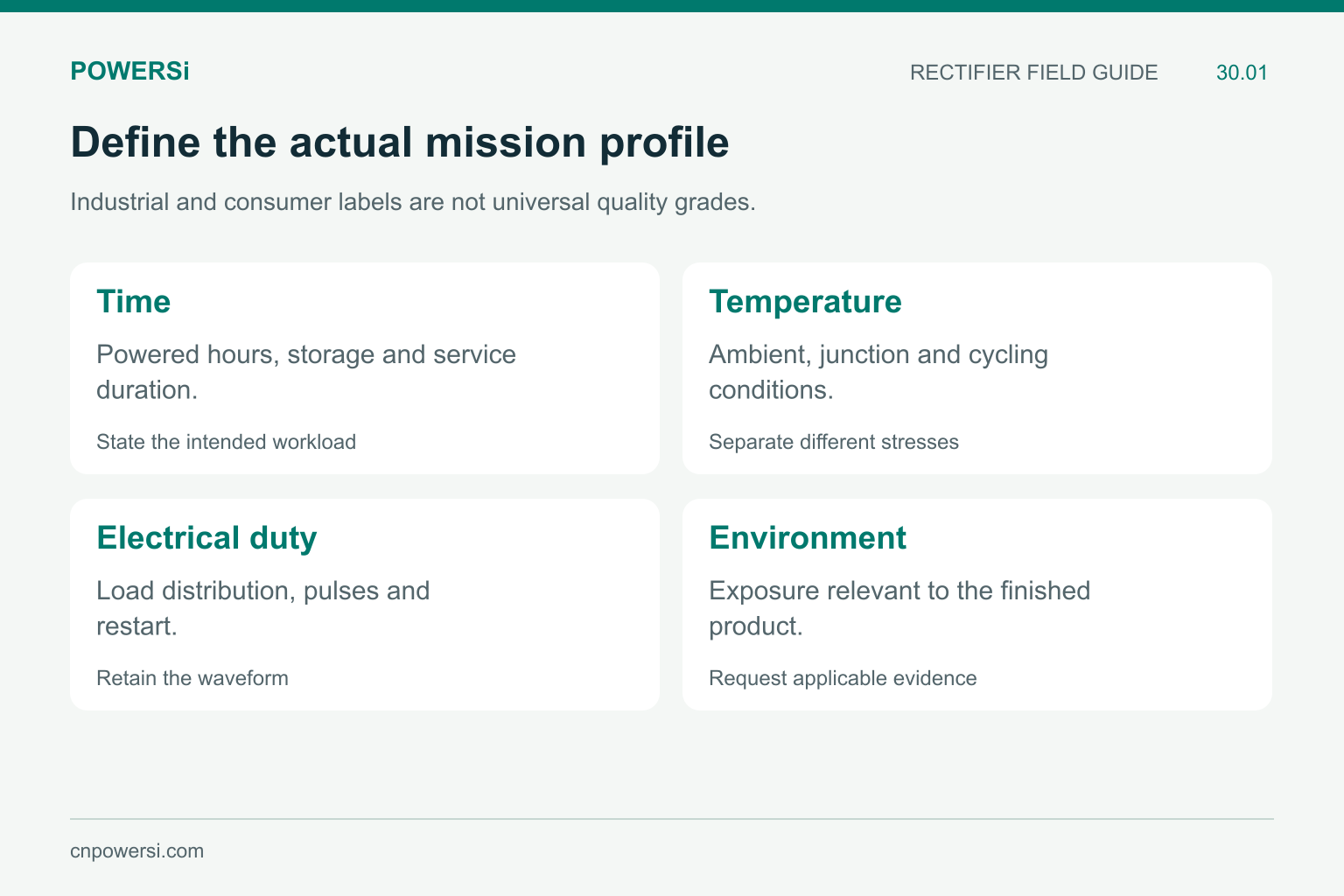
Industrial and consumer labels are not universal quality grades.
Describe the Mission Profile
A mission profile describes the electrical and environmental loads over the intended service life. Include operating hours, powered and unpowered temperatures, load distribution, startup frequency, thermal cycling and relevant environmental exposure. Nexperia discusses mission profiles in its Diode Application Handbook.
Avoid assuming that every industrial application is harsher than every consumer product. A lightly loaded control board in a stable enclosure and a compact consumer appliance beside a hot motor can present different demands. The actual workload determines the qualification question.
For example, compare a hypothetical controller operating continuously at moderate load with a product used briefly at high peak load. The controller may accumulate more powered hours, while the other product may impose more severe pulse stress per event. Neither description alone establishes which diode needs the larger current rating.
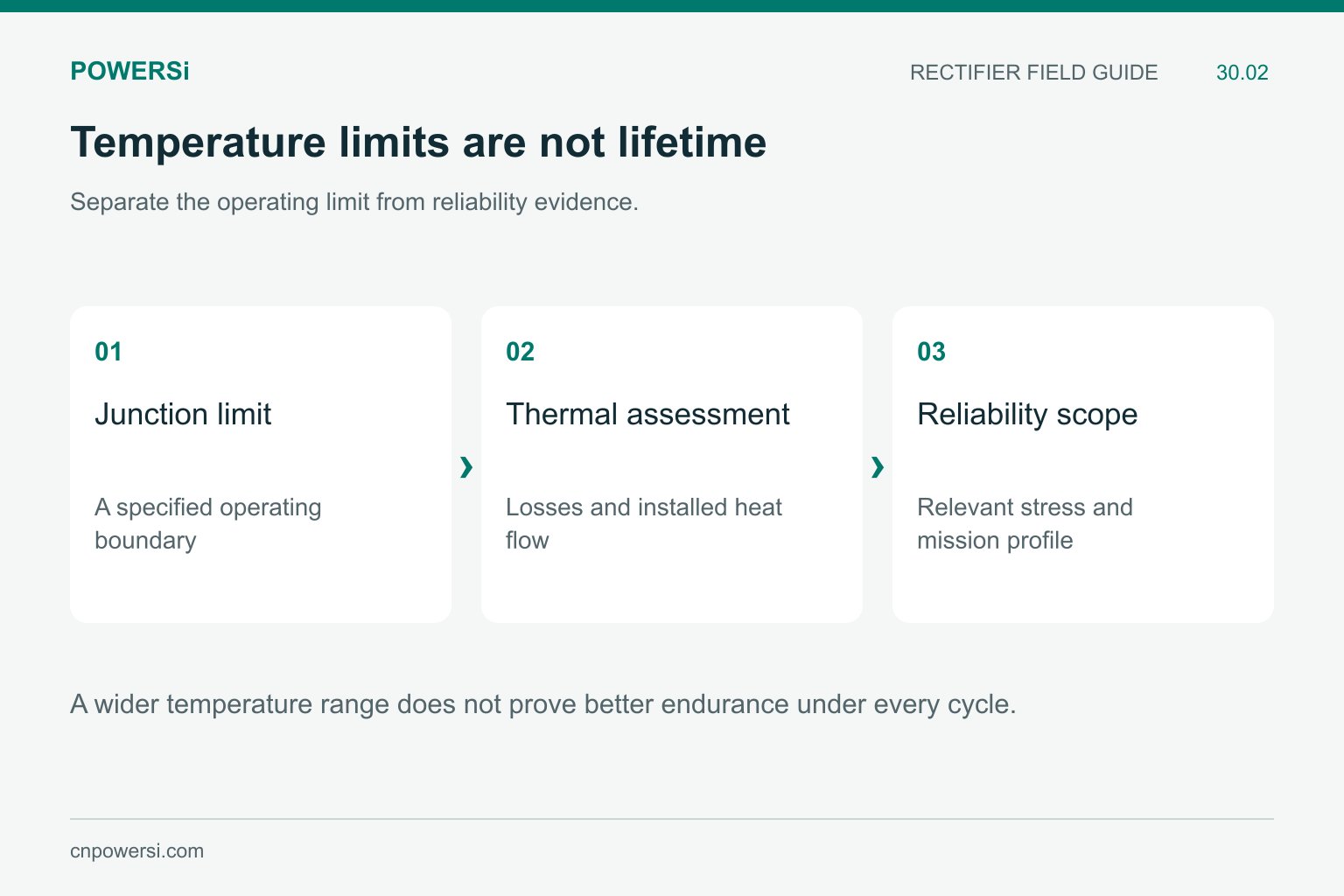
A wider temperature range does not prove better endurance under every cycle.
Separate Temperature Limits From Lifetime Evidence
A maximum junction-temperature rating is an operating limit, not a promise of a particular lifetime at that temperature. Ambient temperature is also not junction temperature. Estimate losses and heat flow before deciding whether the installed device remains within the intended margin.
Temperature cycling introduces a different question from steady hot operation. Its relevance depends on temperature swing, frequency and the affected interfaces. A wider published temperature range does not automatically demonstrate better endurance under every cycling profile.
Ask which qualification evidence applies to the exact family, construction and process. Keep the stress conditions and acceptance criteria with the result. Do not infer product qualification from a company-level quality-system certificate or treat a catalogue market category as a test report.
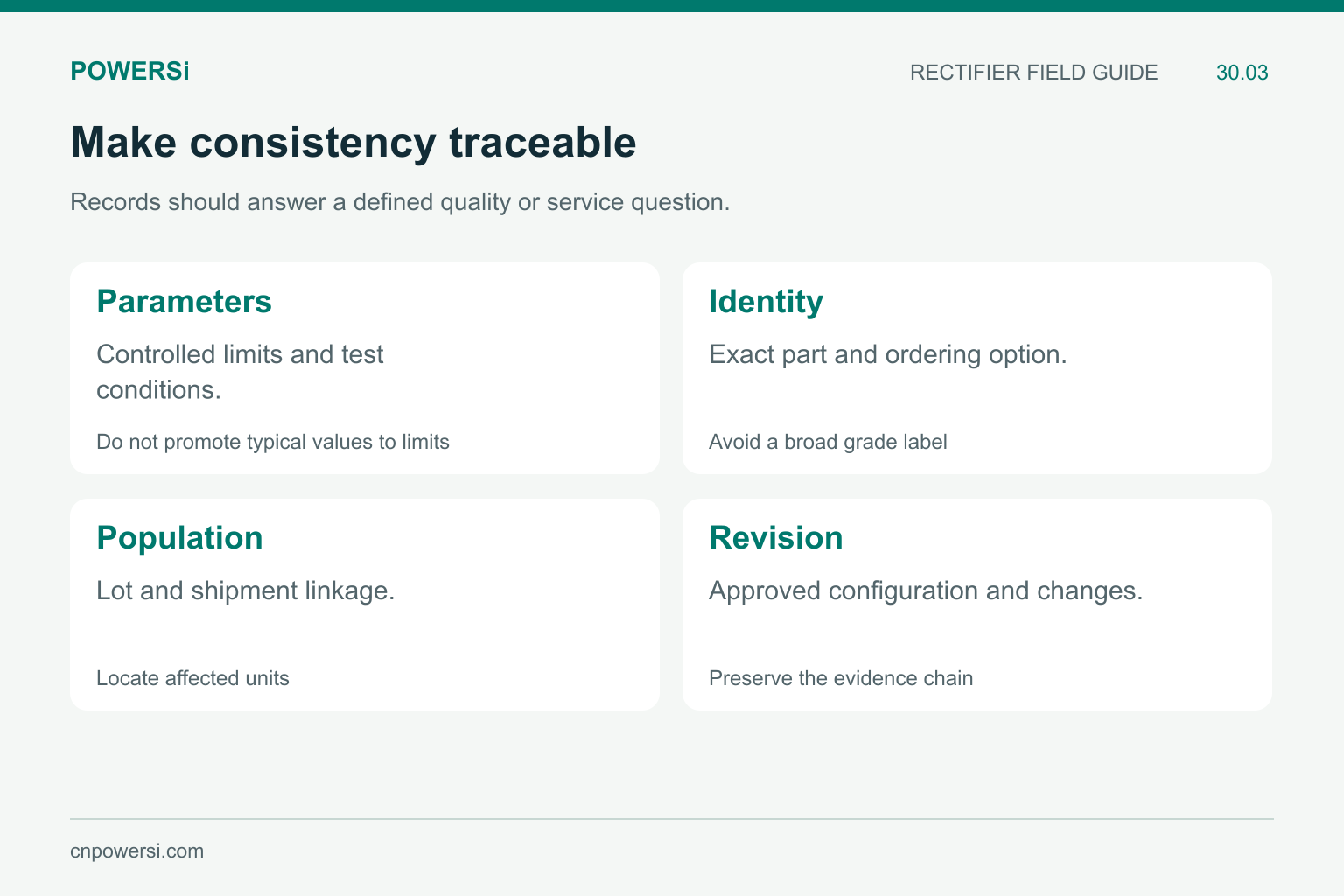
Records should answer a defined quality or service question.
Define Consistency and Traceability Requirements
Manufacturing consistency matters when a released design must behave predictably across lots. Define the parameters and limits that the application depends on, with their conditions. Typical values help explain expected behavior but should not become unannounced production acceptance limits.
Traceability requirements can include lot identification, shipment records and linkage to approved product revisions. Specify which documents must accompany delivery and which records must remain available. More paperwork does not automatically improve the component; the record must help answer an actual quality or service question.
For a field concern, a useful record connects the affected units to a defined production population and approved configuration. A vague description such as “industrial grade diode” cannot replace that identity chain.
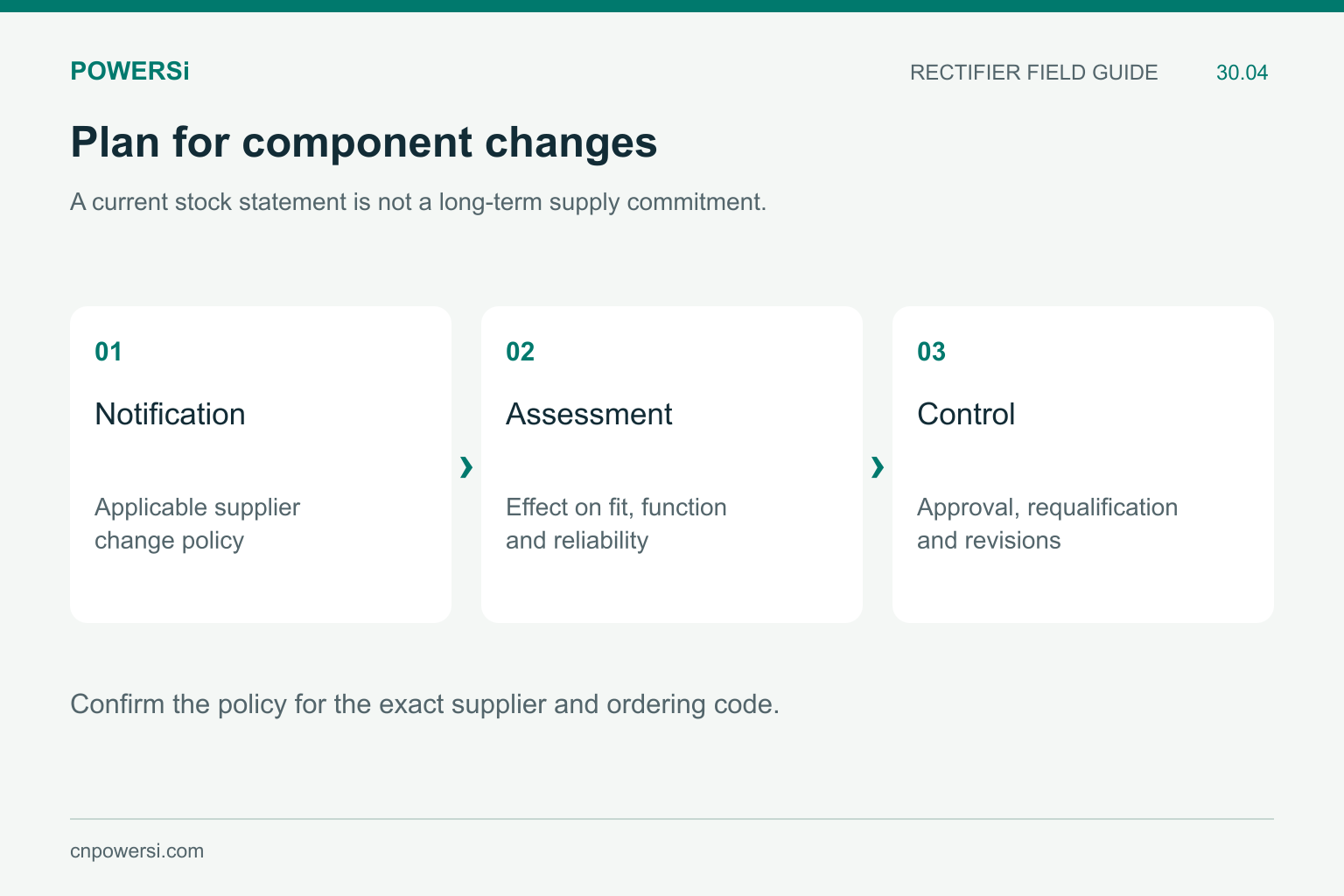
Confirm the policy for the exact supplier and ordering code.
Compare Change Control and Supply Commitments
A design expected to remain in production needs a way to assess component changes. Product change notifications can identify changes affecting fit, form, function, quality or reliability; NXP’s change-management policy provides one manufacturer’s example.
Do not transfer another supplier’s notice period or longevity policy to POWERSi. Request the commitments applicable to the exact ordering code and purchasing agreement. Distinguish a current stock statement from a long-term supply commitment, and a planned lifecycle from a contractual guarantee.
Define who evaluates a notification, what triggers requalification and how old and new revisions are controlled. An approved alternate can reduce supply exposure, but only if it has been evaluated against the same application requirements. A last-minute label-based substitution can undo earlier qualification work.
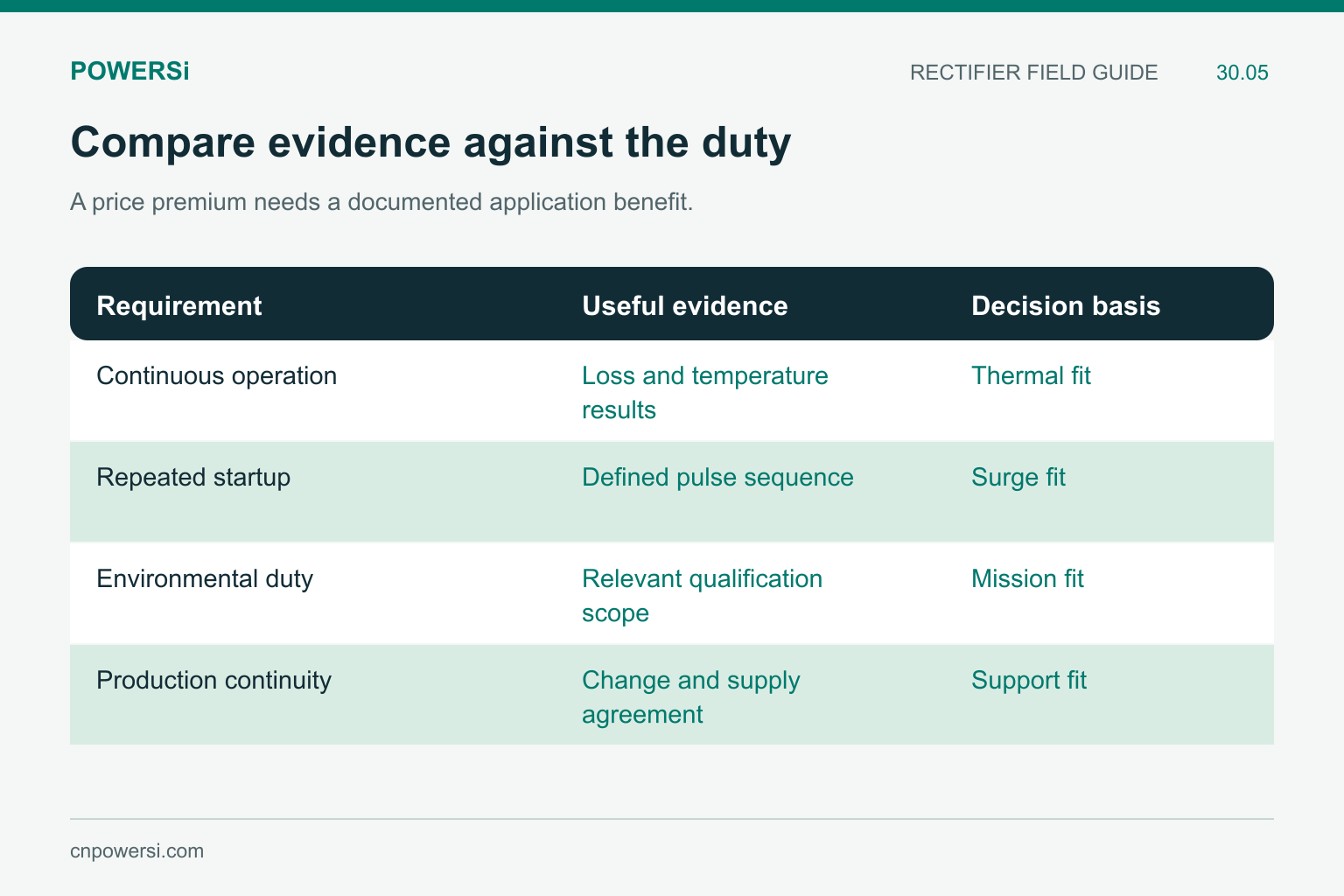
A price premium needs a documented application benefit.
Build an Application-Based Comparison
| Requirement | Evidence that makes it meaningful |
|---|---|
| Continuous duty | Loss and temperature assessment across the load range |
| Repeated startup | Defined pulse sequence and initial thermal conditions |
| Environmental exposure | Relevant qualification scope and test conditions |
| Lot consistency | Controlled parameter limits and traceability |
| Long production life | Applicable change notices and supply agreement |
Compare the complete cost of meeting these requirements. A lower component price may be offset by extra cooling, testing or a more difficult replacement process. Conversely, paying for an unsupported grade label does not create reliability evidence. Tie the premium, if any, to a documented capability or service commitment the application needs.
Key Takeaways
- Market labels are not universal technical grades.
- Use the mission profile to define the required evidence.
- Keep temperature limits separate from lifetime claims.
- Treat traceability, change control and supply commitments as explicit requirements.
Conclusion
Moving from “works on the bench” to “fits the product” requires a defined workload and a controlled component record. Share that mission profile and the required support documents with POWERSi when evaluating a rectifier for a long-running design.
FAQs
Does industrial grade always mean a wider temperature range?
No. Compare the exact published range and its conditions rather than assuming a universal label definition.
Does maximum junction temperature establish service life?
No. Lifetime assessment needs the workload, relevant failure mechanisms and supporting reliability evidence.
Can a consumer application impose demanding diode stresses?
Yes. Compact packaging, hot surroundings or repeated high-current events can create demanding conditions.
Does a quality-system certificate qualify every individual product?
No. Product-specific evidence and its scope remain separate questions.
Is current availability a long-term supply guarantee?
No. Supply duration and change-notification obligations require their own applicable commitments.