Skip to content
TO-220, TO-247 and TO-3P: Comparing Rectifier Thermal Performance
Last Updated: 2026-10-07
Quick Answer
TO-220, TO-247 and TO-3P thermal performance depends on the exact device, its losses and the installed heat path. Package size alone cannot establish a current rating or junction temperature. Compare junction-to-case resistance, interface resistance, heatsink performance and mechanical fit under the same operating conditions before choosing a rectifier package.
A larger body may offer useful mounting area, but it is not a complete thermal specification. Two devices in the same outline can have different die construction and losses. Two assemblies using the same device can also run at different temperatures because their interfaces and cooling differ.
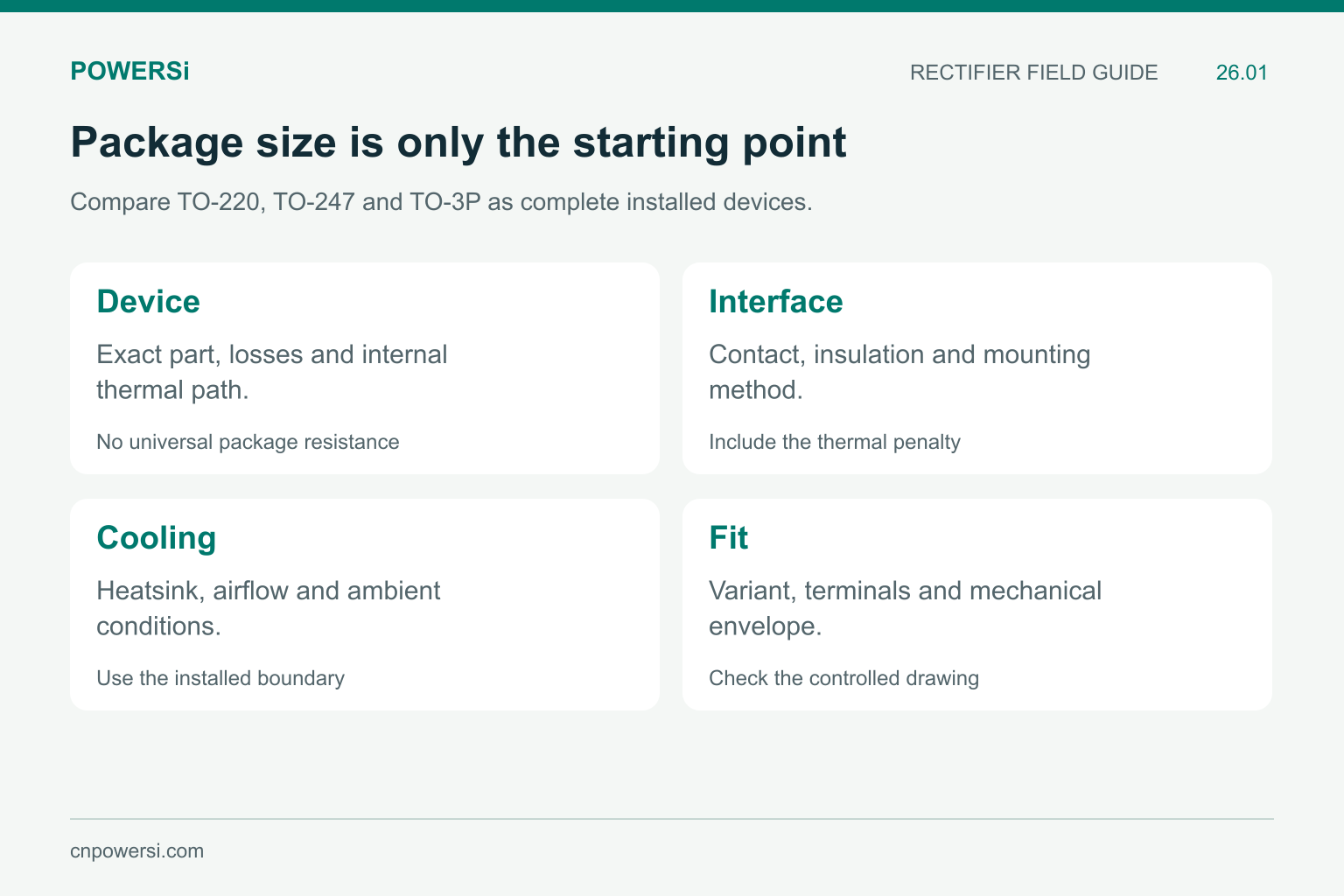
Compare TO-220, TO-247 and TO-3P as complete installed devices.
Compare the Exact Package Variants
TO-220, TO-247 and TO-3P identify package families. Lead arrangements, exposed metal, insulation and dimensions still require the exact variant drawing. Do not assume TO-247 and TO-3P are interchangeable because their bodies appear similar, or that every TO-220 shares the same thermal resistance.
| Package family | Useful starting question | Evidence needed |
|---|---|---|
| TO-220 | Does the smaller mounting envelope fit the heat budget? | Exact device thermal limits and interface |
| TO-247 | Does the larger outline improve the complete assembly? | Loss calculation, heat path and mechanical fit |
| TO-3P | Is the specific variant compatible with the mounting system? | Controlled drawing, insulation and thermal data |
Keep package geometry and electrical connection as separate checks. A matching screw hole does not prove compatible terminals, and a larger tab does not guarantee lower junction temperature.
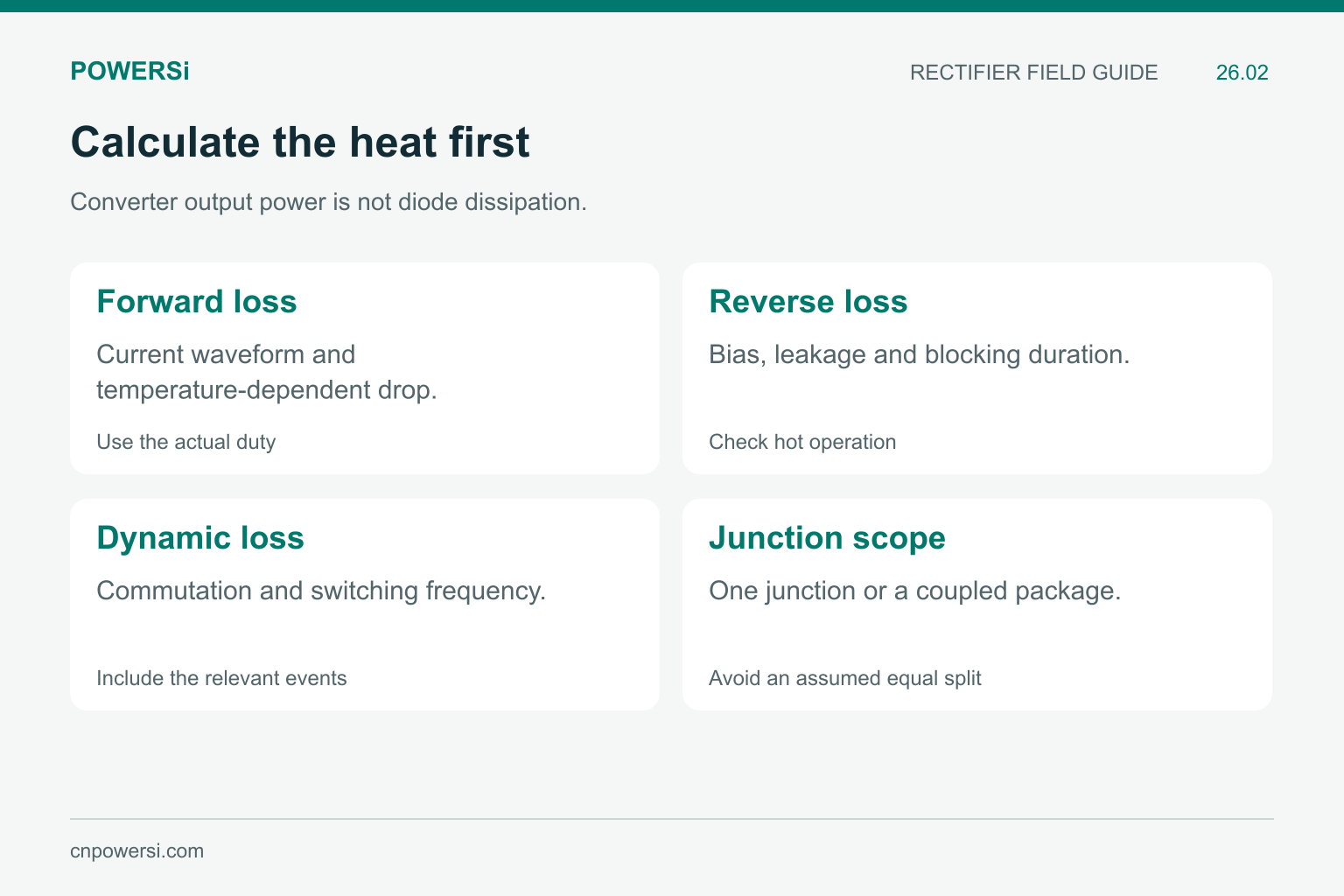
Converter output power is not diode dissipation.
Start With Device Losses
Estimate conduction, reverse-blocking and switching losses at the intended current and temperature. The heat to remove is the diode’s dissipation, not the converter’s output power. Use the same waveform and temperature assumptions for each candidate.
For a dual rectifier, establish whether thermal data describe one junction, simultaneous operation or another defined condition. Shared package heating can couple the junctions. Do not divide total loss equally unless the circuit actually produces equal dissipation, and do not apply a single-junction model blindly to the whole package.
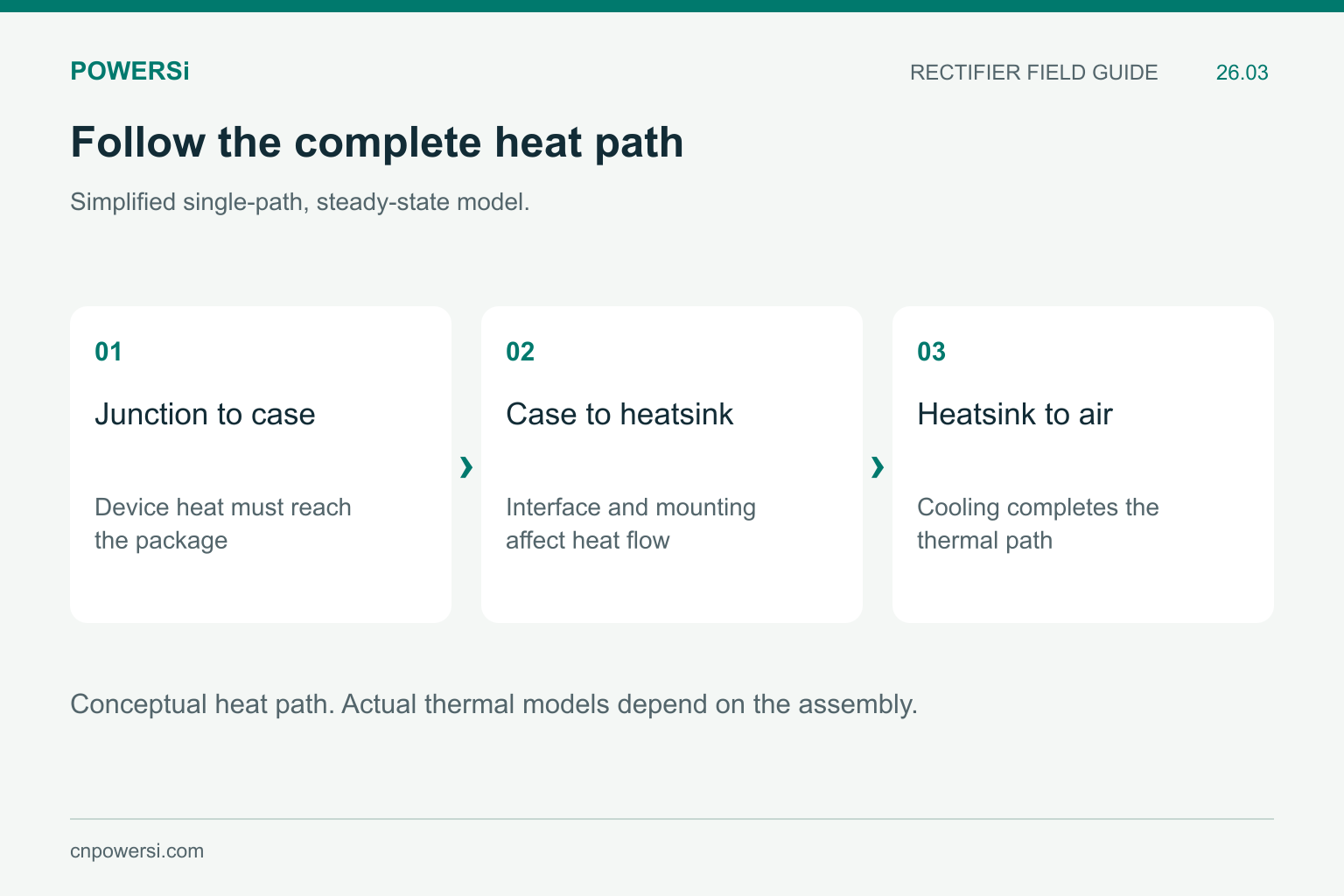
Use transient thermal behavior for short pulses and keep the temperature boundary consistent.
Follow the Heat Path
For a simplified steady-state, single-path model, junction temperature is approximately ambient temperature plus dissipation multiplied by the sum of junction-to-case, case-to-heatsink and heatsink-to-ambient resistances. This model assumes that the stated path carries the relevant heat and that its boundary conditions match the assembly.
onsemi’s power-package mounting guide discusses the influence of interface materials and mounting. Its product-specific forces and procedures are not automatic instructions for another manufacturer’s package. Use the exact device’s mechanical requirements when defining the assembly process.
If case temperature is already measured and controlled, a junction-to-case calculation starts from that case temperature. Do not add an ambient-to-case rise a second time. For short pulses, use an appropriate transient thermal model instead of treating steady-state resistance as an instantaneous response.
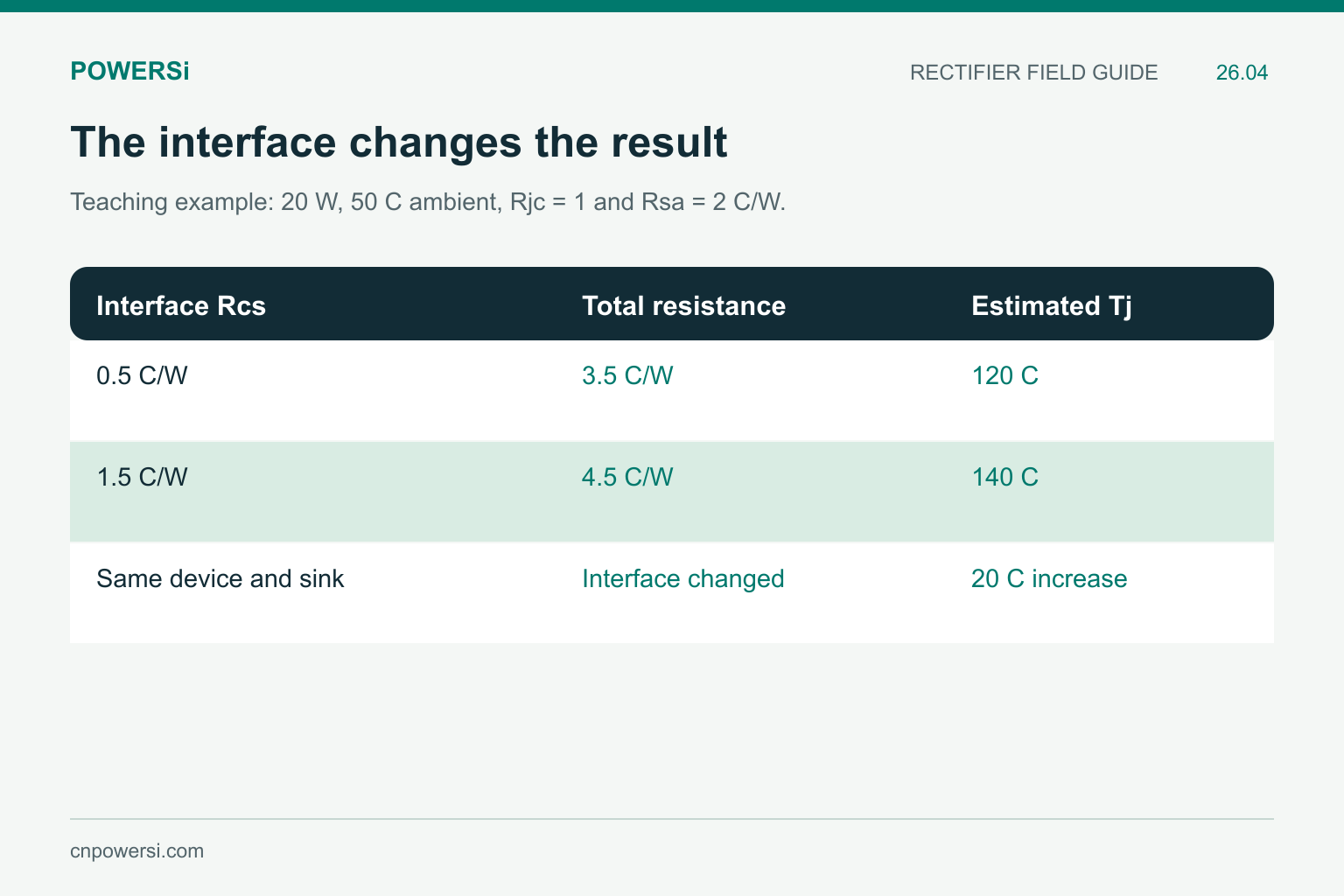
Teaching example: 20 W, 50 C ambient, Rjc = 1 and Rsa = 2 C/W.
Test the Interface Before Buying a Larger Body
Consider a hypothetical 20 W device at 50°C ambient. With 1.0°C/W junction-to-case, 0.5°C/W interface and 2.0°C/W heatsink-to-ambient, the simplified estimate is 120°C. If the interface resistance becomes 1.5°C/W, the estimate rises to 140°C with the same device and heatsink.
These values are teaching assumptions, not ratings for TO-220, TO-247, TO-3P or a POWERSi model. The example shows why an insulating pad, contact condition or mounting change can consume the expected benefit of a package change. Include electrical isolation requirements when comparing interfaces; thermal improvement cannot override the required insulation arrangement.
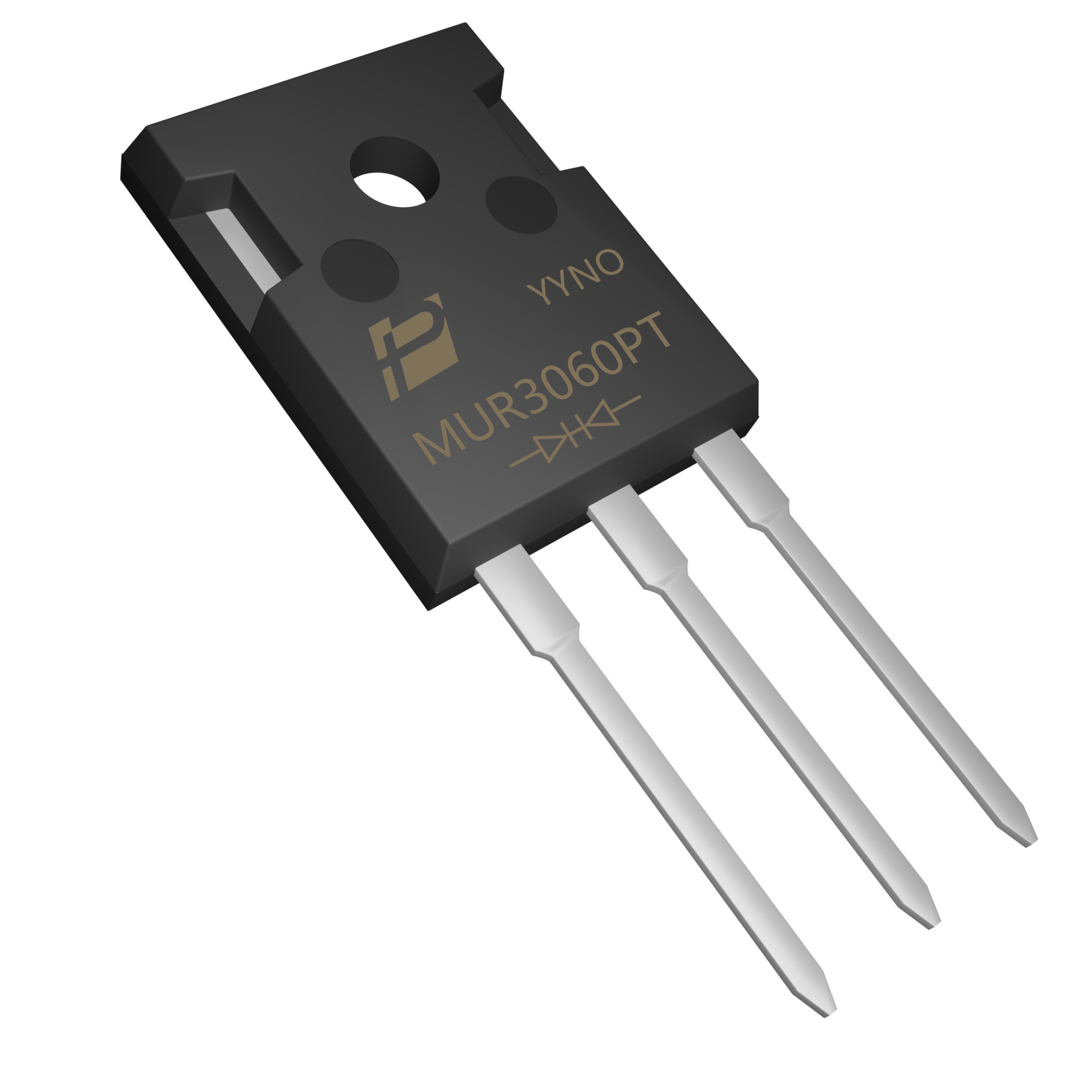
MUR3060PT original TO-247AD model image; its 1.1 C/W junction-to-case entry is device-specific.
Anchor the Package to an Exact Product
POWERSi MUR3060PT V2.0 identifies a TO-247AD package and lists junction-to-case thermal resistance of 1.1°C/W. That entry belongs to this device and its defined thermal specification. It is not a universal value for TO-247 or a direct comparison with all TO-220 and TO-3P parts.
Verify the installed case temperature and losses under the hottest relevant operation. Keep the mounting method, interface material, heatsink, airflow and terminal connection in the approval record. A package upgrade is useful only if the finished assembly meets its temperature target without introducing an unacceptable mechanical or electrical change.
Key Takeaways
- Compare exact devices, not package names alone.
- Calculate losses before selecting a heat-removal path.
- Include interface and heatsink resistance in the thermal budget.
- Preserve electrical isolation and mechanical compatibility.
Conclusion
Choose the smallest practical package that satisfies the complete electrical and thermal requirements with the intended margin. Share the loss estimate, cooling arrangement and mounting constraints when discussing POWERSi rectifier options.
FAQs
Is TO-247 always cooler than TO-220?
No. The result depends on the exact device losses, internal thermal path and installed cooling arrangement.
Are TO-247 and TO-3P mechanically interchangeable?
Not automatically. Compare the exact drawings, terminals, insulation and mounting requirements.
Can junction-to-case resistance predict temperature from ambient alone?
No. The case-to-environment heat path must also be included or the case temperature must be known.
Why can an insulating pad increase temperature?
It adds interface thermal resistance, whose effect depends on the material, thickness and mounting conditions.
Does the 1.1°C/W MUR3060PT value apply to every TO-247 device?
No. It is a device-specific entry, not a package-family guarantee.