Skip to content
TVS, Zener and Rectifier Diodes: Why Their Ratings Are Not Interchangeable
Last Updated: 2026-09-30
Quick Answer
TVS, Zener and rectifier diodes are specified for different operating duties. A rectifier normally conducts forward current and blocks reverse voltage; a Zener is characterized for controlled reverse operation, and a TVS for specified transient protection. Similar appearance or forward conduction does not establish equivalent continuous-current, pulse-energy or thermal capability.
The phrase “it is also a diode” is not a sufficient replacement argument. A protection diode and a rectifier can conduct in the same direction during a bench check while performing very different jobs in the finished circuit.
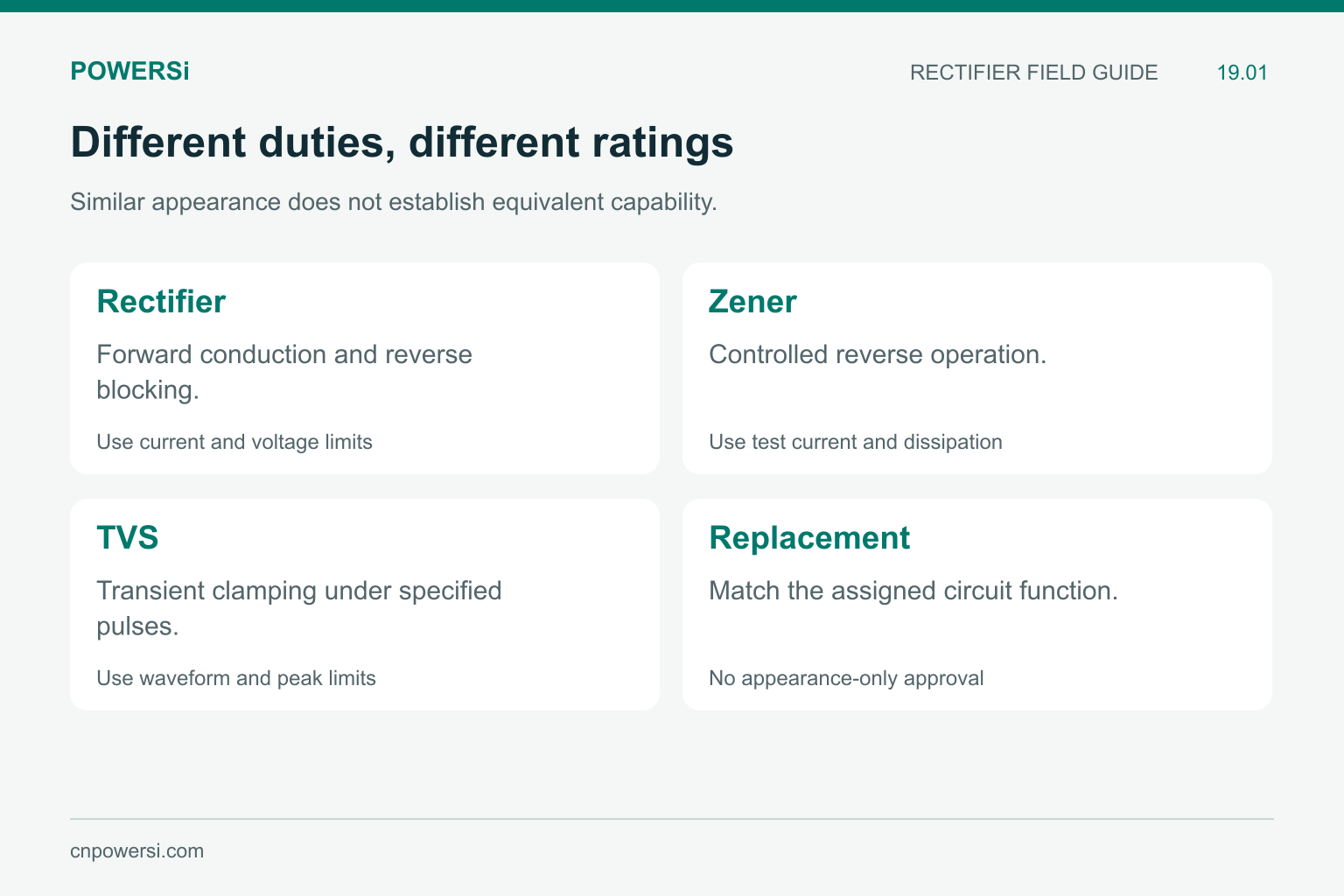
Similar appearance does not establish equivalent capability.
Start With the Intended Operating Region
A rectifier’s normal reverse-blocking interval is intended to remain within its specified reverse limits. A Zener used for regulation operates in a defined reverse-breakdown region with current limiting. A TVS usually remains at low leakage during normal operation and conducts strongly during a transient that reaches its protection region.
This is a functional comparison, not an assertion that no device can serve more than one purpose. A unidirectional TVS or a Zener can conduct forward current. Using that behavior in another role still requires adequate forward-current, thermal and dynamic specifications. A bidirectional TVS has a different polarity characteristic and cannot be treated as a single ordinary rectifier junction.
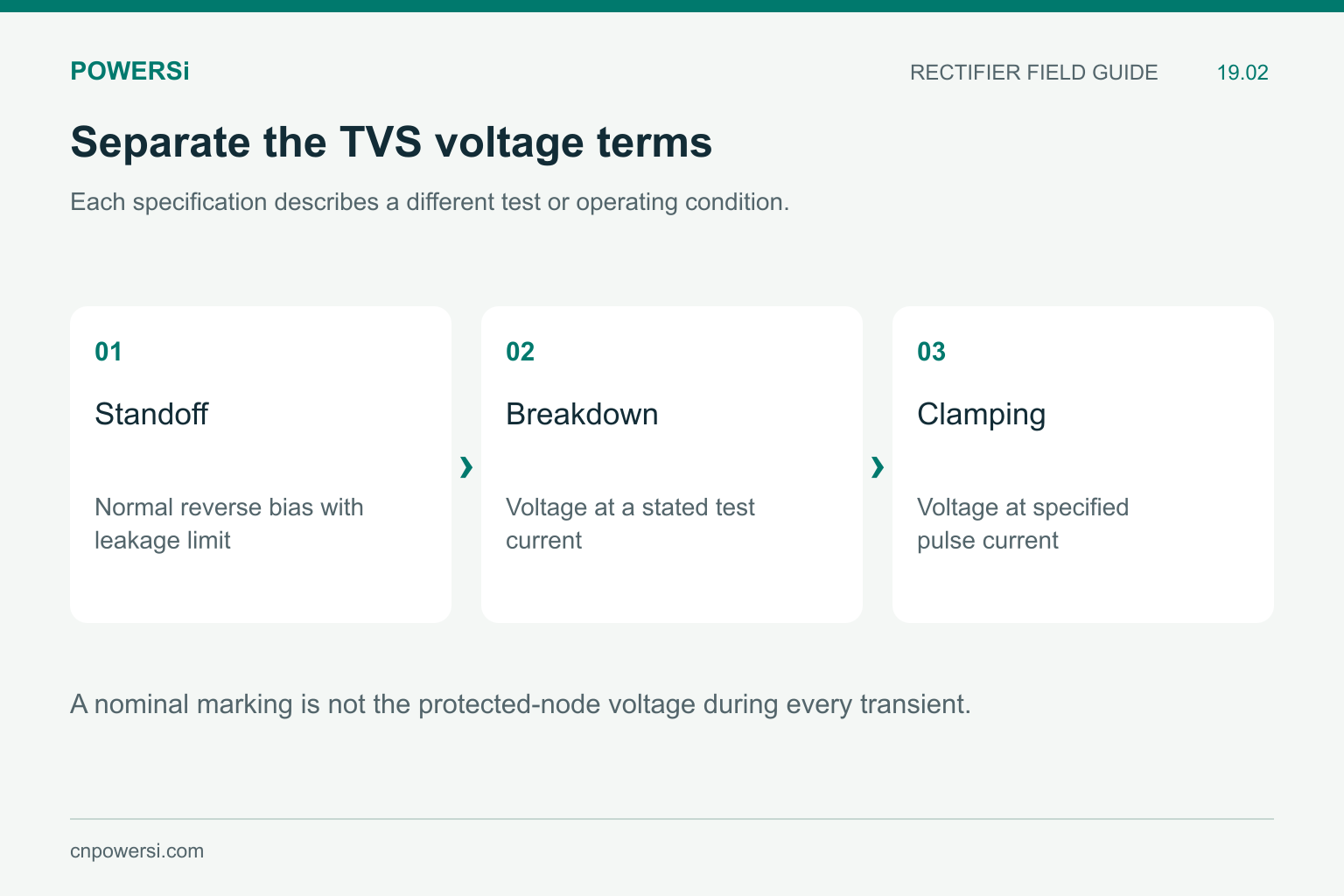
A nominal marking is not the protected-node voltage during every transient.
Keep the Three TVS Voltages Separate
Working standoff voltage defines a normal reverse-bias condition with a leakage specification. Breakdown voltage is measured at a stated test current. Clamping voltage corresponds to a specified pulse current and waveform. These are not three names for the same operating voltage.
Vishay’s TVS application note explains the distinction between low-current breakdown measurement and clamping at peak pulse current. Choose protection using the maximum normal voltage and the protected circuit’s tolerance under the actual transient, including interconnect effects.
A TVS marked with a particular nominal voltage does not hold every transient at precisely that voltage. Current, temperature, waveform and wiring inductance affect the voltage the protected node sees. A device can survive the pulse while the downstream circuit still experiences excessive voltage.
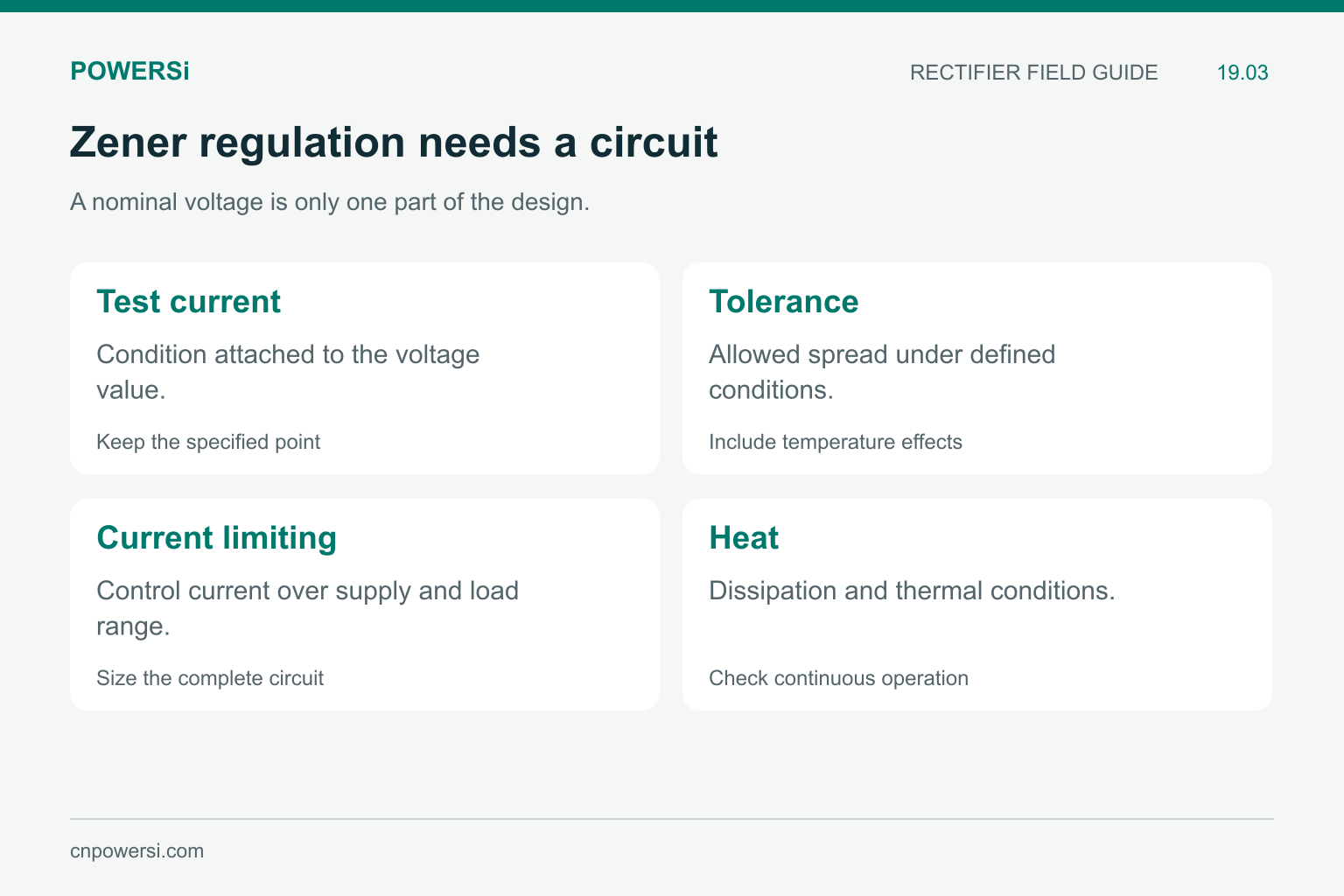
A nominal voltage is only one part of the design.
Understand What a Zener Rating Describes
A Zener voltage is specified at a stated test current and temperature condition, with tolerance and dynamic behavior. The regulator circuit must limit current and keep dissipation within the applicable thermal conditions. A nominal voltage alone does not determine an acceptable series resistor or load range.
For example, the Vishay 1N4728A–1N4761A family provides voltage-regulation characteristics and test conditions. Such entries serve a different purpose from a power rectifier’s average forward-current rating. Device selection should follow the intended operating region and load, not the similarity of the axial package.
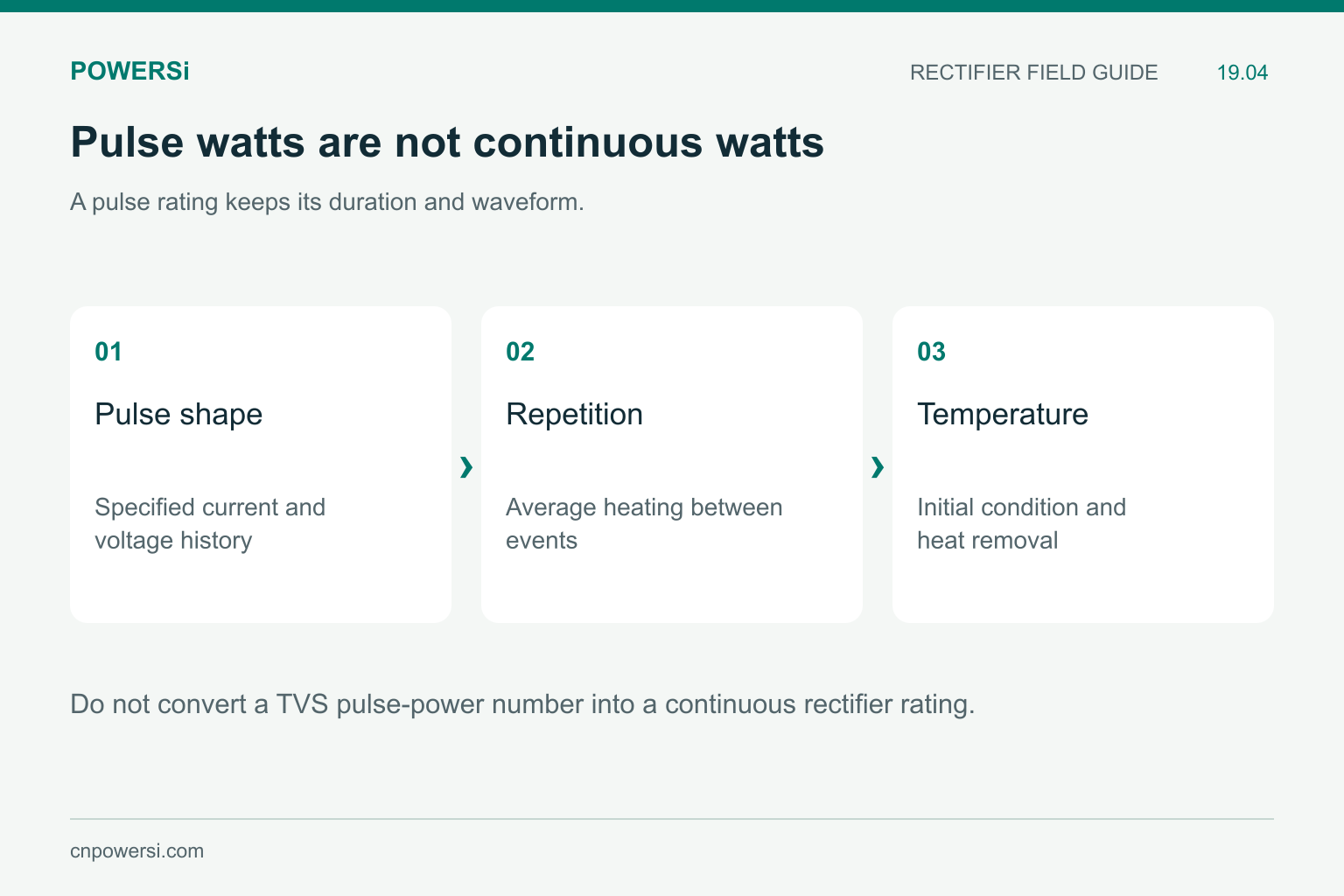
Do not convert a TVS pulse-power number into a continuous rectifier rating.
Do Not Convert Pulse Watts Into Continuous Amperes
A TVS peak pulse-power rating applies to a specified pulse shape, duration and temperature condition. Dividing that number by a voltage does not produce a continuous rectifier-current rating. Repeated pulses can also impose average heating that a single-pulse comparison misses.
Similarly, a rectifier’s surge-current rating does not establish that it can clamp arbitrary reverse transients. Ordinary rectifier blocking capability and specified avalanche-energy capability are separate questions. Confirm any intended reverse-energy operation explicitly rather than inferring it from a large forward-surge number.
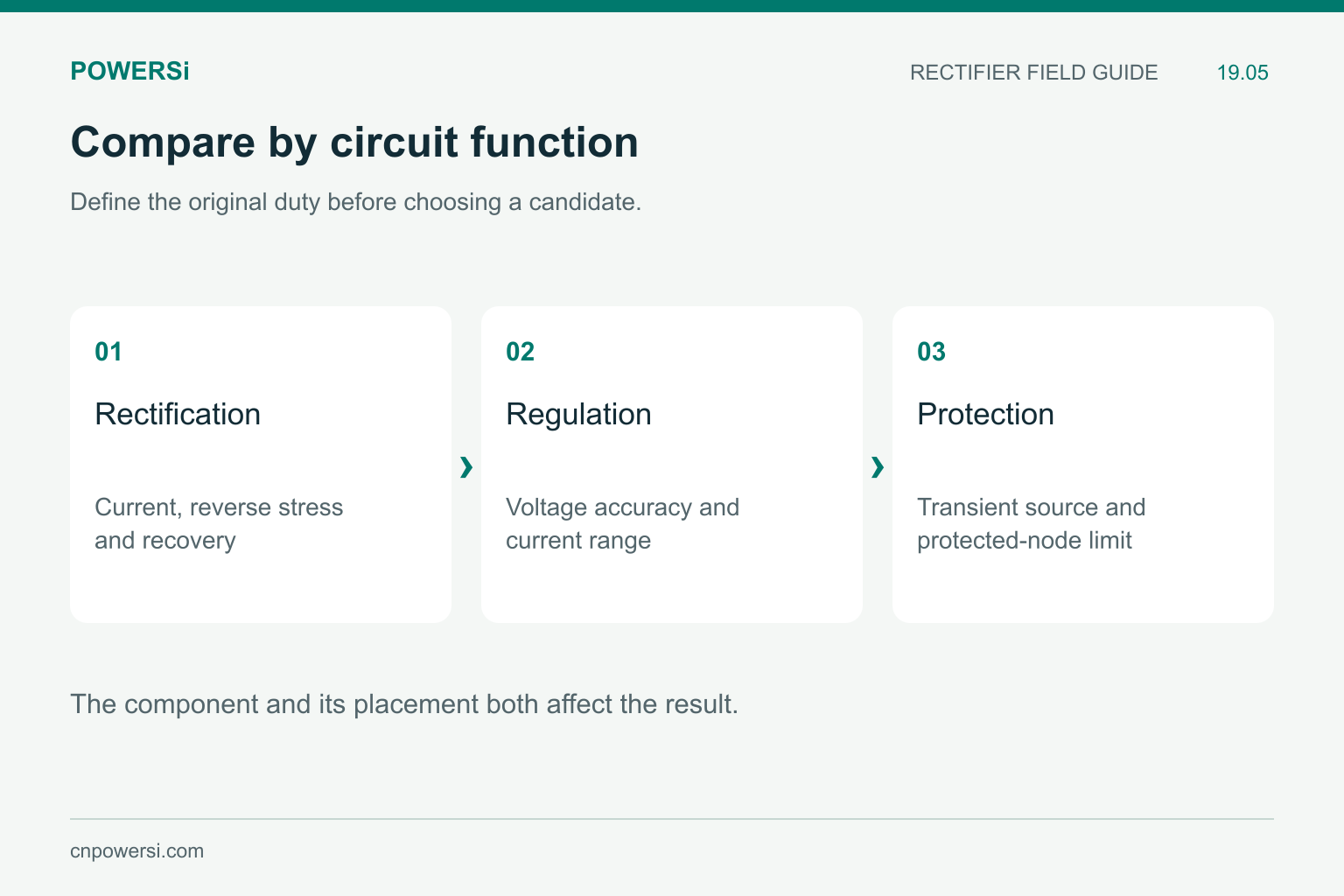
The component and its placement both affect the result.
Evaluate a Replacement by Function
For a rectifier, define forward waveform, reverse stress, recovery and cooling. For a regulator, define supply tolerance, required current range, voltage accuracy and dissipation. For a transient suppressor, define the normal operating voltage, transient source, pulse waveform and acceptable protected-node voltage.
Then compare exact candidate limits. Include polarity, package orientation and placement. A technically appropriate protection element with long connecting traces can behave differently from the same element mounted close to the protected node. The component and its circuit implementation must be considered together.
Key Takeaways
- Shared diode behavior does not establish interchangeable ratings.
- TVS standoff, breakdown and clamping voltages answer different questions.
- Peak pulse power is not continuous rectifier capability.
- Approve a substitution against the original circuit function.
Conclusion
Choose the device around its assigned job. When discussing POWERSi rectifiers, identify whether the component must carry current, block voltage or absorb a transient. That distinction keeps a superficially similar part from becoming an unsuitable substitute.
FAQs
Can a Zener conduct forward current?
Yes, but that alone does not establish a suitable continuous-current or thermal rating for a rectifier application.
Are TVS breakdown and clamping voltages equal?
Not generally. They are specified at different currents and conditions.
Can pulse-power watts be treated as continuous power?
No. Pulse duration, waveform, repetition and temperature conditions are essential to the rating.
Is every TVS unidirectional?
No. Unidirectional and bidirectional types have different polarity behavior and must be selected accordingly.
Can a rectifier automatically replace an overvoltage clamp?
No. Reverse blocking does not by itself establish a controlled clamping characteristic or energy-absorption capability.