Skip to content
Chinese SiC Schottky Alternatives: Separate Discrete Diodes From Automotive Modules
Last Updated: 2026-10-08
Quick Answer
A Chinese SiC Schottky diode can be evaluated as an alternative to a specified discrete diode, but it is not automatically a replacement for a Wolfspeed or Infineon automotive power module. Compare function and integration level first, then electrical behavior, mechanical interfaces, thermal design and qualification evidence for the exact candidate.
“Can it replace an imported SiC product?” is too broad to answer from material alone. SiC appears in diodes, MOSFETs, bare die and power modules. A shared semiconductor material does not establish a shared circuit function, terminal arrangement or qualification scope.
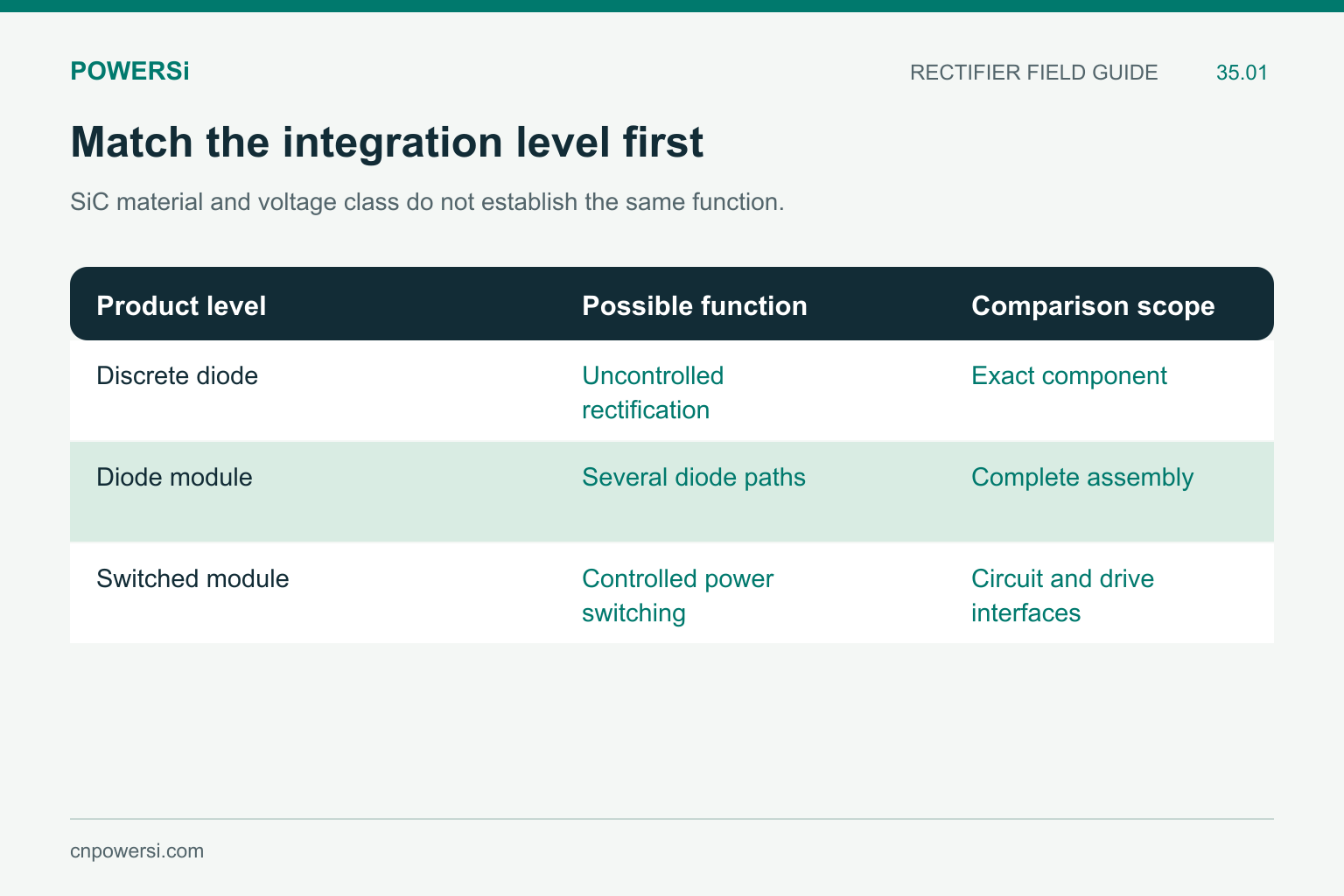
SiC material and voltage class do not establish the same function.
Identify What Is Being Replaced
Start with the original complete ordering code and internal circuit. Is it a single Schottky diode, a diode module, a half-bridge containing controlled switches, or another configuration? Determine whether the task is a part substitution on an existing assembly or a redesign of the power stage.
Wolfspeed’s power-module portfolio includes integrated module configurations and package families. Infineon’s module portfolio also spans different functions and integration levels. The manufacturer’s name and voltage class alone do not identify an equivalent module.
A discrete diode cannot perform the controlled switching function of a MOSFET. Likewise, several separate components do not become a module equivalent merely by matching a simplified schematic. Interconnections, insulation, thermal coupling and mechanical construction remain part of the comparison.
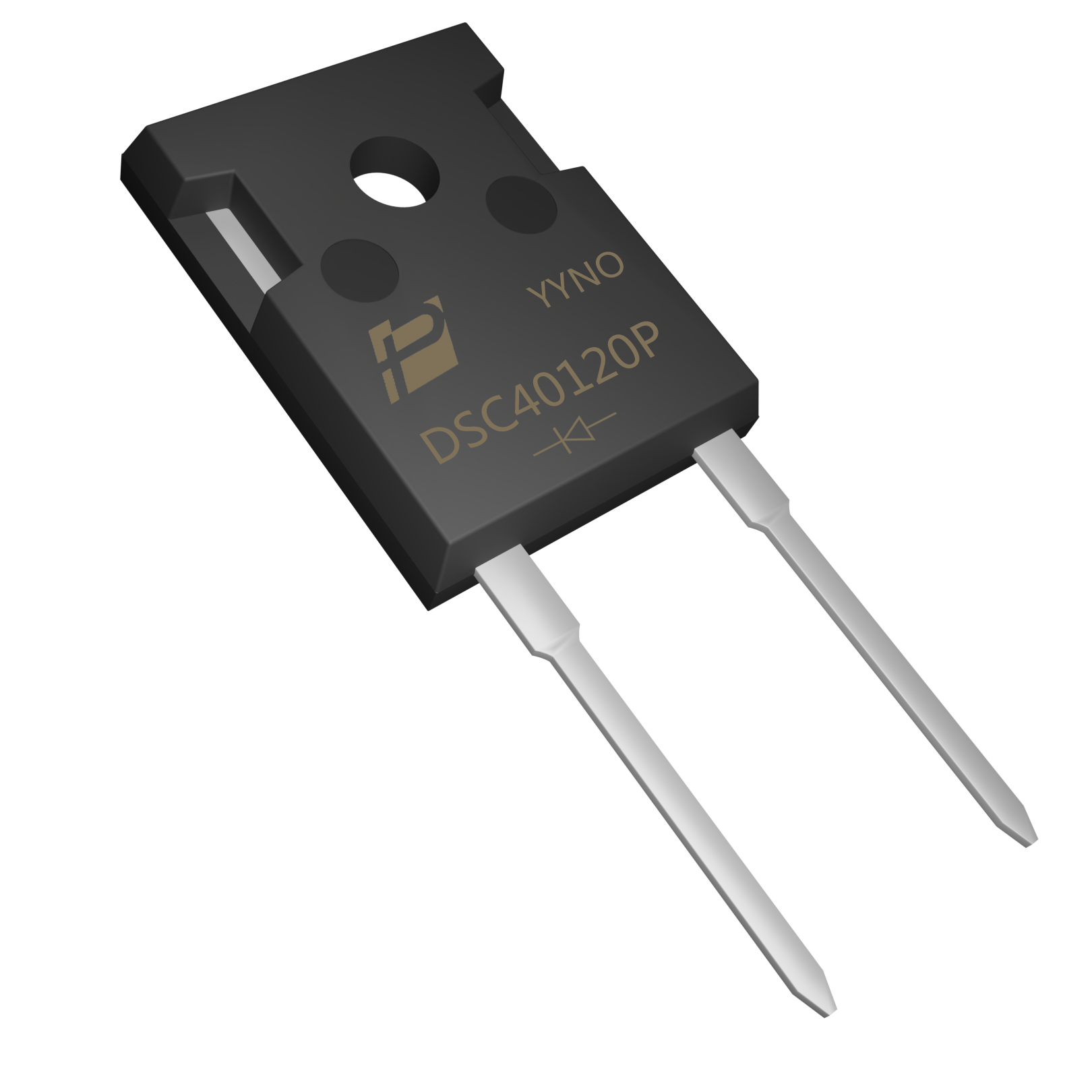
DSC40120P original two-lead TO-247AC SiC Schottky image; discrete parameters do not establish automotive module qualification.
What a Real Discrete SiC Example Establishes
POWERSi DSC40120P is a 1200 V SiC Schottky diode in a two-lead TO-247AC package. At IF = 40 A, its table lists typical forward voltage of 1.40 V at Tj = 25°C and 2.15 V at Tj = 175°C, with respective maxima of 1.53 V and 2.36 V.
These entries establish specific characteristics of this discrete device. They do not establish an automotive qualification, a module-level thermal capability or drop-in equivalence to an unnamed imported product. The 40 A forward-voltage test point is also not an ambient-air continuous-current guarantee.
The existence of a documented Chinese discrete option is useful evidence of product availability in a technical catalogue. It is not a measure of the entire industry’s progress, current stock or suitability for every automotive application.
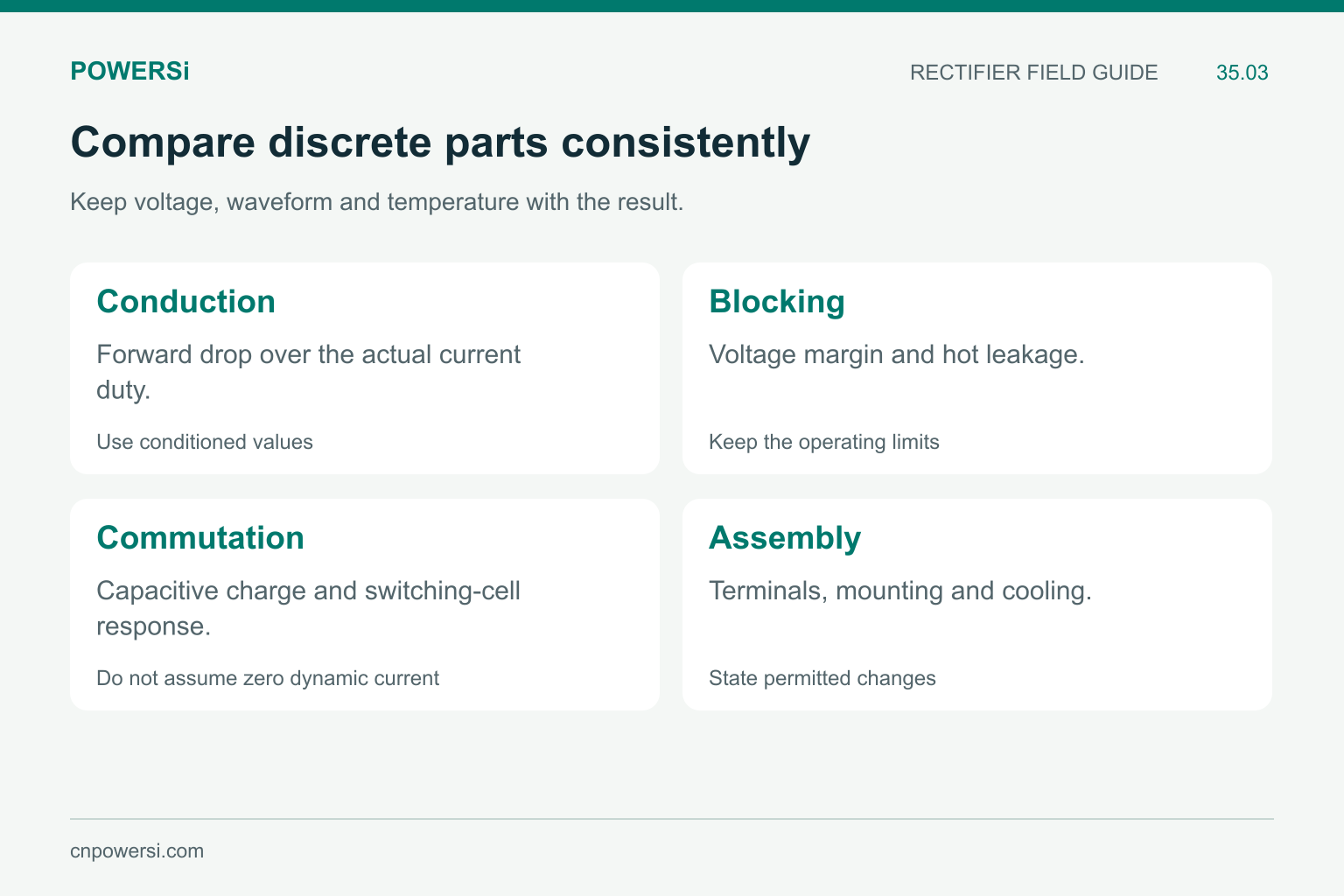
Keep voltage, waveform and temperature with the result.
Compare Discrete Candidates on the Same Basis
For a discrete-to-discrete comparison, match the original circuit role, voltage margin, current waveform and temperature. Compare conduction loss, reverse leakage and capacitive charge under relevant conditions. SiC Schottky operation does not remove junction-capacitance current during voltage transitions.
Keep the exact package variant, terminal connection, mounting requirements and cooling boundary. A candidate with acceptable electrical characteristics can still require a board or heatsink change. State whether those changes are permitted before calling it a replacement.
Test the candidate in the intended switching cell when dynamic behavior matters. Include the active switch’s response and total losses rather than judging only the diode’s headline parameters.
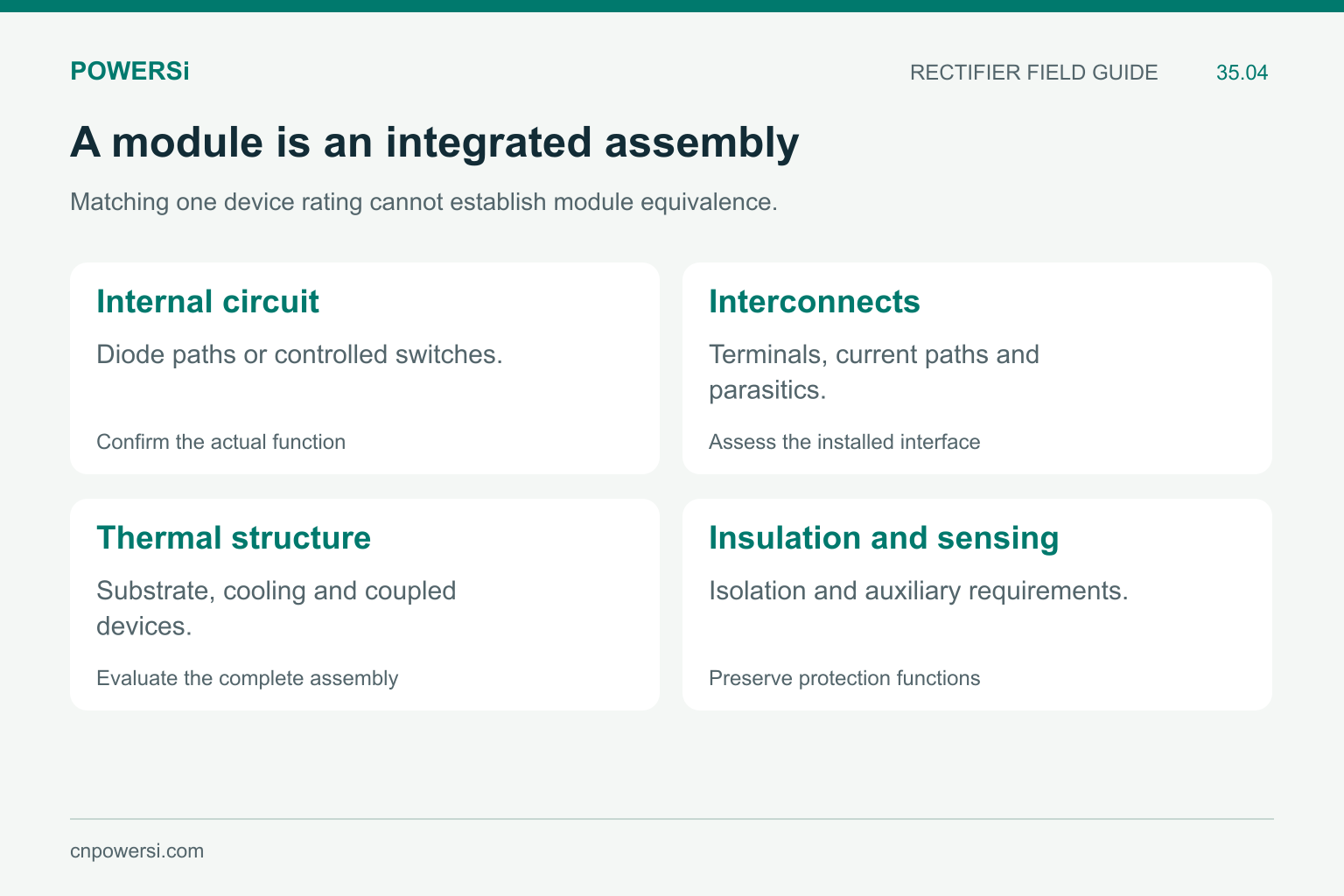
Matching one device rating cannot establish module equivalence.
Evaluate a Module as an Assembly
| Module-level item | Why a discrete rating is insufficient |
|---|---|
| Internal circuit | May include several controlled switches or diode paths |
| Terminals and interconnects | Determine current paths, parasitics and installation |
| Insulation system | Establishes electrical separation within a defined assembly |
| Thermal structure | Couples devices to a substrate, baseplate or cooling interface |
| Sensors and auxiliary connections | May be required by protection and control functions |
For a diode-only module, compare its actual junction arrangement and current distribution. For a switched module, include drive and protection requirements. In both cases, the replacement decision belongs to the complete assembly and its operating conditions.
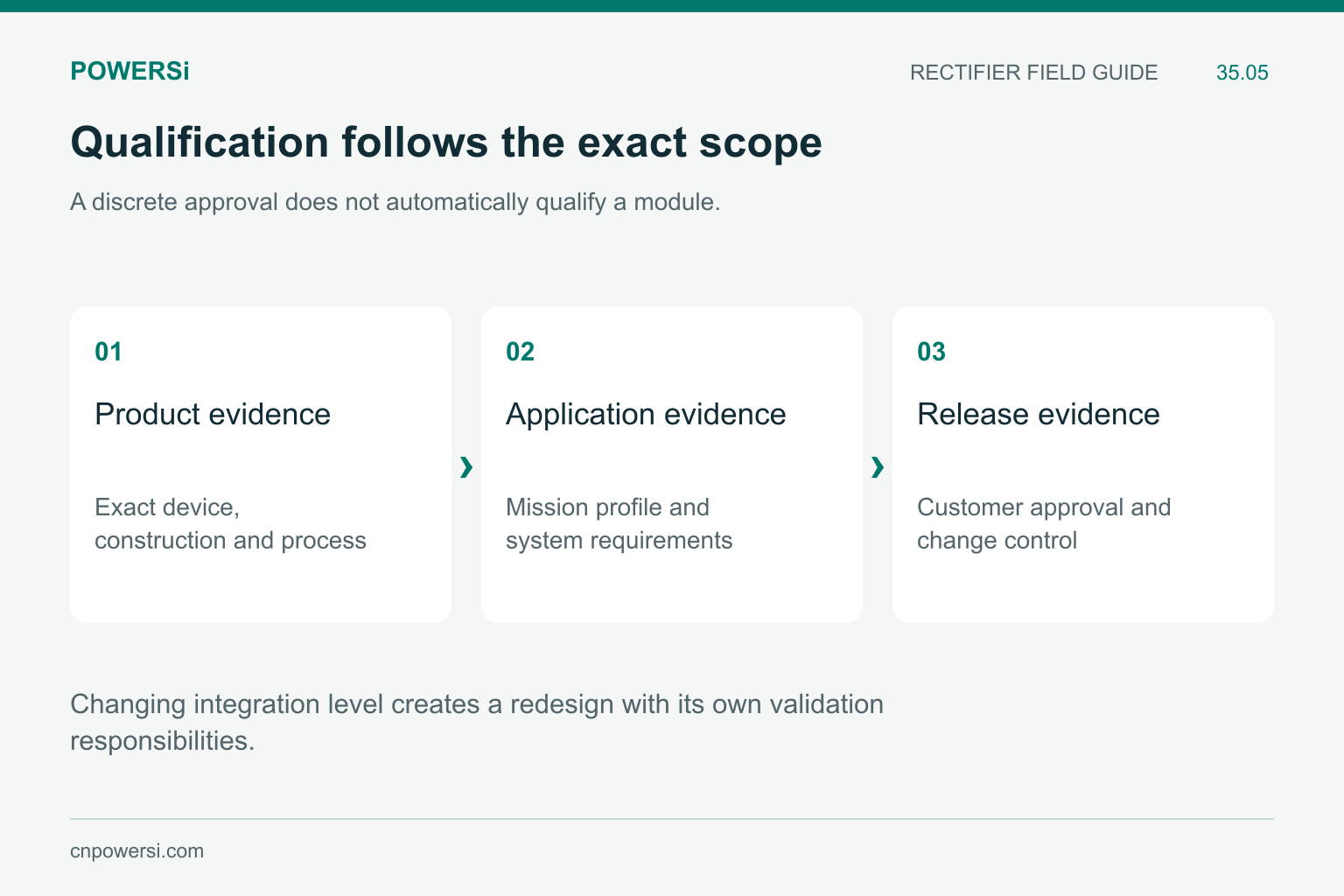
Changing integration level creates a redesign with its own validation responsibilities.
Keep Automotive Qualification at the Correct Level
Request qualification evidence tied to the exact device or module, its construction and applicable manufacturing scope. A discrete-component qualification does not automatically qualify a module built with that component, and qualification of a similar family does not automatically transfer to another part.
Include the customer’s mission profile, change-control requirements and approval process. Temperature limits or a general quality-system certificate cannot substitute for the requested product evidence. Do not describe DSC40120P as automotive-qualified without model-specific supporting documentation.
If the proposed solution changes integration level, treat the work as a redesign with defined validation responsibilities. That can still be a legitimate sourcing strategy, but its engineering effort and schedule should be visible.
Key Takeaways
- Compare the exact function and integration level before the brand.
- A discrete diode cannot replace a controlled-switch module by rating alone.
- Device characteristics and automotive qualification are separate evidence.
- A change from module to discrete construction requires assembly-level validation.
Conclusion
An actionable SiC inquiry identifies the original device or module and the allowed redesign scope. Share those details when evaluating POWERSi SiC rectifiers so that the candidate is compared at the correct level.
FAQs
Can a SiC diode replace a SiC MOSFET?
No. A diode does not provide the MOSFET’s controlled switching function.
Does matching 1200 V establish module equivalence?
No. Circuit configuration, current duty, interfaces, insulation and thermal behavior still need comparison.
Does a high junction-temperature limit prove automotive qualification?
No. Automotive qualification requires evidence with the appropriate product and process scope.
Is every SiC power module a diode module?
No. Modules can contain controlled switches and different internal circuit configurations.
Can discrete components be used in a redesigned power stage?
Potentially, but the new assembly needs its own electrical, thermal, mechanical and qualification assessment.