Skip to content
Chinese Rectifier Alternatives: How to Build an Evidence-Based Equivalence Matrix
Last Updated: 2026-10-08
Quick Answer
Chinese rectifier alternatives should be approved against a defined original part and application, not a blanket claim of complete interchangeability. Build an equivalence matrix that separates matched specifications, unresolved differences and circuit-test results. A candidate becomes an approved alternate only within the mechanical, electrical, thermal and quality scope actually evaluated.
An online cross-reference is a useful search result. It is not evidence that every operating condition, lead option or production requirement is identical. Country of manufacture does not establish equivalence in either direction; the exact device and the installation decide whether the change works.
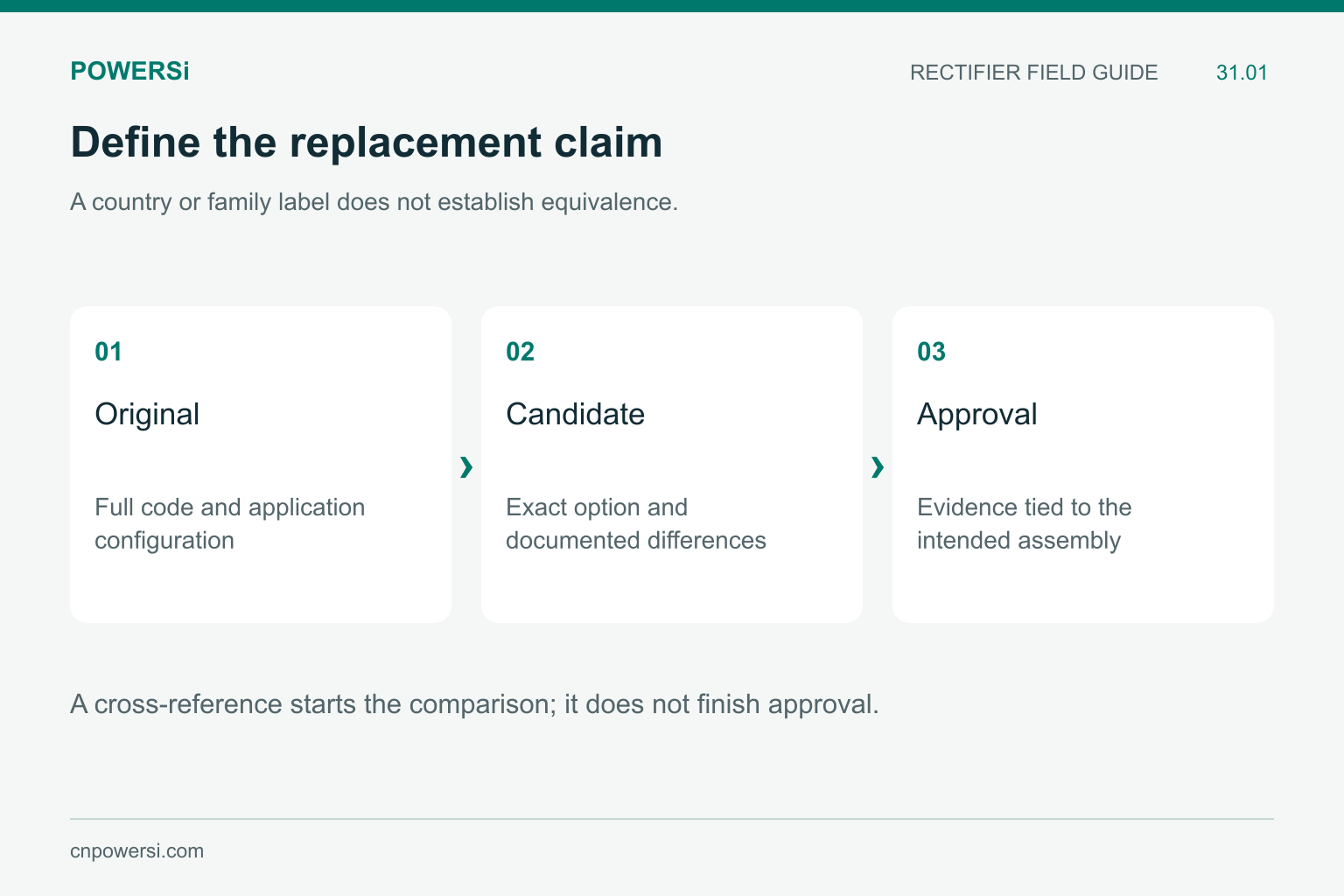
A cross-reference starts the comparison; it does not finish approval.
Define What Equivalence Must Cover
Start with the original manufacturer, complete ordering code, specification revision and circuit position. State whether the change must fit the existing board and heatsink or whether a redesign is allowed. Those are different substitution projects with different acceptance boundaries.
Separate three outcomes: a search candidate, an engineering-qualified alternate and a released purchasing option. Keep them visible in the comparison record. A device may satisfy the voltage requirement while still lacking evidence for recovery behavior or a required mechanical option.
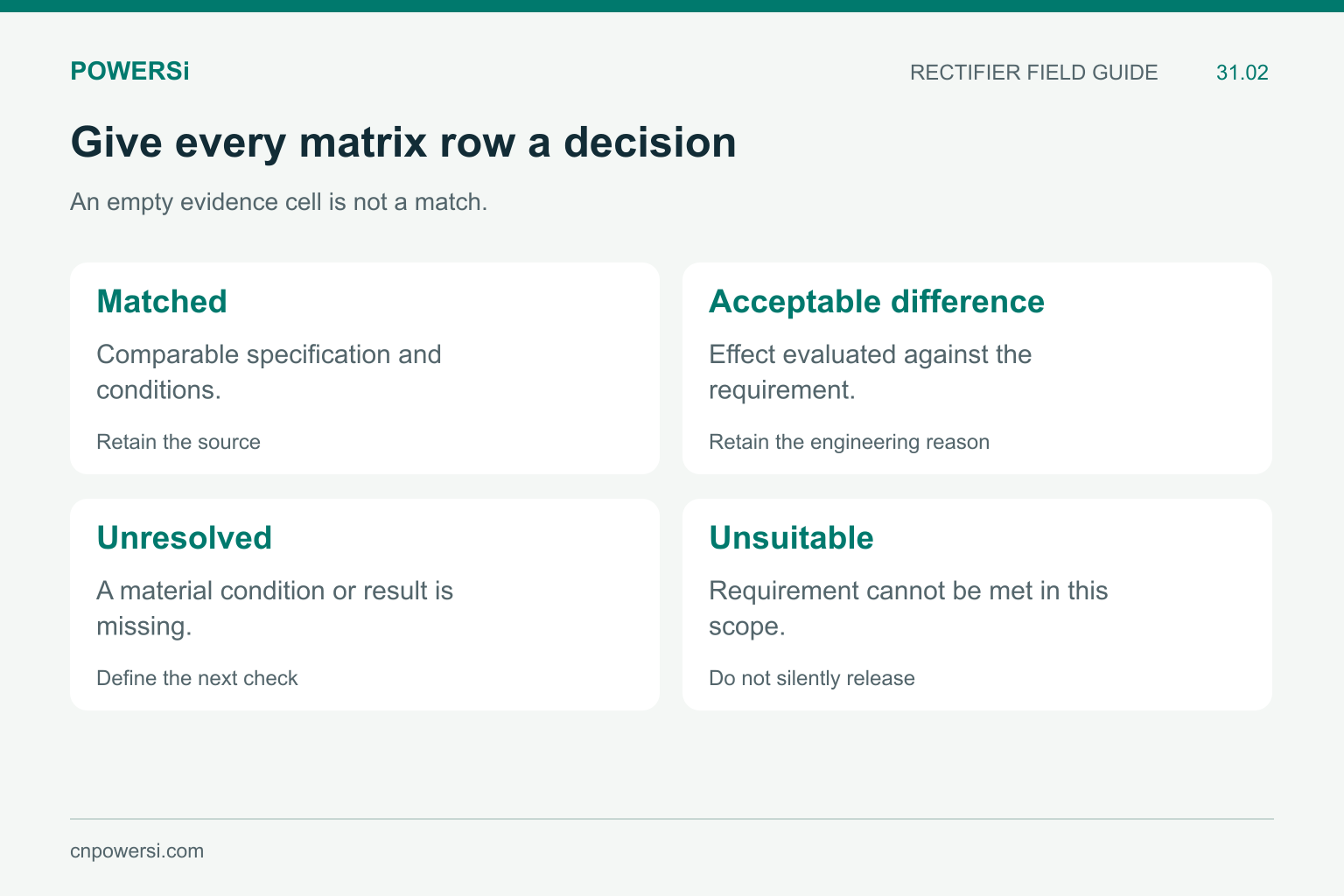
An empty evidence cell is not a match.
Build the Matrix Around Failure-Relevant Differences
| Comparison row | Original requirement | Candidate evidence |
|---|---|---|
| Reverse blocking | Worst-case stress and required margin | Applicable voltage and hot leakage limits |
| Forward duty | Average, RMS, peak and pulse sequence | Current scope, loss and surge conditions |
| Dynamic behavior | Commutation current and voltage | Recovery or capacitive-charge evidence |
| Assembly | Terminal map, outline, mounting and isolation | Exact variant drawing and assembly checks |
| Production support | Qualification, traceability and change requirements | Documents tied to the orderable option |
Give each row a disposition: matched, different but acceptable, unresolved or unsuitable. An empty cell must not be interpreted as a match. For an acceptable difference, retain the engineering reason and the test or calculation supporting it.
Use comparable conditions. A typical forward voltage at a hot junction does not demonstrate compliance with a room-temperature maximum requirement. Likewise, a package-total current rating cannot be compared directly with another part’s single-junction rating.
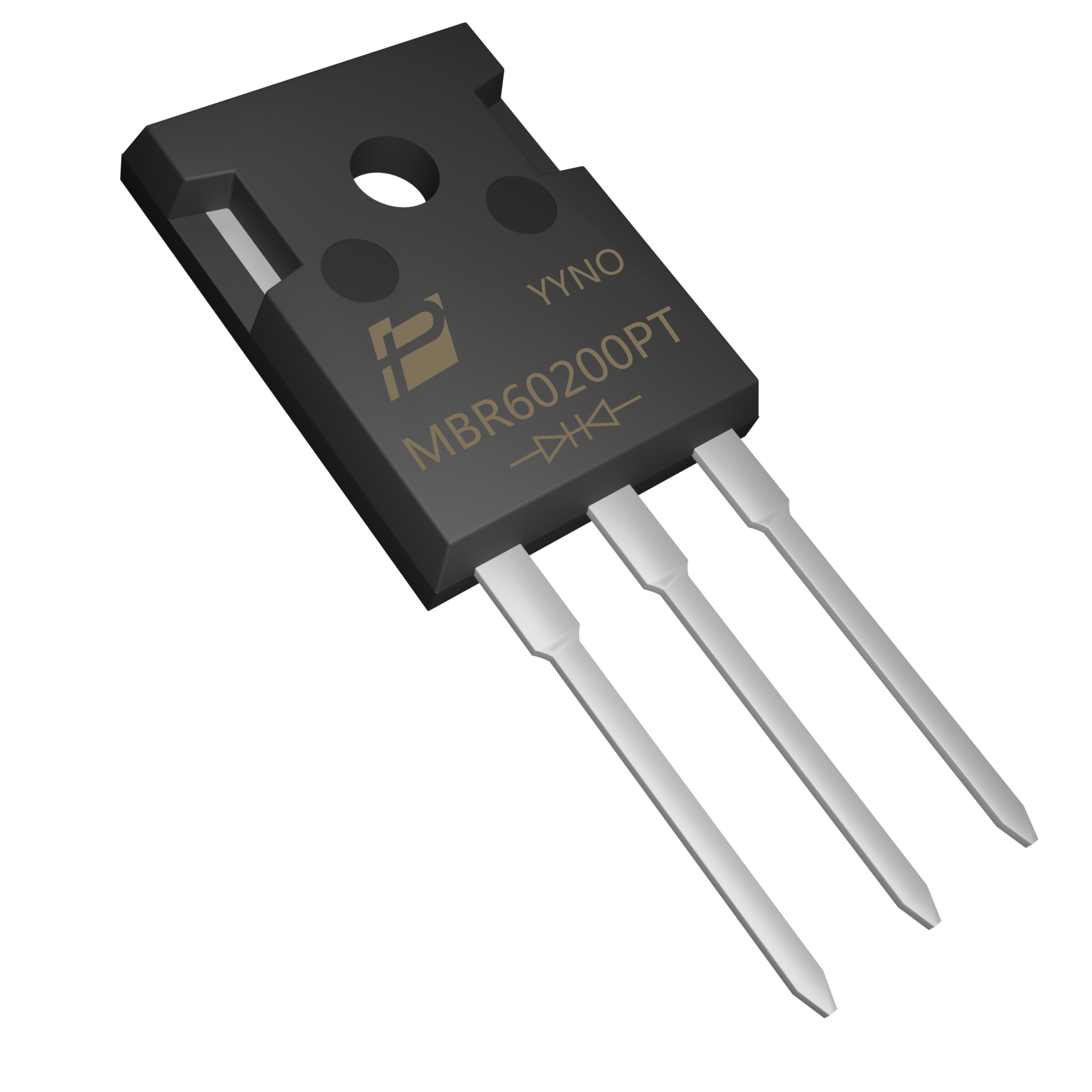
MBR60200PT original model image; 60 A per device and 30 A per diode are different rating scopes.
Keep the Current Scope Visible
POWERSi MBR60200PT V2.0 distinguishes 60 A per device from 30 A per diode. Its TO-247AD body and familiar marking identify a candidate, but neither establishes equivalence to every rectifier described as “60 A, 200 V.” The original device’s connection and rating conditions still need to be matched.
The same discipline applies to package names. A family designation does not settle lead length, terminal order, mounting requirements or electrical isolation. Compare the controlled drawings before ordering a sample that cannot be installed in the intended assembly.
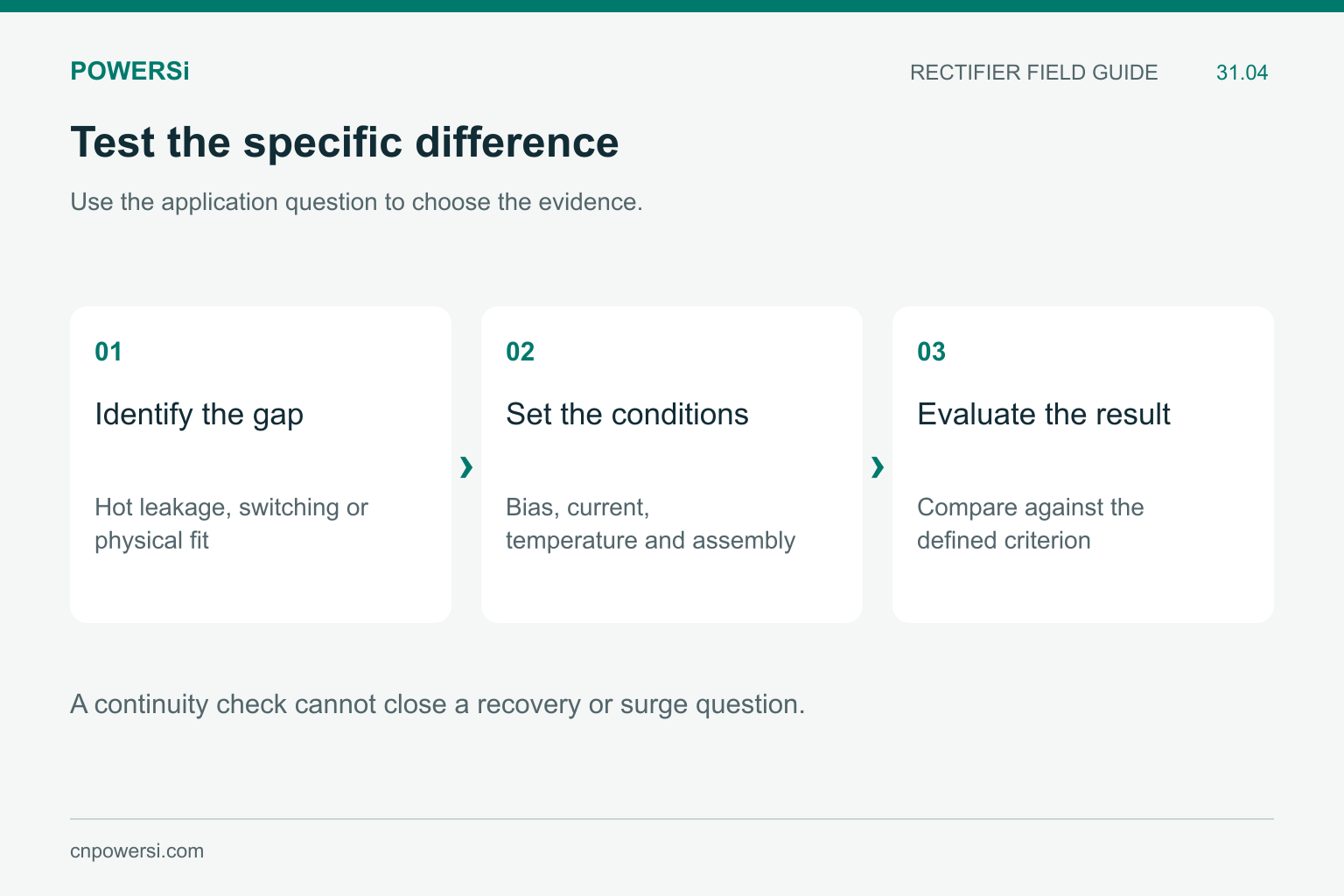
A continuity check cannot close a recovery or surge question.
Use Tests to Resolve Specific Gaps
Each unresolved row should lead to a defined question. If hot leakage is the concern, measure under the relevant reverse bias and temperature. If switching stress is the concern, capture diode and active-switch waveforms in a controlled circuit comparison. If mounting differs, evaluate the installed thermal path and mechanical fit.
Do not build a large test list without linking it to the application’s requirements. Conversely, a successful continuity check does not close a recovery or surge question. Sample results support their conditions and population; they do not create a universal guarantee for all future applications.
Separate a parameter difference from its consequence. A candidate can have a different forward drop yet meet the thermal budget. Another can share the same headline ratings but produce unacceptable ringing. The matrix should explain the acceptance decision rather than simply count identical numbers.
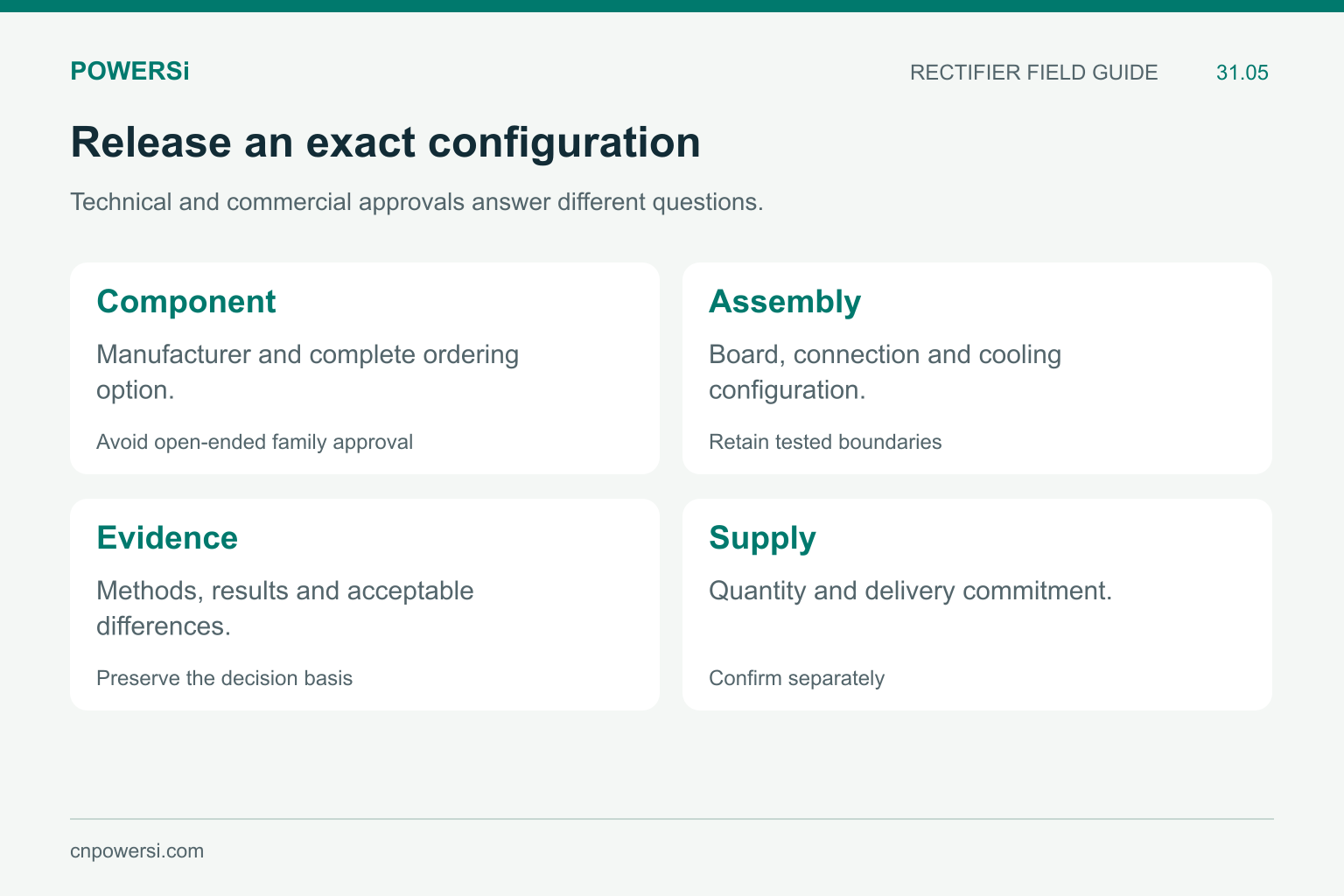
Technical and commercial approvals answer different questions.
Release the Decision With Its Boundaries
Record the exact candidate code, approved board and cooling configuration, relevant test conditions and any restrictions. If one manufacturing site, package option or process revision is part of the evidence, preserve that scope in the release record.
Keep commercial approval separate from technical approval. A competitive quotation does not qualify a device; a technically qualified part does not establish current availability or a delivery commitment. Procurement needs both decisions before treating the alternate as an executable order.
Key Takeaways
- Treat a cross-reference as a starting candidate.
- Compare conditions and current scope, not just headline numbers.
- Resolve each material difference with relevant evidence.
- Approve an exact part for a defined application and assembly.
Conclusion
The useful replacement claim is specific enough to verify. Send the original ordering code, application conditions and open matrix rows with a POWERSi rectifier inquiry so that the proposed alternate can be assessed against the actual requirement.
FAQs
Does the same part-number pattern prove interchangeability?
No. Manufacturer-specific conditions, construction and ordering options can differ.
Must every parameter be numerically identical?
Not necessarily. A difference can be acceptable if its effect is evaluated against the application’s requirements.
Can an unresolved matrix row be treated as a pass?
No. Identify the missing evidence and resolve it before granting the affected approval.
Does a larger package current rating prove more margin?
Only after current scope, waveform and thermal conditions have been compared consistently.
What does an approved alternate record identify?
It identifies the exact ordering option, application configuration, evidence and limits of the approval.