Skip to content
FR107, 1N4007 and SS34 Alternatives: Verify the Part Before the Lead Time
Last Updated: 2026-10-08
Quick Answer
FR107, 1N4007 and SS34 alternatives require separate technical comparisons because they represent different rectifier families and package choices. A short sample-dispatch promise does not establish production availability or arrival date. Confirm the exact candidate, quantity, packing, qualification status and shipment milestone before relying on a quoted lead time.
An urgent purchase often combines two questions: which part can replace the original, and when can an acceptable quantity arrive? Solve them in parallel, but keep the answers separate. A fast shipment of the wrong recovery class or footprint does not shorten the production interruption.
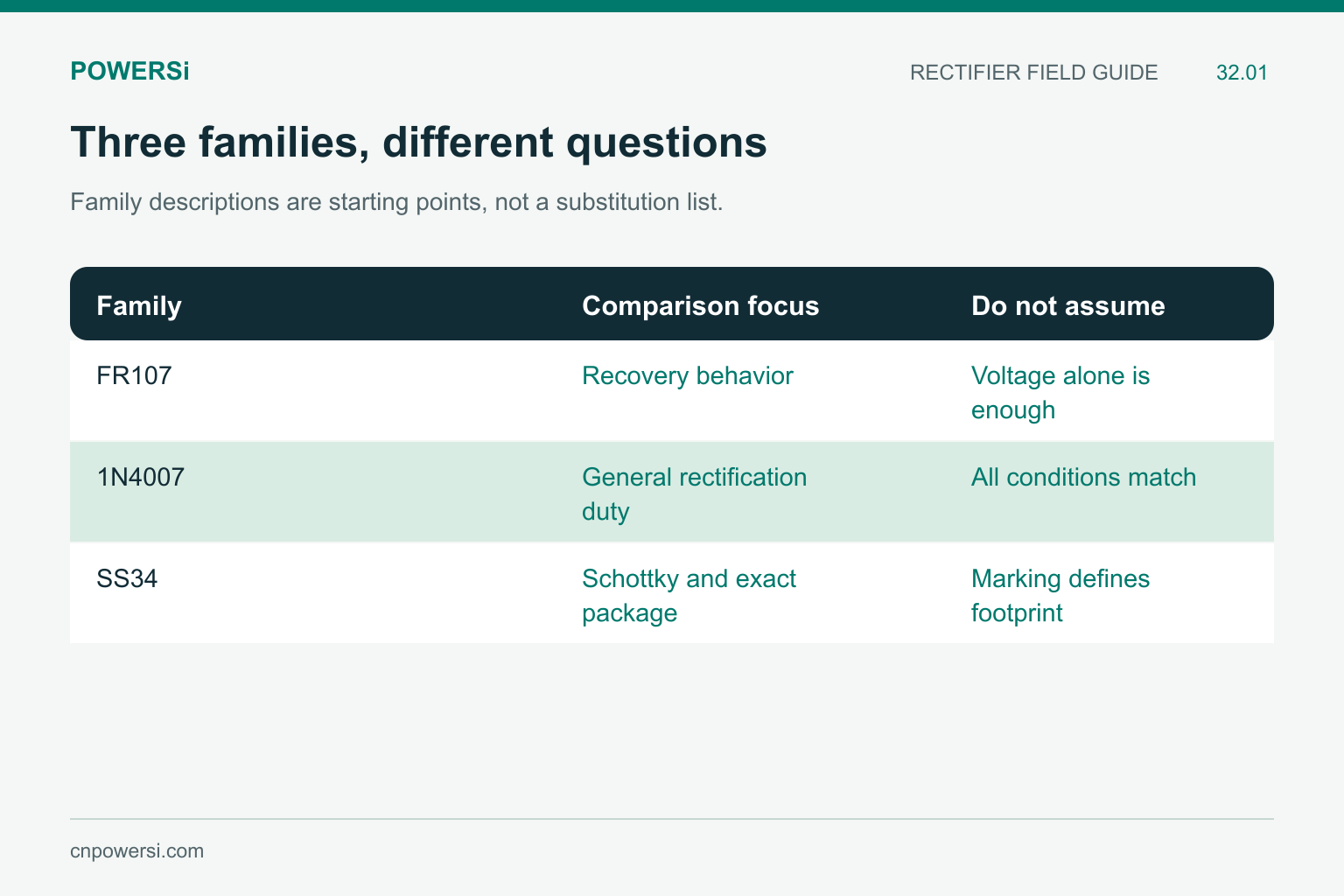
Family descriptions are starting points, not a substitution list.
Keep the Three Families Separate
The Kingtronics FR101–FR107 family is identified as fast-recovery rectifiers. POWERSi’s 1N4001–1N4007 DO-41 V2 document describes general-purpose silicon rectifiers. Its SS32–SS320 documents describe surface-mount Schottky barrier rectifiers. These descriptions provide starting comparison groups, not a three-way substitution list.
| Requested family | First technical question | Common sourcing mistake |
|---|---|---|
| FR107 | What recovery behavior does the circuit require? | Replacing it using voltage and package alone |
| 1N4007 | Does the candidate meet the actual rectification duty? | Assuming a familiar number covers every mounting condition |
| SS34 | Which exact surface-mount package and thermal conditions apply? | Ordering from the marking without confirming the footprint |
The original manufacturer’s complete ordering code remains essential. A family label does not identify all electrical limits, lead options or packing formats across suppliers.
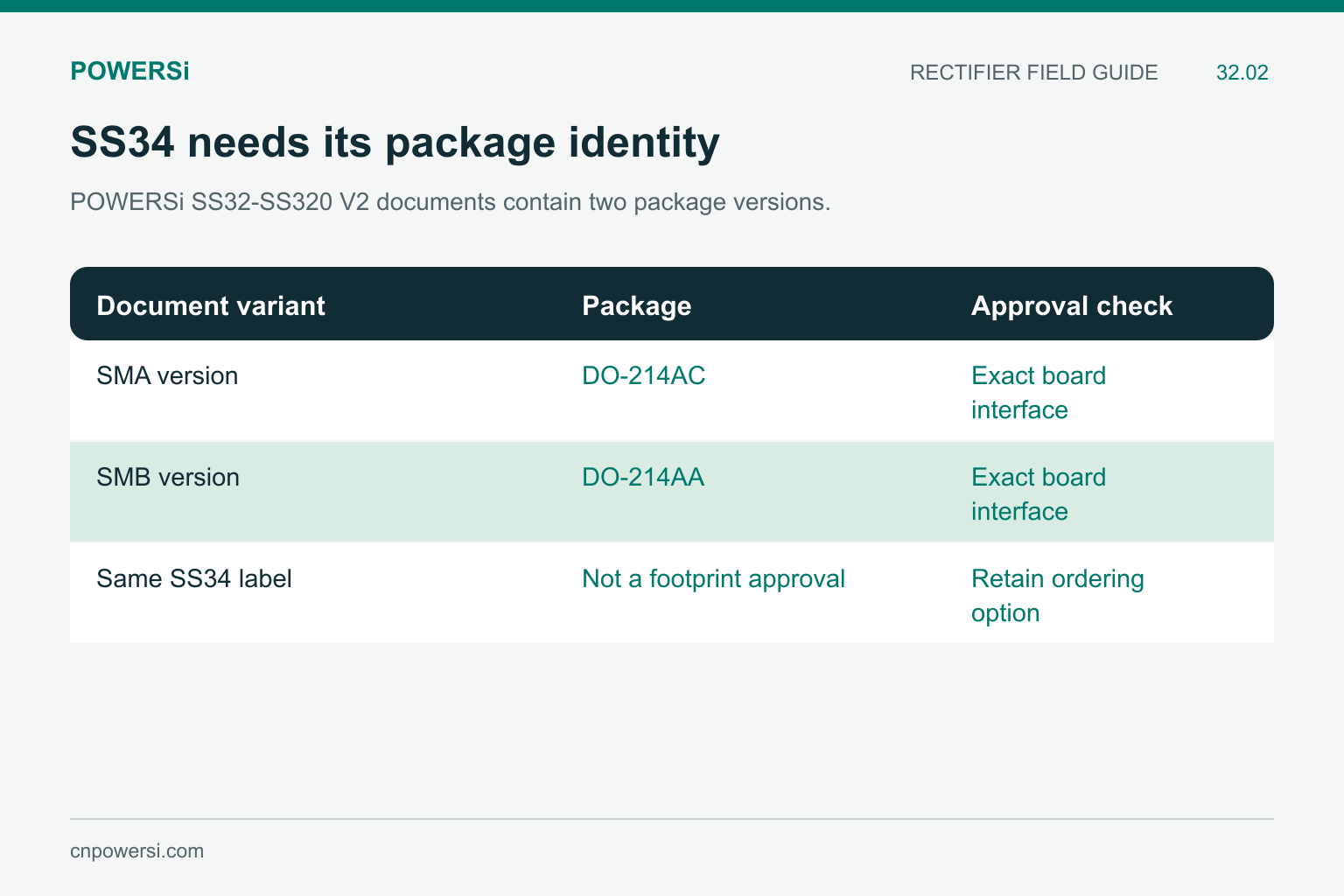
POWERSi SS32-SS320 V2 documents contain two package versions.
Resolve the SS34 Package Before Quoting
POWERSi has separate SS32–SS320 V2 documents for DO-214AC/SMA and DO-214AA/SMB. Both include SS34. That makes “SS34” alone an incomplete footprint description for this comparison.
Confirm the exact package, land-pattern compatibility, polarity and thermal test conditions. Do not assume that the same visible marking allows one package to replace the other on the existing board. Keep the approved document and ordering option in the quotation request so that the supplier does not have to guess which version is required.
This is a concrete reason to finish identity checks early: a package ambiguity can waste a sample cycle even when both parties believe they supplied the requested model.
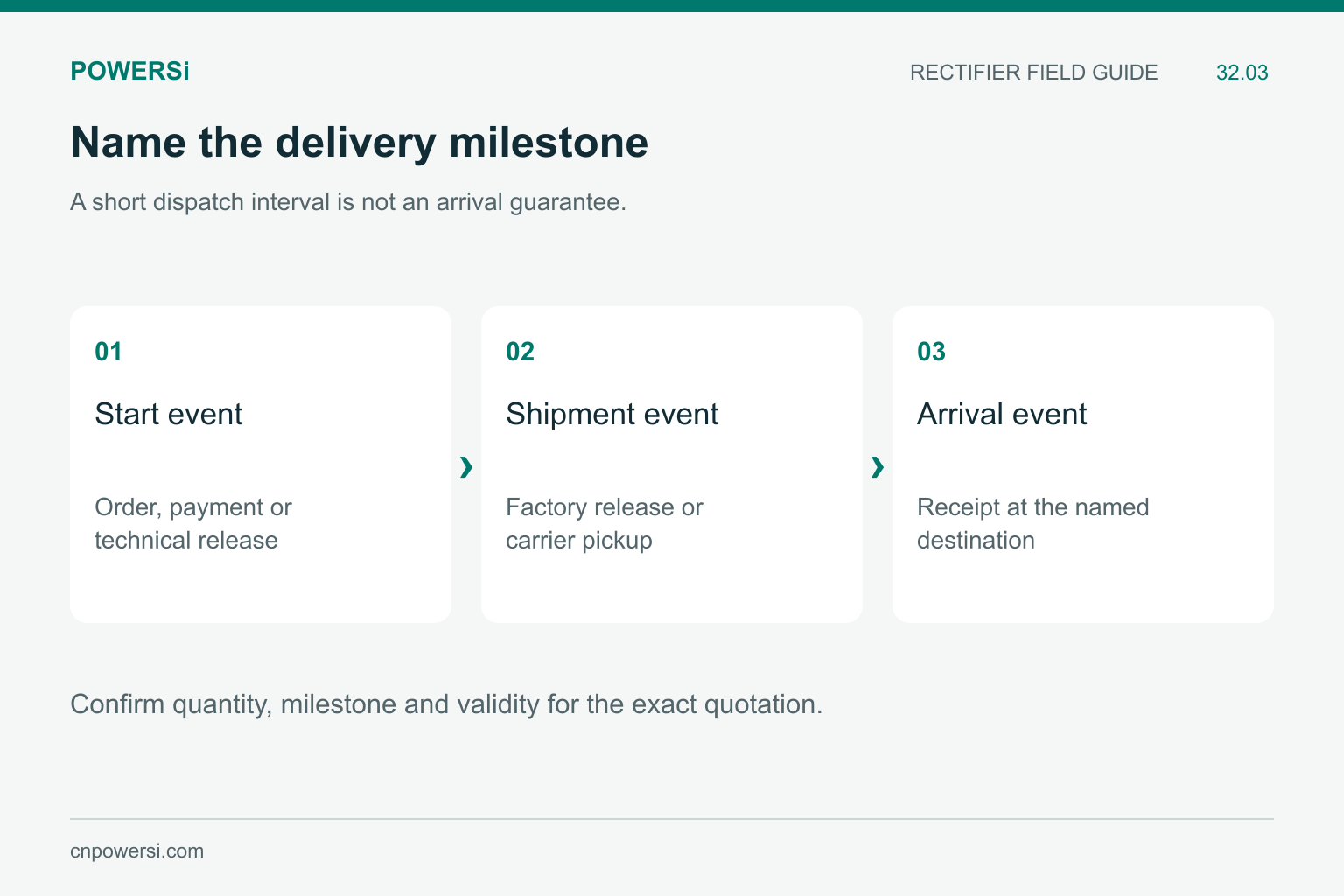
Confirm quantity, milestone and validity for the exact quotation.
Define What the Lead-Time Clock Measures
Ask whether the quoted interval ends at sample dispatch, factory release, carrier pickup or delivery to the receiving site. Define its starting event as well: quotation acceptance, payment, order confirmation or technical release can produce different dates.
A three-day sample-dispatch offer, if confirmed for a particular request, does not imply that a production order arrives in three days. Quantity, stock allocation, packing, inspection and transport can change the schedule. No universal three-day delivery commitment follows from choosing a Chinese manufacturer.
Separate units already available for allocation from units planned for production. Record the quantity covered by the date and the quotation’s validity. A sample quantity and a production quantity should have distinct confirmations when their supply paths differ.
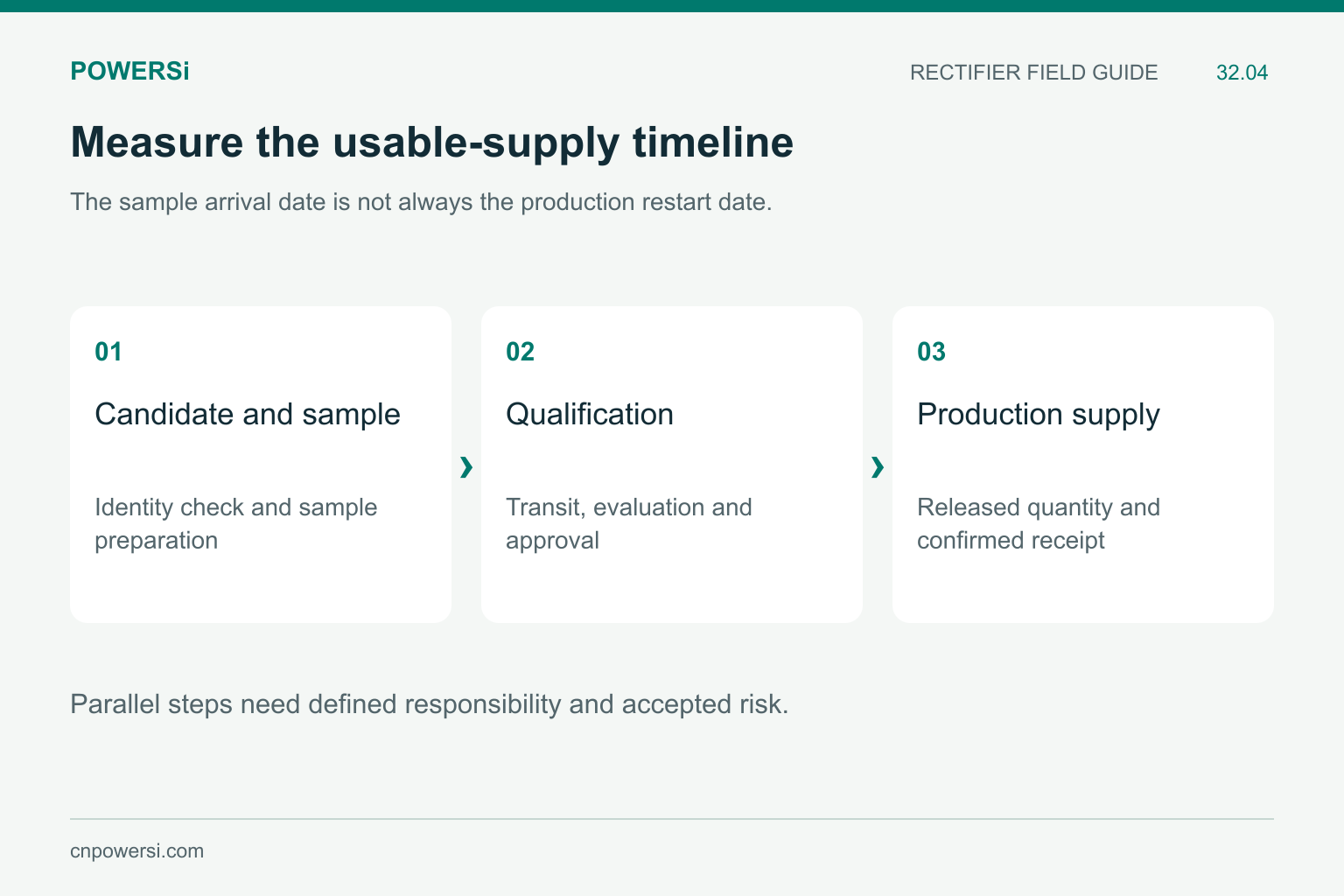
Parallel steps need defined responsibility and accepted risk.
Compare the Total Approved-Arrival Path
Build the timeline around technical selection, sample preparation, transit, evaluation, production release and receipt. Some steps can overlap, but only if the risk and authority are clear. Do not count an unqualified sample’s arrival as the date when production can safely resume.
Evaluate cost on the same quantity, packing and delivery basis. Freight, inspection, changed assembly requirements and qualification effort can outweigh a lower unit price. Current price or availability claims require a dated, part-specific quotation; they should not be inferred from a broad market narrative.
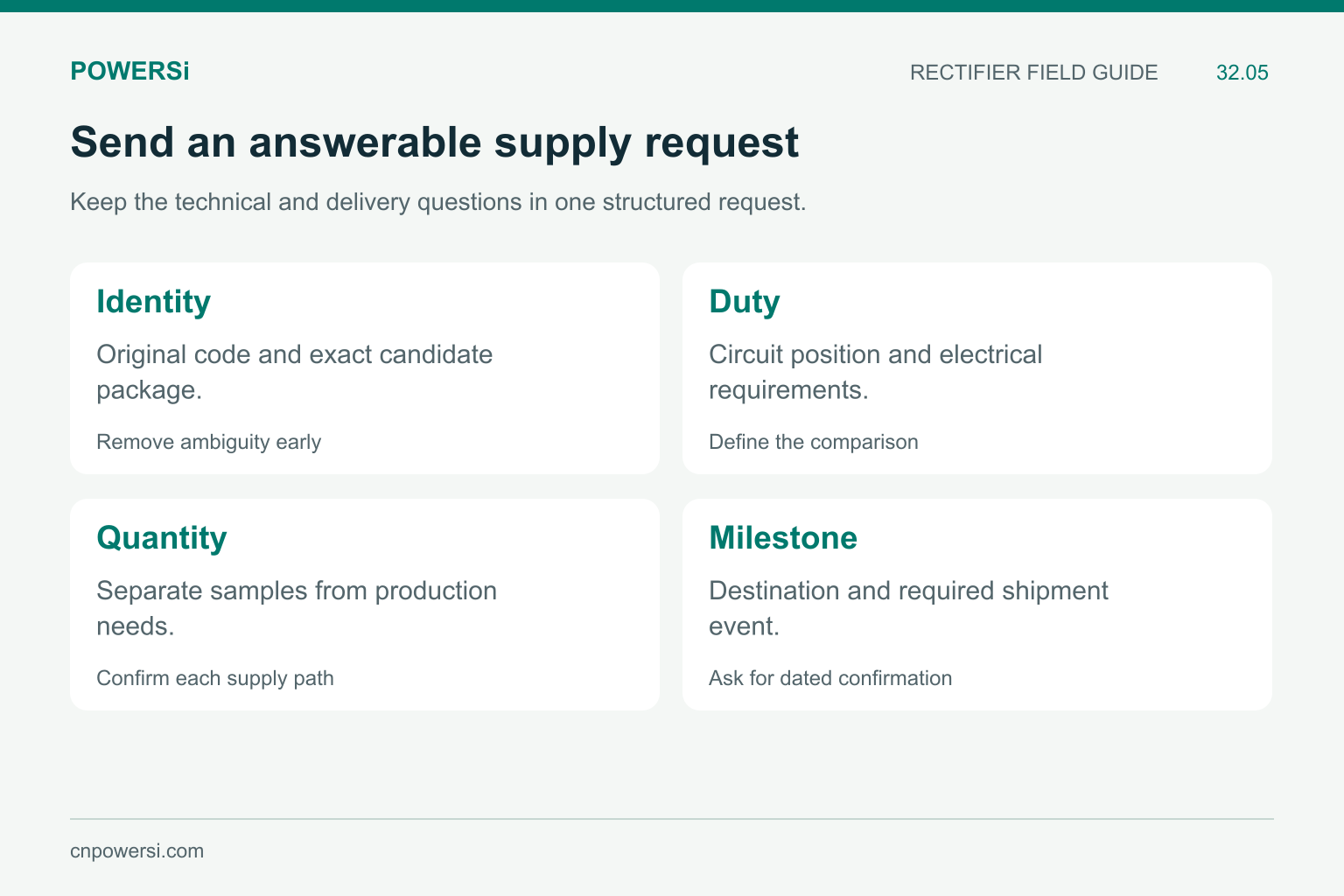
Keep the technical and delivery questions in one structured request.
Send One Request That Can Be Answered Precisely
Include the original code, proposed package, circuit role, relevant electrical requirements, sample quantity, production quantity and destination. Ask the supplier to return the offered full code, any technical differences, confirmed quantity and named shipment milestone.
If an option is already engineering-approved, identify the approval revision. If it is still a candidate, state which checks remain. This lets purchasing accelerate the commercial steps while engineering resolves the actual substitution questions.
Key Takeaways
- FR107, 1N4007 and SS34 require different comparison questions.
- Confirm the exact SS34 package rather than relying on its marking.
- Separate sample dispatch, production release and arrival dates.
- Compare the complete path to an approved, usable quantity.
Conclusion
The fastest useful delivery is the one that brings the correct approved part. Include both the technical identity and the required shipment milestone when requesting POWERSi rectifier options.
FAQs
Are FR107, 1N4007 and SS34 interchangeable families?
No. Their functions and operating requirements need separate evaluation.
Does SS34 uniquely identify the package in every catalogue?
No. Confirm the exact manufacturer document and ordering option, including SMA or SMB where applicable.
Does sample dispatch in three days mean delivery in three days?
No. Dispatch and arrival are different milestones, and transport time remains additional.
Does a sample quotation establish production availability?
No. Confirm the production quantity, allocation or manufacturing plan separately.
What should accompany a delivery request?
Provide the exact code, package, approval status, quantities, destination and required milestone.