Skip to content
How to Write Rectifier BOM Requirements That Engineering and Purchasing Can Use
Last Updated: 2026-10-07
Quick Answer
Useful rectifier BOM requirements connect an exact component identity to its circuit role, electrical conditions, mechanical interface and approval rules. Keep the purchasing line concise and link it to a controlled engineering specification. A buyer should be able to identify the orderable part and distinguish an approved alternative from an unqualified suggestion.
“Diode, 60 A, 200 V, TO-247” looks specific, but it leaves important questions unanswered. Is the current per junction or per package? Is the device single or dual? Which connection and mechanical option are required? A supplier can answer the abbreviated request accurately and still offer the wrong part for the board.
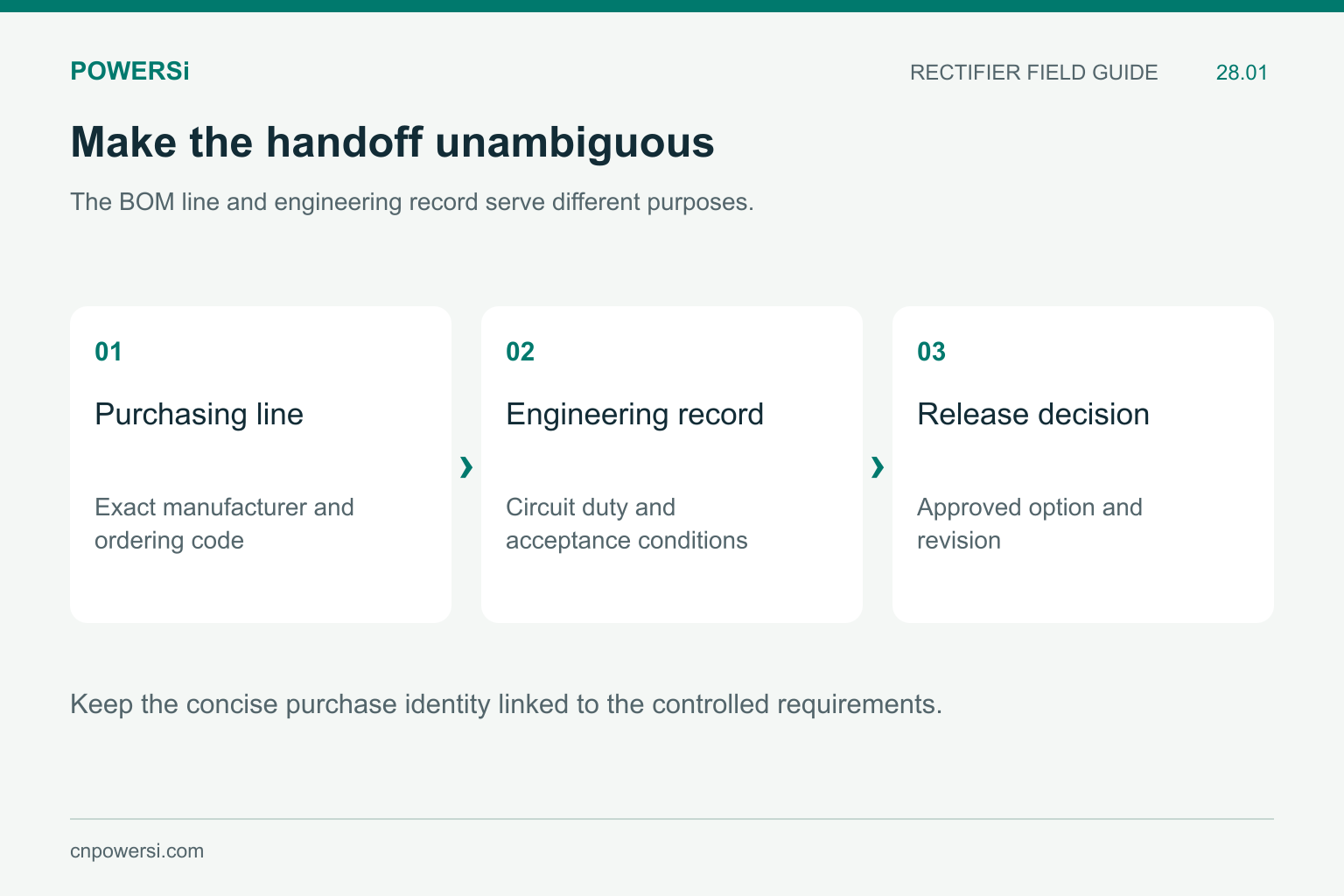
Keep the concise purchase identity linked to the controlled requirements.
Separate the BOM Line From Its Supporting Specification
The BOM line should identify what to buy: internal item number, manufacturer, complete ordering code, description, quantity and the controlled approval reference. The supporting specification explains why that item fits and how an alternate is evaluated.
Avoid putting a long, unversioned paragraph into a free-text description field. Important conditions become difficult to compare and easy to lose during export. Use named fields and a revision-controlled attachment where the purchasing system cannot store the complete engineering requirement.
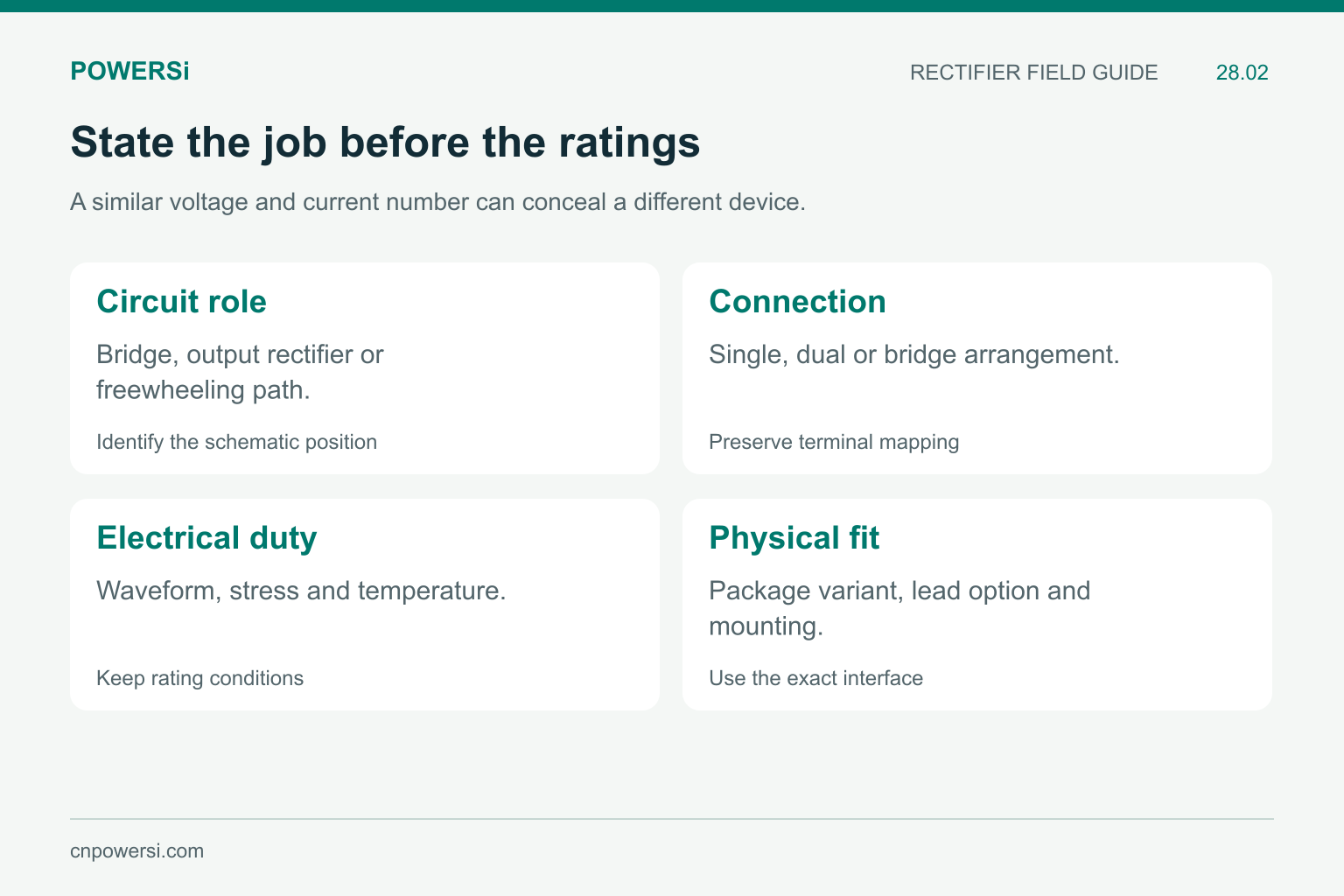
A similar voltage and current number can conceal a different device.
Define Function Before Listing Numbers
State the circuit position and connection: input bridge, secondary rectifier, freewheeling diode or another defined role. Identify whether the component contains one junction, a dual common-cathode or common-anode arrangement, or a bridge. Keep the schematic symbol and terminal mapping linked to the footprint.
Then state voltage, current waveform, thermal boundary and switching requirements. Distinguish the application’s measured or bounded stress from the component’s rating. A requirement such as “maximum operating reverse stress 120 V; selected rating subject to the project’s derating policy” describes a different quantity from “VRRM at least 120 V.”
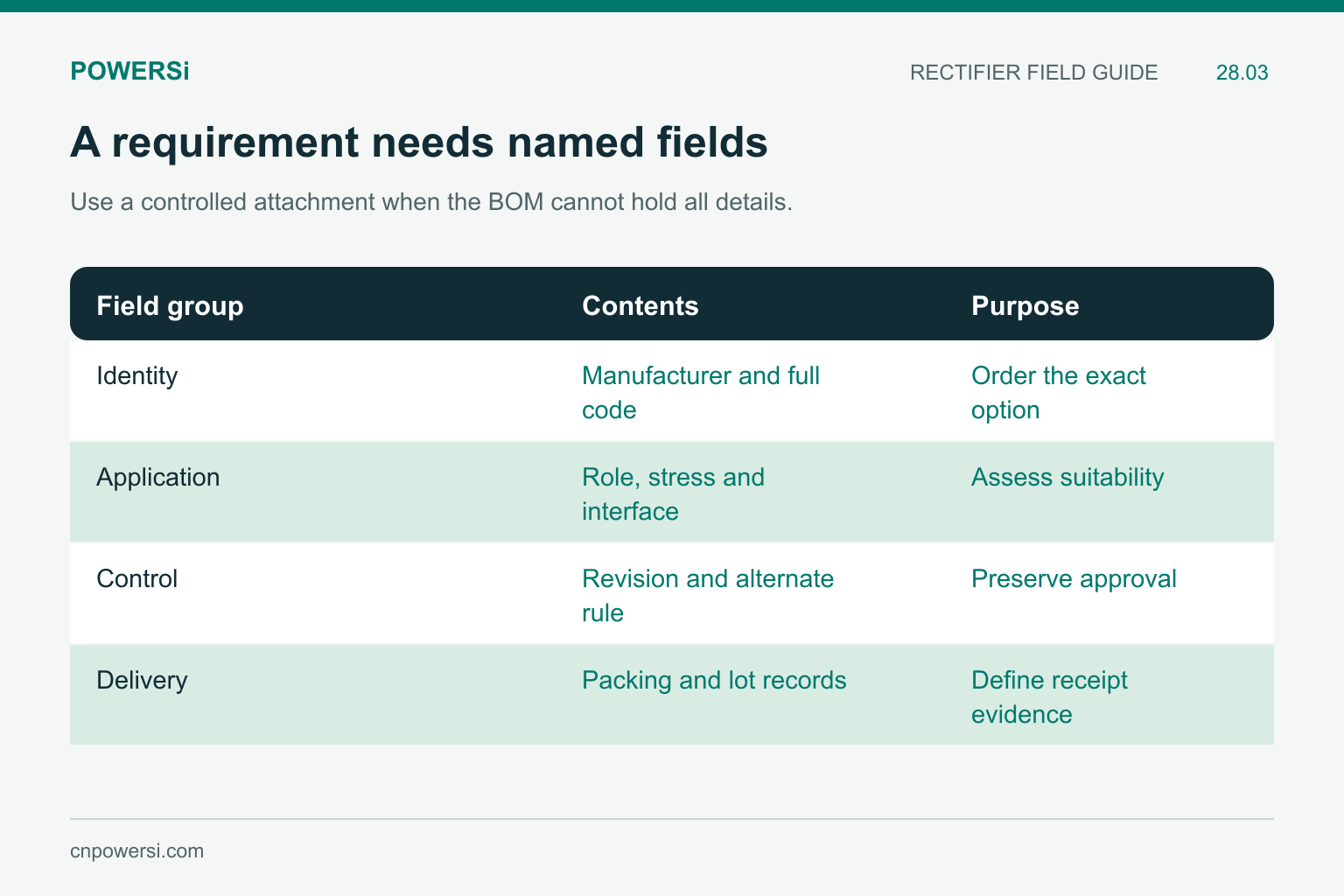
Use a controlled attachment when the BOM cannot hold all details.
Use a Structured Requirement Record
| Field | What belongs in it |
|---|---|
| Identity | Manufacturer, complete order code, internal item and revision |
| Circuit role | Reference designator, topology position and internal connection |
| Electrical duty | Reverse stress, current waveform, temperature and switching conditions |
| Mechanical interface | Exact outline, terminal map, lead option and mounting constraints |
| Evidence | Approved specification revision and relevant qualification results |
| Alternate rule | Named approved parts and the authority for further substitutions |
| Delivery | Packing format, lot identification and required documents |
Use explicit units and value types. “Low forward drop” is an objective; a maximum voltage at a stated current and temperature is a testable requirement. Likewise, a recovery-time limit without a method or conditions can create a comparison that engineering never intended.
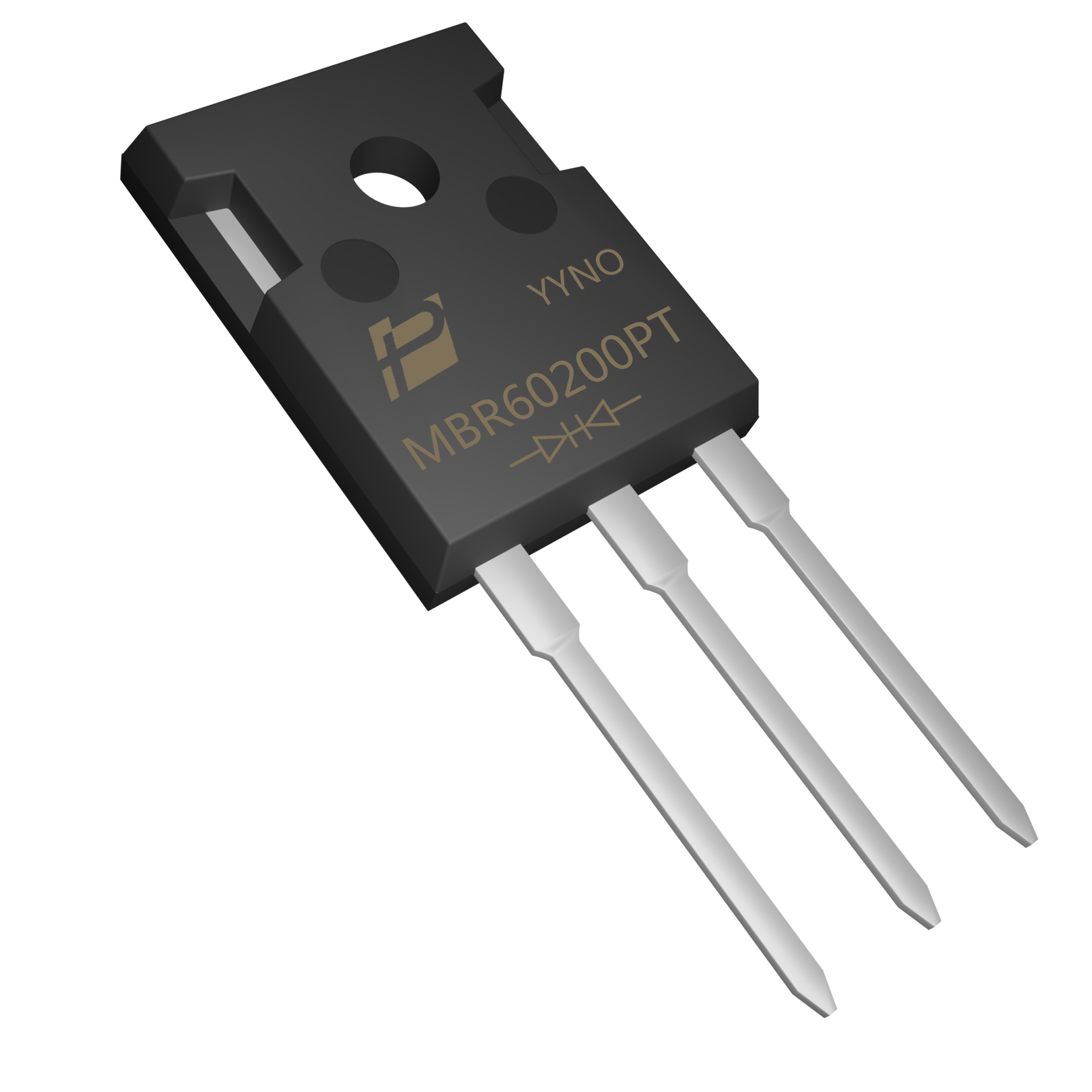
MBR60200PT original product image; the documented full tube-packed order code is WMBR60200PT000P.
A POWERSi Identity Example
POWERSi MBR60200PT V2.0 lists the full order code WMBR60200PT000P, body marking MBR60200PT, TO-247AD package and tube packing. Its current table distinguishes 60 A per device from 30 A per diode. These fields belong in separate places rather than being compressed into one informal “60 A diode” description.
An example identity line could read: manufacturer POWERSi; order code WMBR60200PT000P; description MBR60200PT Schottky rectifier, TO-247AD, tube packing. This identifies a documented product option; it does not approve that option for an unspecified circuit. The linked engineering record must still establish electrical, thermal and terminal compatibility.
Do not use a product photograph as a footprint drawing or treat a short body marking as the complete purchasing code. Keep the current scope visible in comparison sheets so that an alternate’s per-diode value is not compared with the original package total.
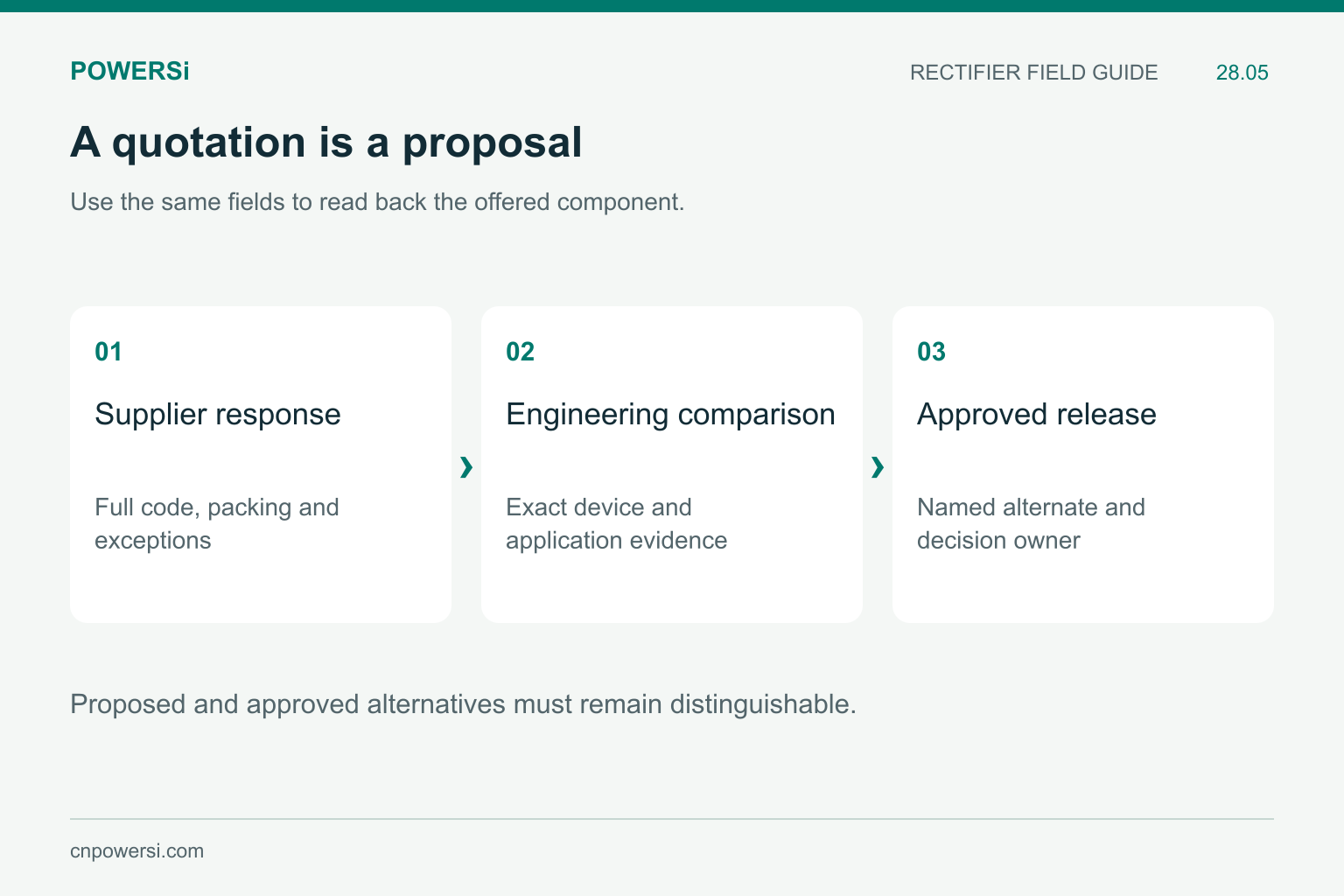
Proposed and approved alternatives must remain distinguishable.
Make Alternate Approval Explicit
Separate “supplier-proposed” from “engineering-approved.” A quotation can introduce a candidate without changing the released BOM. Require comparison of the exact ordering option, connection, dimensions, ratings and relevant application evidence before adding that candidate to the approved list.
Define whether a packing-only change follows a different process from a device or lead-form change. Do not assume that a suffix is logistics-only across all manufacturers. Preserve the approved document revision and the decision owner so that a later order can be traced to a specific release.
Close the Handoff With a Read-Back
Ask purchasing or the supplier to return the offered manufacturer, full code, packing and any exceptions in the same named fields. Engineering can then compare the response directly with the request. Resolve contradictions before sample ordering or production release rather than leaving an ambiguous note beside an otherwise approved BOM line.
Record receiving checks that can actually be performed: label identity, quantity, lot information, packing and visible condition. These checks support the purchasing record but do not replace the application tests needed to qualify an alternate.
Key Takeaways
- Keep the orderable identity separate from the engineering acceptance basis.
- Include circuit role, current scope and terminal mapping.
- Treat a proposed alternate as a candidate until it is approved.
- Use a structured read-back to expose exceptions before release.
Conclusion
A clear requirement reduces avoidable clarification cycles. Send the exact identity and the linked application requirements with a POWERSi product inquiry so that purchasing and engineering can evaluate the same component option.
FAQs
Is voltage, current and package enough for a rectifier BOM?
No. Connection, current scope, conditions, complete code and approval status can also determine suitability.
Should every test condition fit inside the BOM description?
No. Keep the purchasing line concise and link to a controlled engineering record.
Does a supplier quotation approve an alternate?
No. It proposes an option; approval follows the organization’s defined engineering process.
Is the body marking always the complete ordering code?
No. A marking can omit packing or other orderable-option details.
What should the supplier read back?
Return the manufacturer, full code, packing and exceptions in the same structured fields used in the request.