Skip to content
Rectifier Current Derating: Can a Lower-Rated Diode Replace a Larger One?
Last Updated: 2026-09-30
Quick Answer
Rectifier current derating means operating within a defined margin below the applicable limits under actual thermal and waveform conditions. It does not turn a lower-rated component into a higher-rated one. A replacement can be acceptable only when its own current, temperature, surge, voltage and switching limits satisfy the complete application requirements.
A production circuit may operate far below the original device’s headline rating. That can make a smaller candidate worth evaluating, but it does not establish an automatic substitution. The original choice may have reserved capability for startup, hot operation or abnormal conditions that are absent from a normal-load measurement.
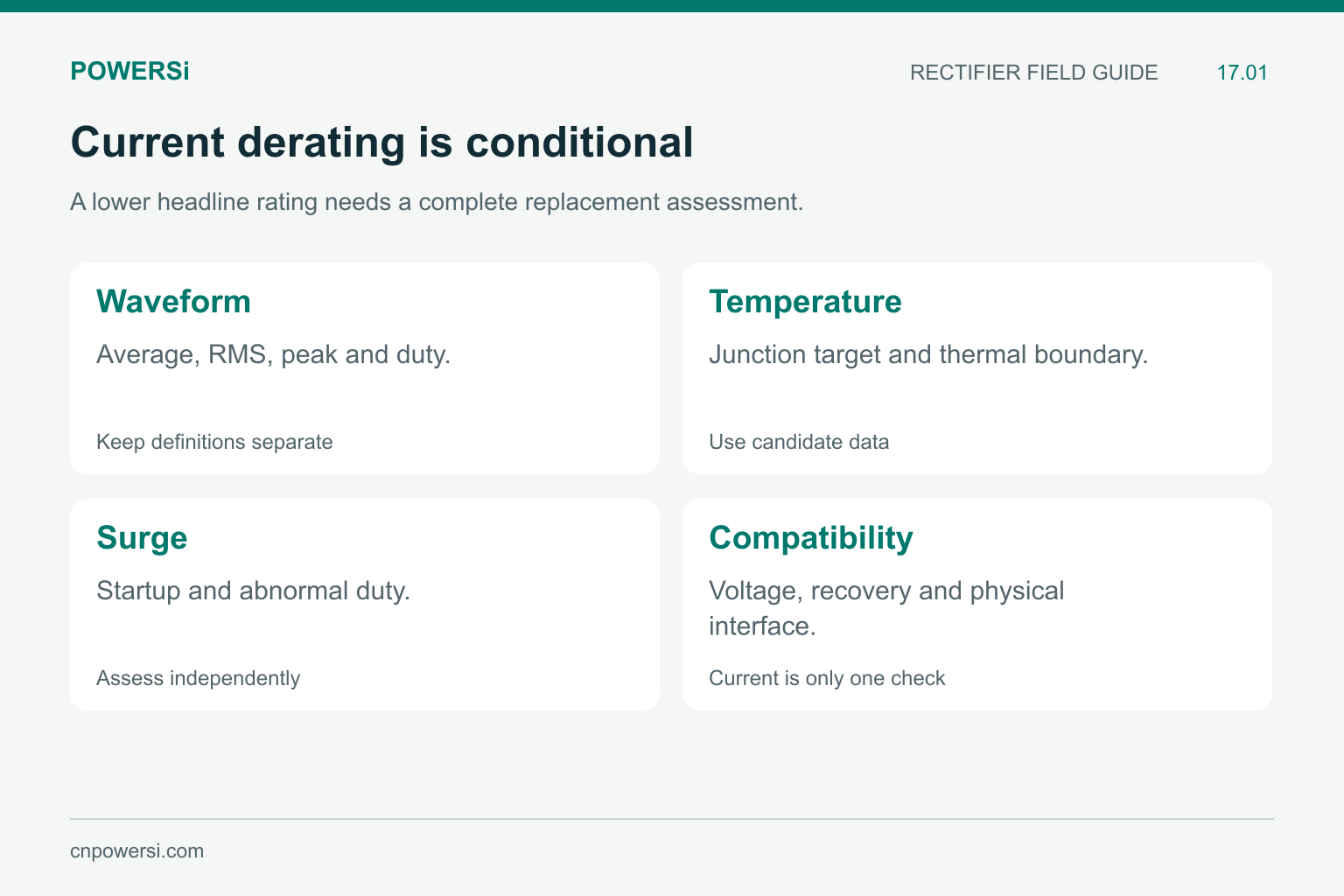
A lower headline rating needs a complete replacement assessment.
Compare Ratings With the Same Meaning
Distinguish average forward current, RMS current, peak current and surge current. Also check whether a dual device’s rating applies per diode or per package. Comparing two numbers without their definitions can create a false impression of margin.
For a simplified rectangular pulse train of 10 A at 20% duty, average current is 2 A while RMS current is approximately 4.47 A. Those values describe the same waveform. They do not by themselves establish that a nominal 2 A diode can carry the pulses. Peak limits, losses and transient temperature still require evaluation.
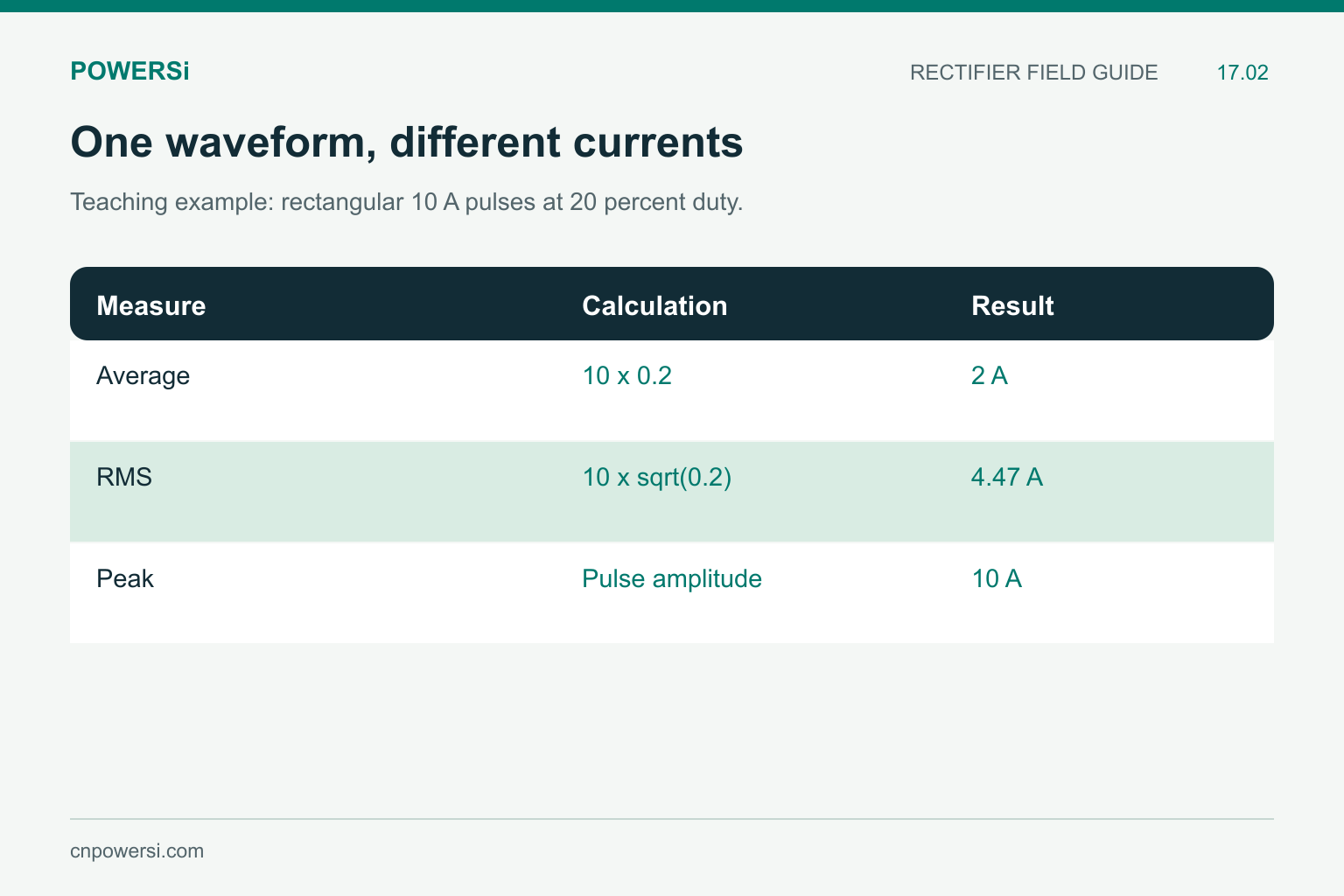
Teaching example: rectangular 10 A pulses at 20 percent duty.
Translate the Waveform Into Loss
Forward conduction loss is the time average of instantaneous forward voltage multiplied by current. A constant-drop estimate can help early screening, while an equivalent model VF = V0 + r × I gives approximately V0 × Iavg + r × Irms squared. The coefficients must be appropriate to the actual device and temperature.
Add reverse-blocking and dynamic losses where relevant. A lower-rated replacement may have a different chip area or package heat path, so the original device’s case temperature is not a prediction of the candidate’s junction temperature. Recalculate with the candidate’s characteristics and test it in the intended assembly.
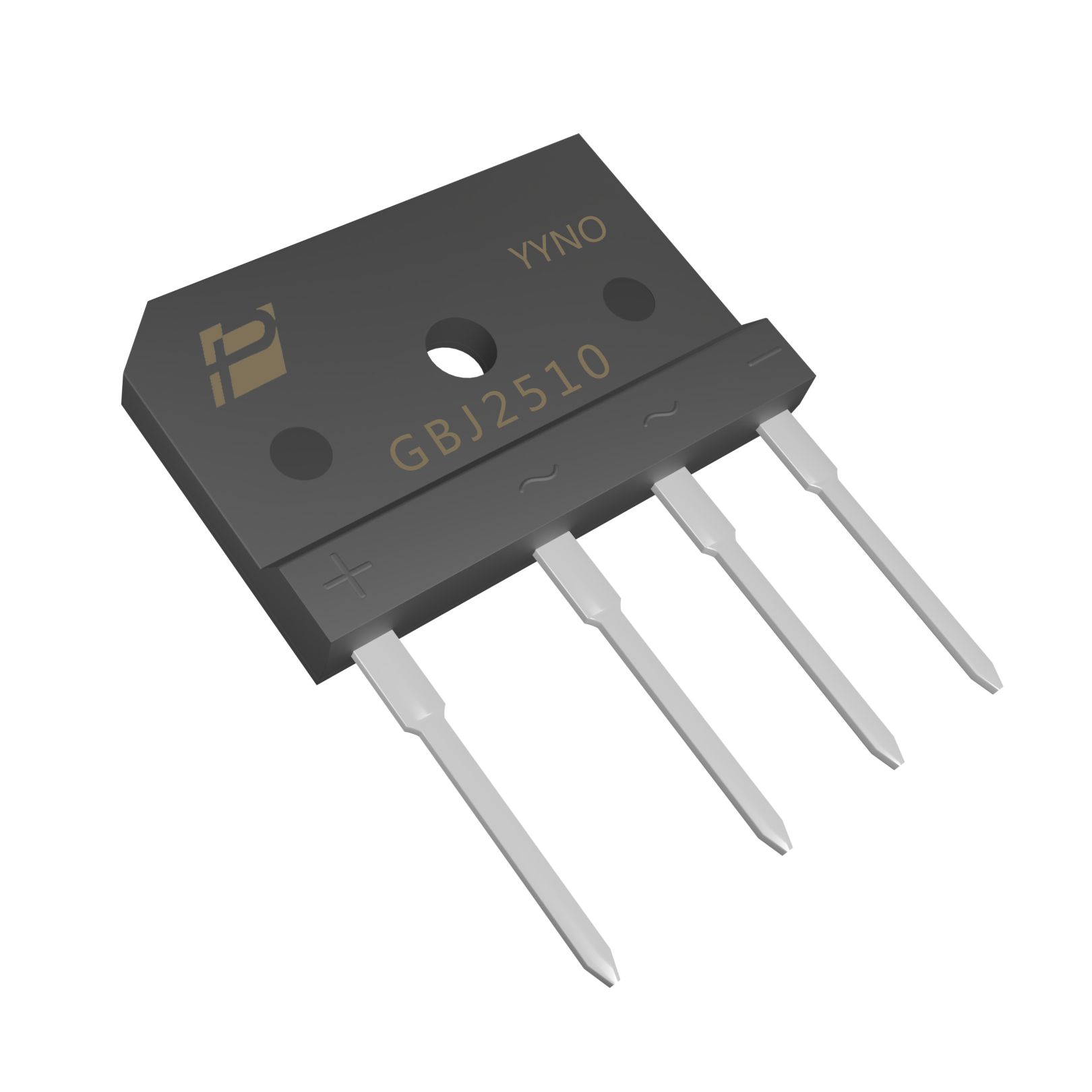
GBJ2510 has a 25 A table condition with a heatsink at Tc = 110 degrees Celsius.
Use the Correct Thermal Boundary
POWERSi GBJ2510 V2.0 lists a 25 A condition with a heatsink at Tc = 110°C. This is not a universal 25 A ambient-air rating. The mounting condition and case temperature remain part of the statement.
For a steady-state single-path illustration, a selected junction-temperature target of 125°C, case temperature of 85°C and junction-to-case resistance of 2°C/W would allow 20 W of dissipation across that path. These are hypothetical thermal values, not a rating for GBJ2510. The result is a power budget, not a current limit; losses must be related back to the actual waveform.
Use ambient-based and case-based thermal models consistently. For short pulses, the relevant transient thermal behavior can differ from steady-state resistance. Do not add overlapping thermal paths or mix per-junction and whole-package quantities without a suitable model.
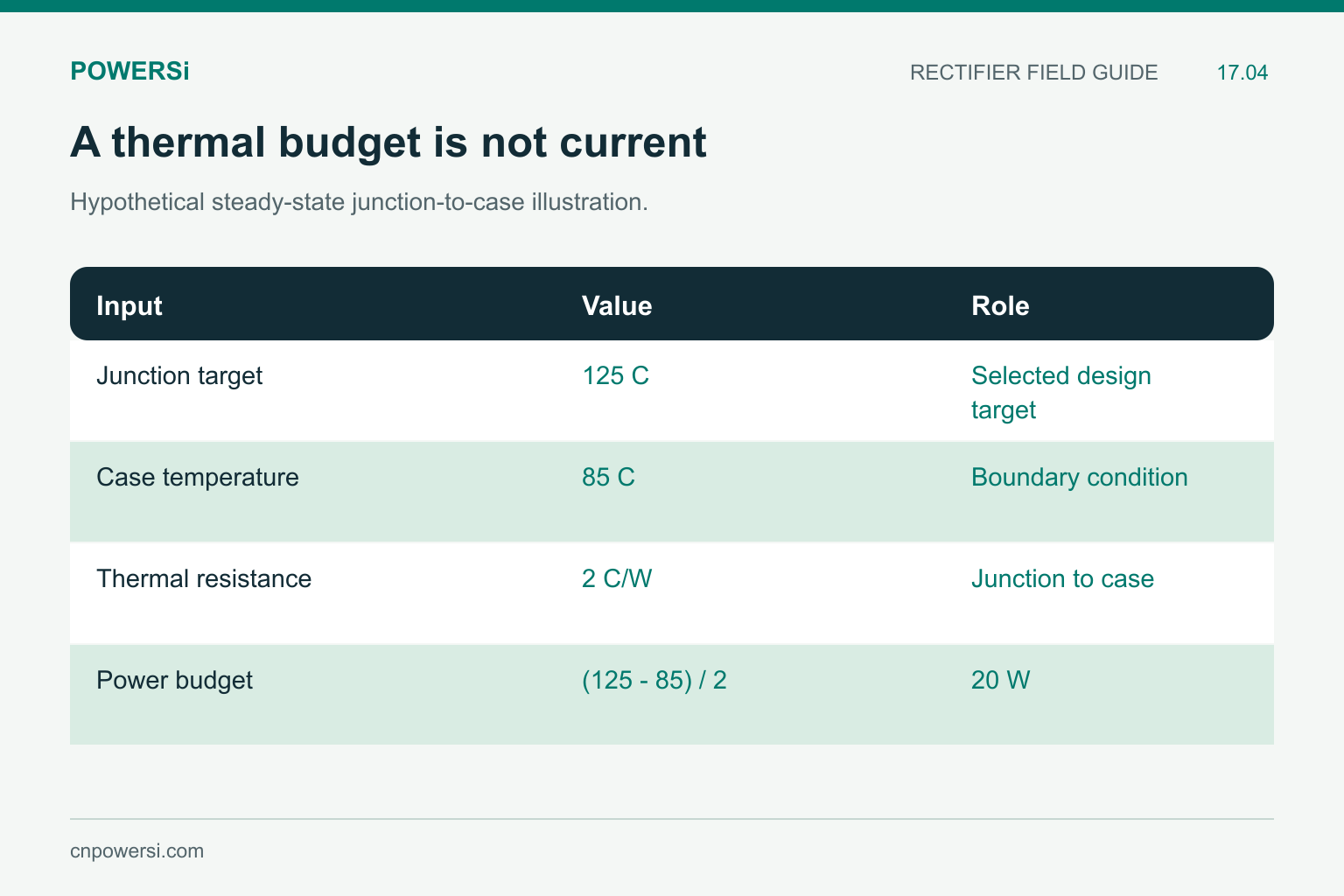
Hypothetical steady-state junction-to-case illustration.
Check the Conditions Missing From Normal Load
Evaluate maximum ambient temperature, restricted airflow, component tolerances, startup and restart. A device with acceptable average loss can still fail during a capacitor-charging pulse. A non-repetitive IFSM value does not authorize unlimited repetition at that peak.
Also compare reverse-voltage capability, recovery behavior, package insulation where applicable, terminal mapping and mounting requirements. Current derating addresses only part of the substitution problem. A change that saves purchase cost but requires a new heatsink or assembly process may not reduce total cost.
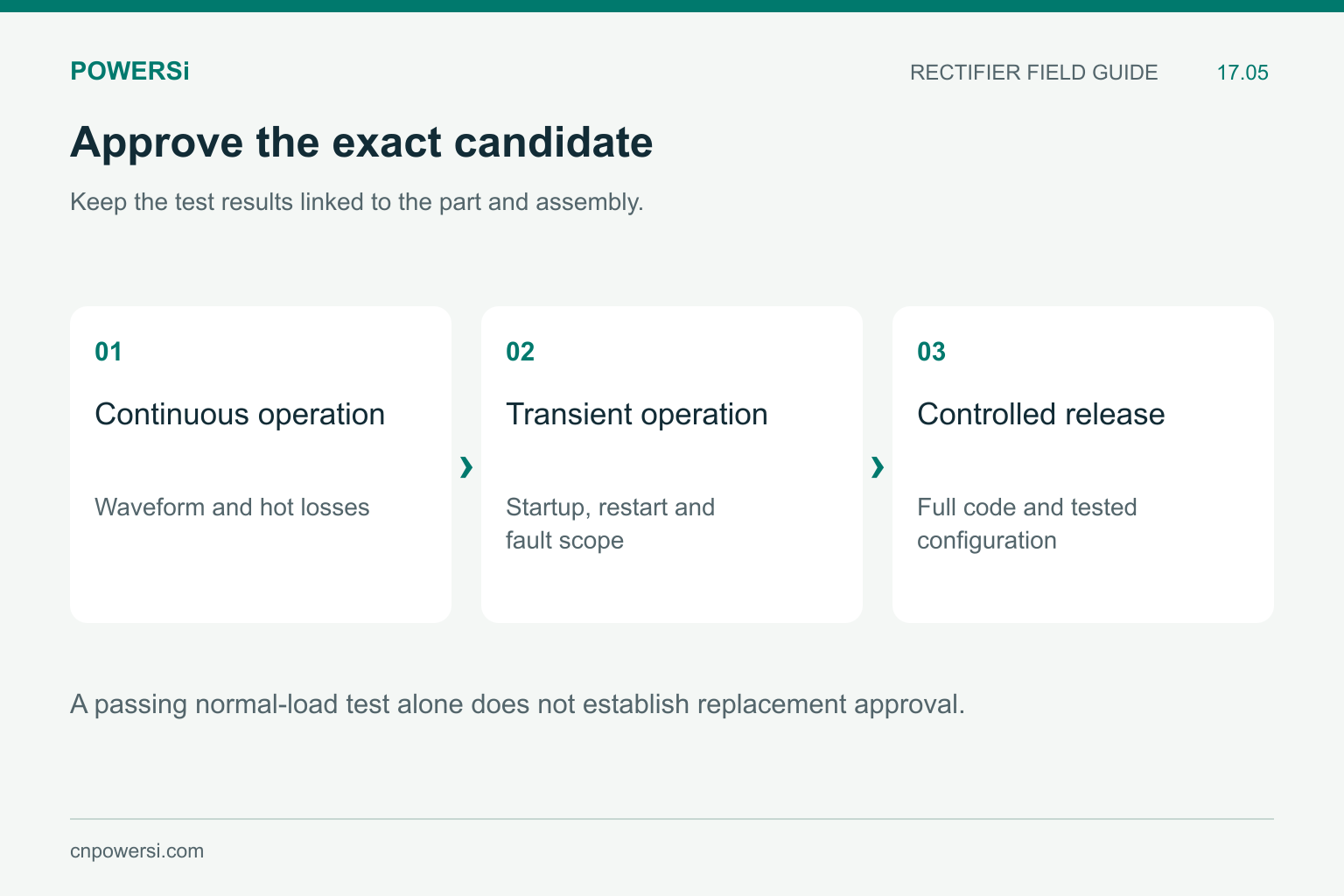
A passing normal-load test alone does not establish replacement approval.
Define a Replacement Acceptance Record
State the maximum current waveform, temperature target and required margin. Identify the candidate’s applicable limits and the worst conditions tested. Document the evidence for startup and any relevant fault duty separately from continuous operation.
Procurement should release the exact approved ordering code. Avoid instructions such as “any diode above 3 A” when the circuit depends on a particular recovery class, connection or thermal interface. The successful result belongs to a specific part and assembly configuration.
Key Takeaways
- Derating preserves margin; it does not increase a component’s rating.
- Average and RMS current answer different questions.
- Convert electrical losses into junction-temperature estimates.
- Validate startup and hot operation before accepting a lower-rated candidate.
Conclusion
A lower headline current is neither automatic rejection nor automatic approval. Assess the candidate against the actual workload. Share the waveform, mounting and temperature requirements when discussing a replacement from the POWERSi product range.
FAQs
Is using half the rated current always sufficient?
No. A fixed percentage cannot replace the rating conditions, waveform and thermal assessment.
Can a 2 A average load contain much higher peaks?
Yes. Pulsed conduction can produce significantly higher RMS and peak currents than the average value suggests.
Is the original case temperature valid for the replacement?
Not automatically. Different losses and thermal paths can change the candidate’s temperature.
Does IFSM establish continuous overload capability?
No. It describes a specified surge condition, not a continuous or unrestricted repetitive allowance.
What must procurement approve?
Approve the exact part, mechanical option and application evidence, including thermal, waveform and surge conditions.