Skip to content
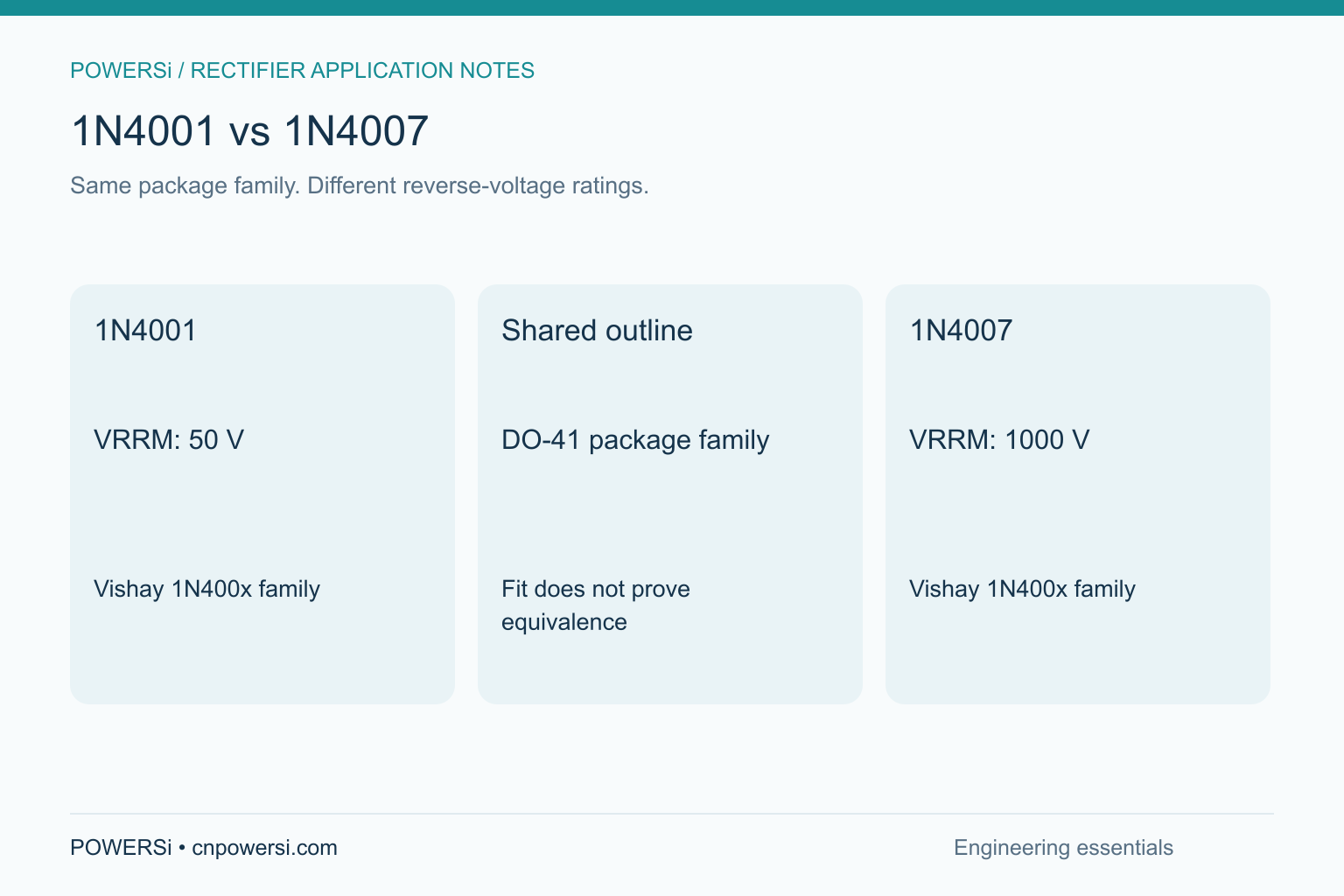
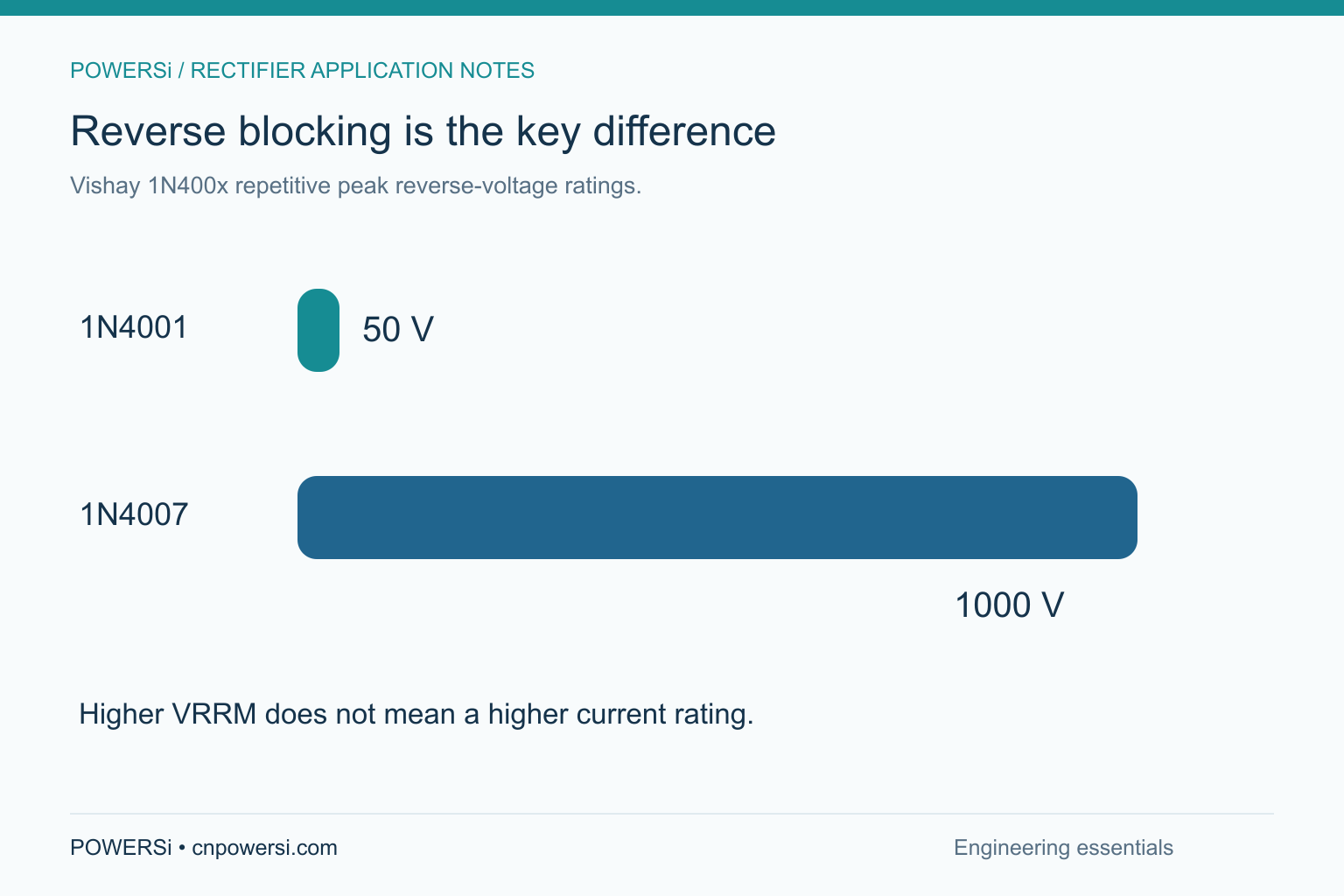
The key difference in a 1N4001 vs 1N4007 comparison is reverse-voltage rating: 50 V versus 1000 V in the referenced Vishay family. A shared DO-41 package does not make substitution symmetric. The replacement must meet the circuit’s electrical, thermal and assembly requirements in the intended operating conditions.
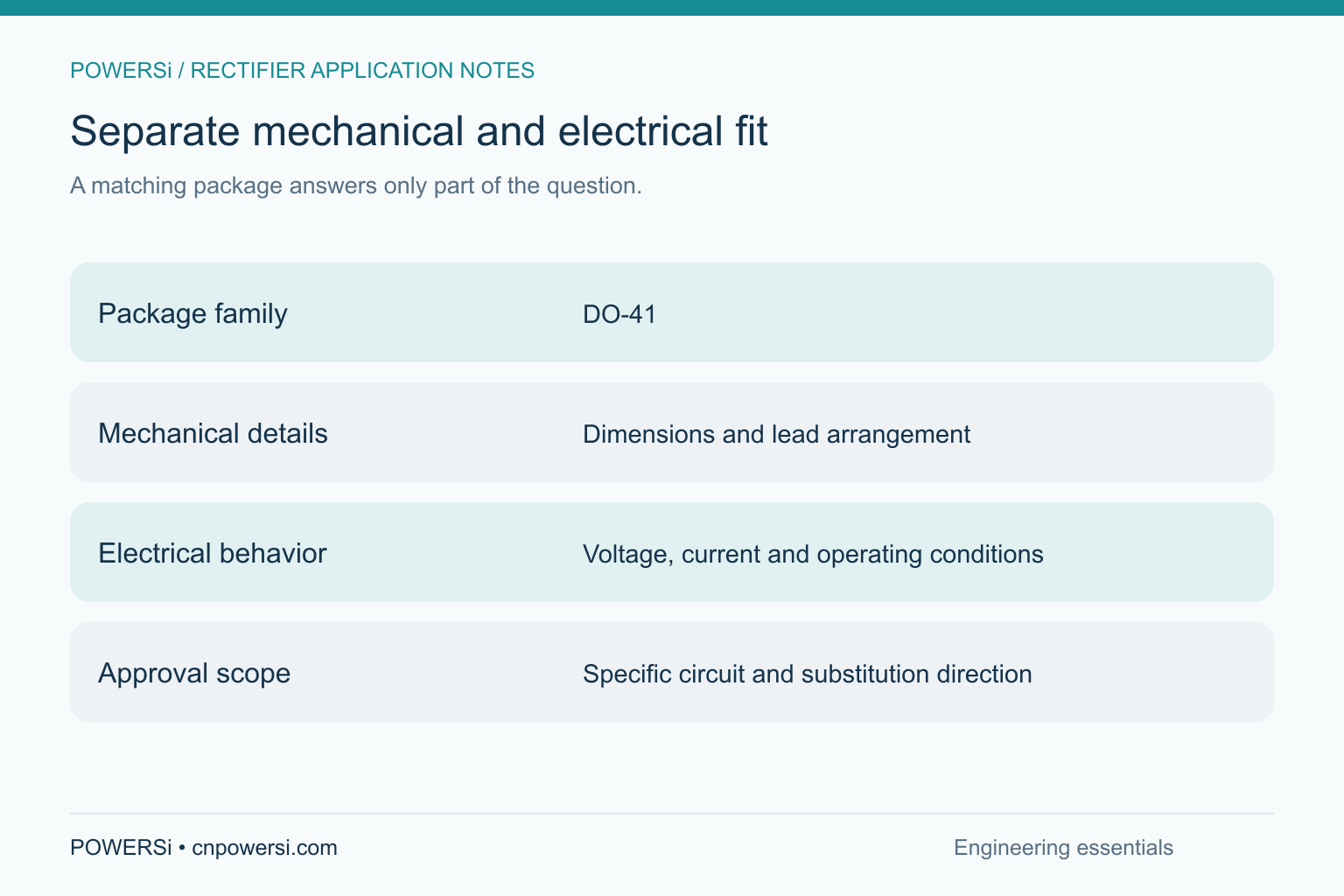
Two axial rectifiers can fit the same holes on a board and still have very different reverse-voltage ratings. The 1N4001 and 1N4007 are a useful example of why a visual match is not enough to approve a replacement.
The Difference Hidden by a Similar Outline
In Vishay's 1N4001–1N4007 family, the repetitive peak reverse-voltage rating is 50 V for 1N4001 and 1000 V for 1N4007. Both use the DO-41 package. The shared outline describes mechanical form; it does not erase the difference in blocking capability.
| Comparison item | 1N4001 | 1N4007 |
|---|---|---|
| Repetitive peak reverse voltage, VRRM | 50 V | 1000 V |
| Package in this family | DO-41 | DO-41 |
| Device category | General-purpose rectifier | General-purpose rectifier |
This comparison identifies a specific manufacturer family. It is not a declaration that all suppliers' ordering options and detailed characteristics are identical.
Why the Replacement Direction Matters
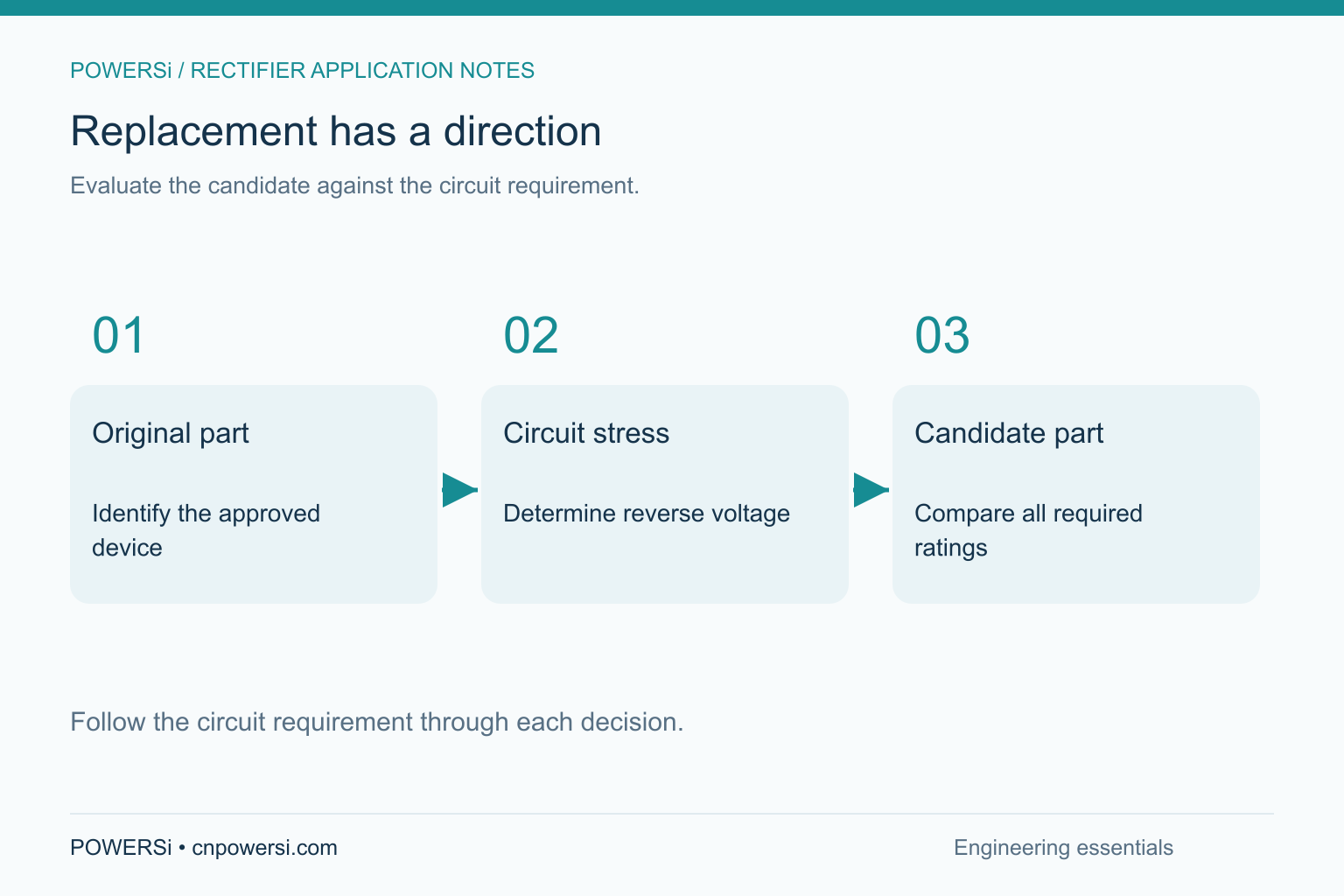
Replacing a 1N4007 with a 1N4001 reduces the reverse-voltage rating substantially. If the circuit needs blocking capability above the candidate's rating, the lower-voltage part is unsuitable even though it fits the board.
Replacing a 1N4001 with a 1N4007 moves in the opposite direction for that particular rating. It can be a candidate in a general-purpose rectification circuit, but higher VRRM alone does not establish a fully approved substitute. The other electrical limits, package dimensions, operating temperature and assembly requirements still belong to the comparison.
The two directions therefore require separate decisions. A replacement approved in one direction should not be entered into purchasing records as unrestricted interchangeability.
Compare the Circuit, Not Only the Supply Label
The relevant voltage is the reverse voltage across the diode. It depends on the rectifier arrangement, transformer or source, stored capacitor voltage and transients. A system label such as 'low-voltage supply' does not describe all of these conditions.
Current also needs its own assessment. Forward average current, peak current and startup surge describe different stresses. A part's ability to block more voltage does not automatically increase its current or surge capability.
A Higher Voltage Number Does Not Mean Faster Switching
The 1N4001–1N4007 family discussed here is a general-purpose rectifier family. Moving from one voltage variant to another does not turn the device into a qualified high-frequency replacement for a fast-recovery or Schottky diode.
If the original position is part of a switching converter, evaluate its required dynamic behavior separately. Voltage class and switching behavior answer different selection questions.
Make the Approved Direction Clear
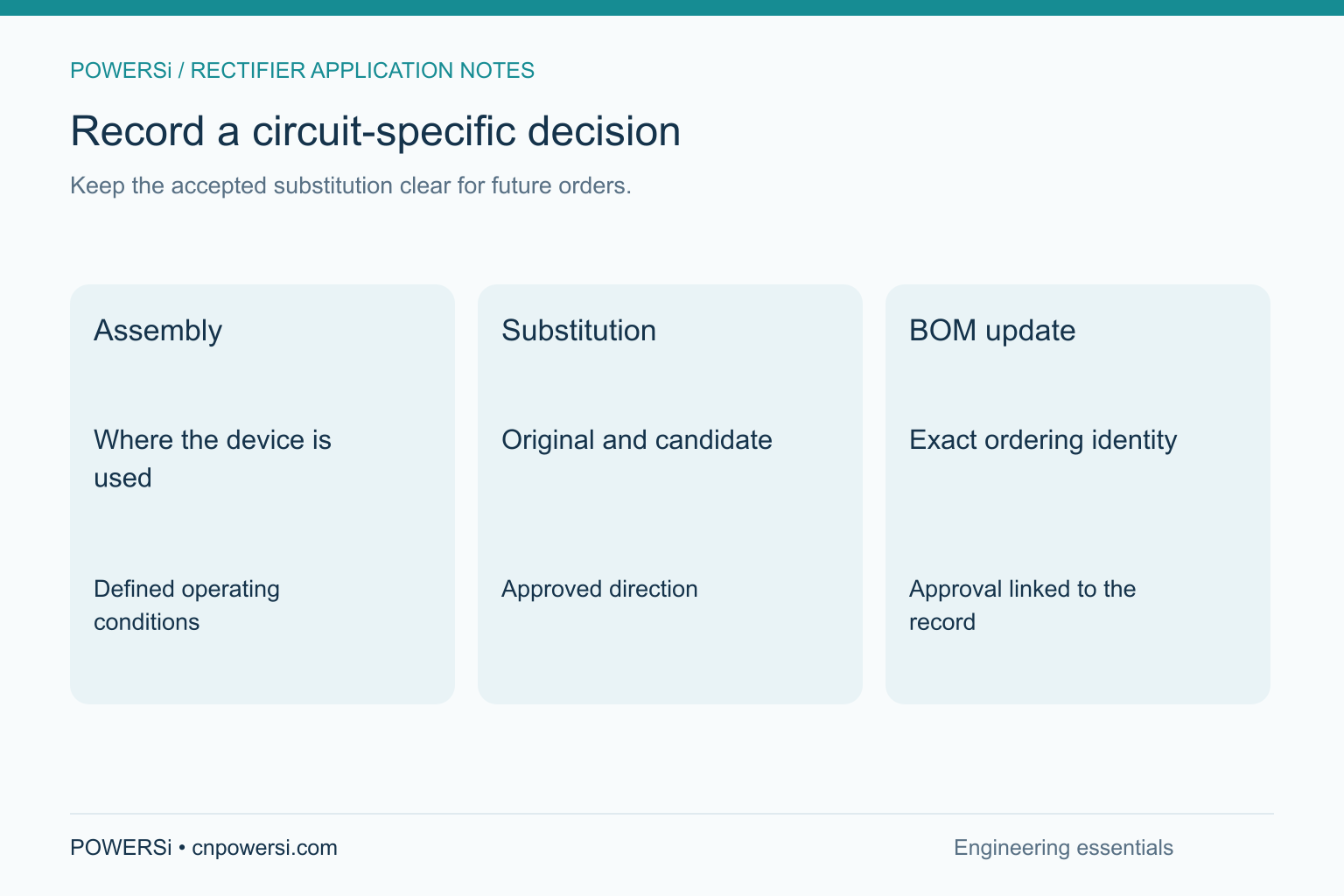
An alternate-parts record should identify the original manufacturer and full code, the candidate manufacturer and full code, the assembly involved and the approved substitution direction. Keep any relevant temperature or operating restrictions with that record.
At purchasing and receiving, match the ordered code and polarity to the approved record. This turns a one-off replacement decision into an instruction that remains clear on repeat orders.
Conclusion
The 1N4001 vs 1N4007 example shows why mechanical fit is only the beginning of a replacement review. Reverse-voltage capability is different, and approval must be tied to the circuit and the direction of substitution.
For other rectifier requirements, explore the POWERSi catalog or send the original part and application requirements to [email protected].
FAQs
Can a 1N4001 always replace a 1N4007?
No. Its lower reverse-voltage rating can make it unsuitable for the original circuit.
Does a 1N4007 automatically carry more current?
No. A higher reverse-voltage rating is not a higher current rating. Compare current specifications separately.
Does the same DO-41 outline prove compatibility?
It establishes only a package-family similarity. Verify actual dimensions, polarity and electrical requirements.
Should a BOM list these parts as interchangeable?
Only where engineering has approved the exact alternatives and substitution direction for that assembly.
Is this a guarantee for parts from any manufacturer?
No. The numerical comparison uses the identified Vishay family. Apply the specification and ordering information of the actual manufacturer being purchased.