Skip to content

Product Overview
DSC20065 provides 20A 650V SiC Schottky rectification in a two-lead TO-220AC package. It suits compact boost and DC-DC stages where mounting space and switching-node charge both influence diode selection.
The 20A rating is specified at Tc = 160°C. Typical capacitive charge is 76nC at 400V and 25°C, providing a defined point for evaluating commutation behavior.
Key Features
● 650V repetitive peak reverse voltage with a 20A current rating.
● 76nC typical capacitive charge at 400V and 25°C.
● 1.46V maximum forward voltage at 20A and 25°C.
● 190A non-repetitive surge current for a 10ms pulse.
Key Specifications
| Parameter | Value and conditions |
| Configuration / package | Single diode / TO-220AC |
| Forward current | 20A at Tc = 160°C |
| Repetitive peak reverse voltage | 650V |
| Forward voltage | 1.32V typ / 1.46V max at IF = 20A, Tj = 25°C 1.43V typ / 1.8V max at IF = 20A, Tj = 175°C |
| Capacitive charge | 76nC typ at VR = 400V, Tj = 25°C |
| Surge current | 190A; non-repetitive, t = 10ms |
| Junction to case thermal resistance | 0.61°C/W |
| Junction temperature range | −55°C to +175°C |
Current capability depends on case temperature and cooling. Use the datasheet derating curve when determining operating current.
Electrical Configuration and Pinout
With the marking face toward you and the leads pointing down, the left lead is K (cathode) and the right lead is A (anode). The exposed mounting tab is electrically connected to K.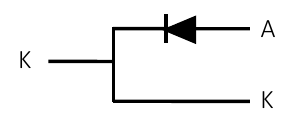
Figure 1. Circuit and connection detail from the DSC20065 datasheet, page 1. A = anode; K = cathode.
| Connection | Function |
| Left lead | K — cathode |
| Right lead | A — anode |
| Metal tab | K — electrically connected to the cathode |
Typical Applications
● Compact industrial power supplies.
● 400V-class boost rectifier stages.
● Modular DC-DC converters.
Compact 650V SiC Rectification
The TO-220AC body provides a compact mounting option when a 20A hot-case current class meets the load requirement. Its charge specification at 400V supports comparison of candidate diodes at a defined reverse-voltage point.
Design Notes
The 20A operating point is tied to Tc = 160°C. Include conduction loss, commutation loss, the thermal interface and heatsink when determining usable current. Check reverse-voltage peaks against the 650V limit.
The metal tab carries the cathode potential. If the heatsink must remain at a different potential, use an appropriate insulating mounting interface and include its thermal resistance.
Capacitive charge is a typical characterization value, not a guaranteed maximum. Compare devices at the same reverse voltage and temperature; converter efficiency also depends on forward loss, the companion switch and operating frequency.