Skip to content
Comparing fast vs ultrafast recovery rectifiers requires more than sorting reverse recovery time. Match test conditions, then consider recovery charge, waveform softness, forward voltage and temperature. A shorter trr can be useful, but the right device is the one that meets the circuit’s switching, thermal and noise requirements.
A purchasing comparison may show one rectifier as 'fast' and another as 'ultrafast.' That description points toward switching behavior, but it does not answer whether the second part improves the intended power supply.
The useful comparison starts with how each device behaves as current commutates and how that behavior interacts with the rest of the circuit.
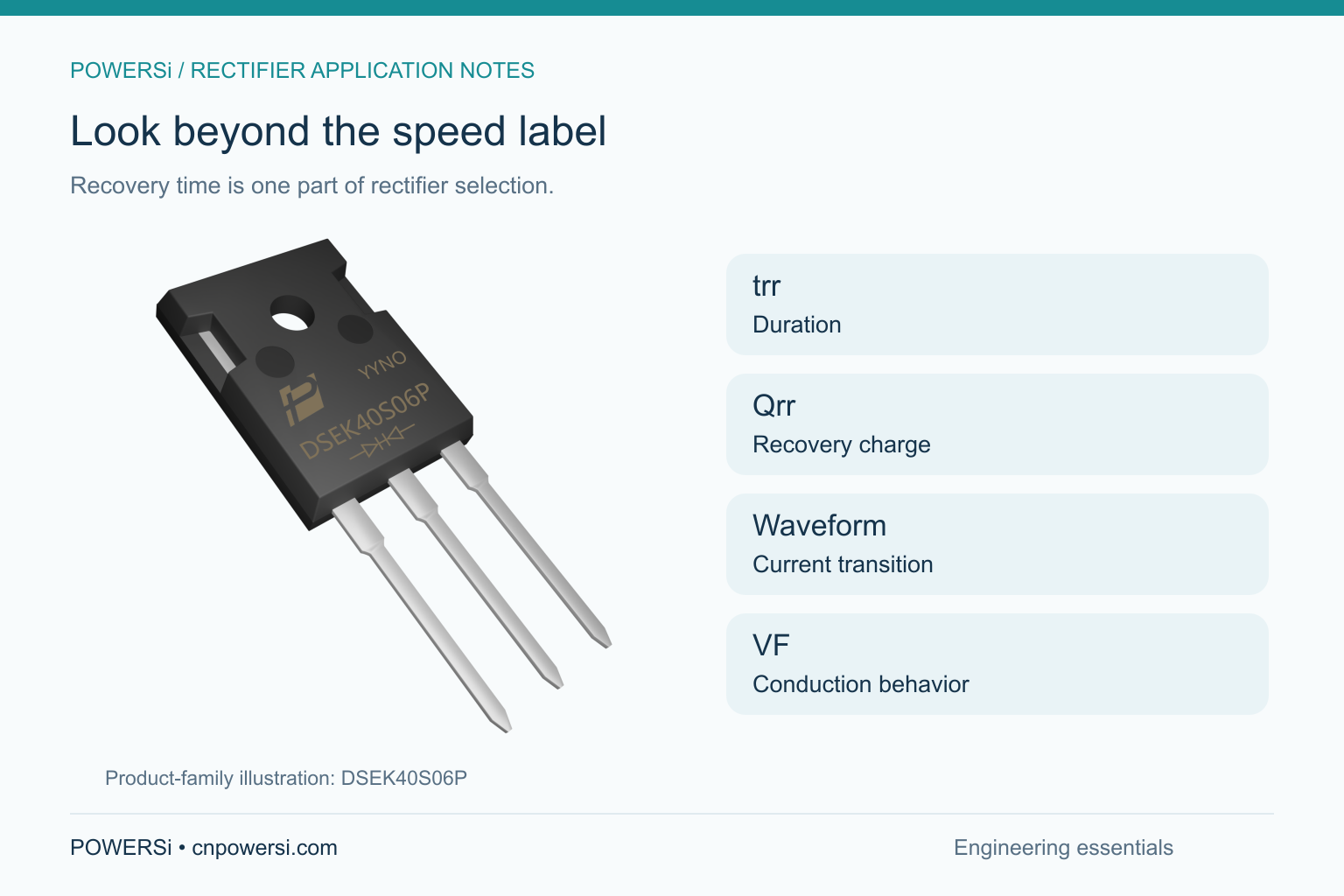
What trr Describes
After forward conduction, a PN-junction rectifier needs to remove stored charge before establishing reverse blocking. Reverse recovery time describes the interval under stated test and measurement conditions.
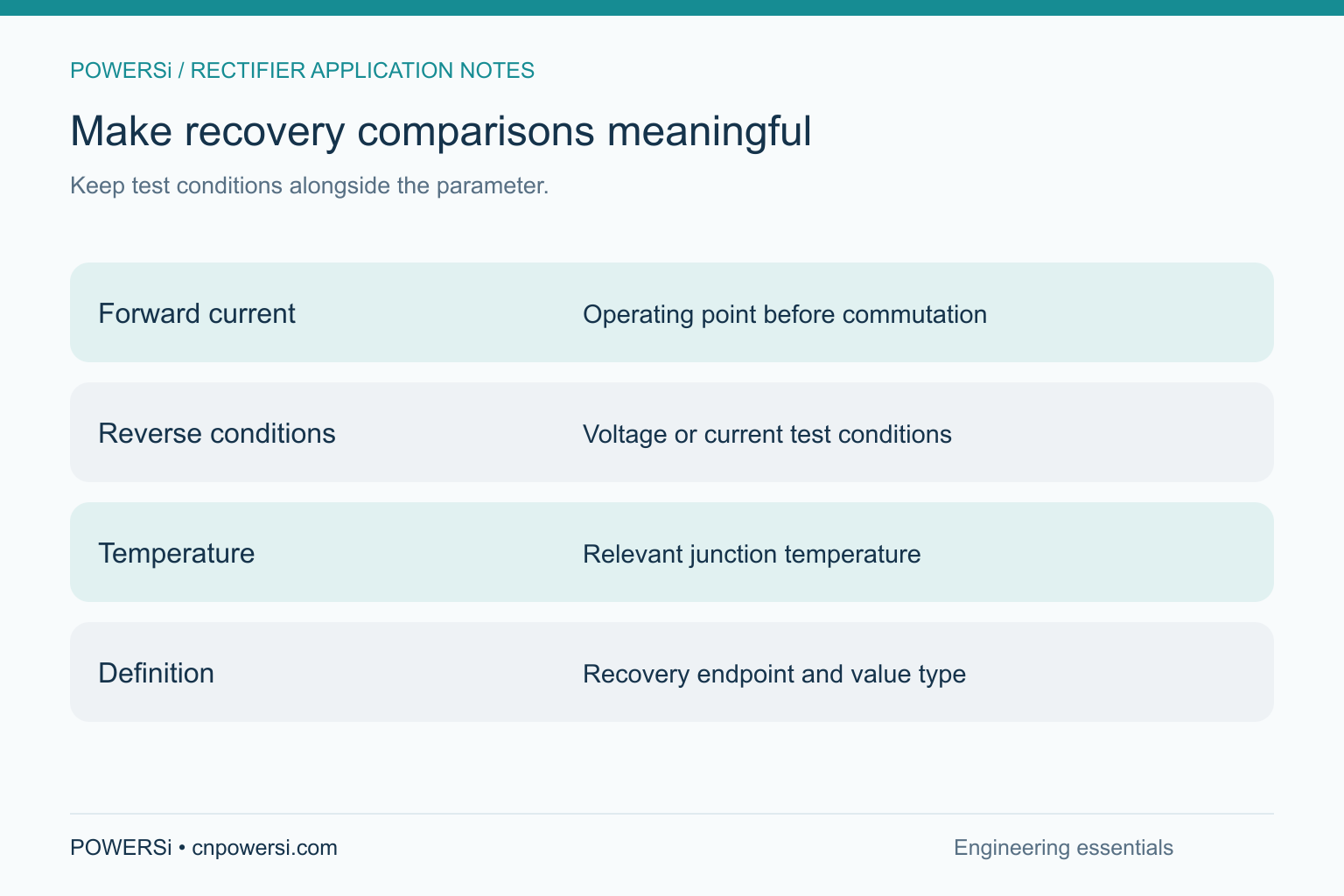
The family name is a starting point for finding candidates. The actual data provides the comparison. Use matched forward current, reverse conditions, current slew rate where specified, junction temperature and recovery endpoint definition.
A faster result measured under a lighter condition is not direct evidence of better performance under the intended load.
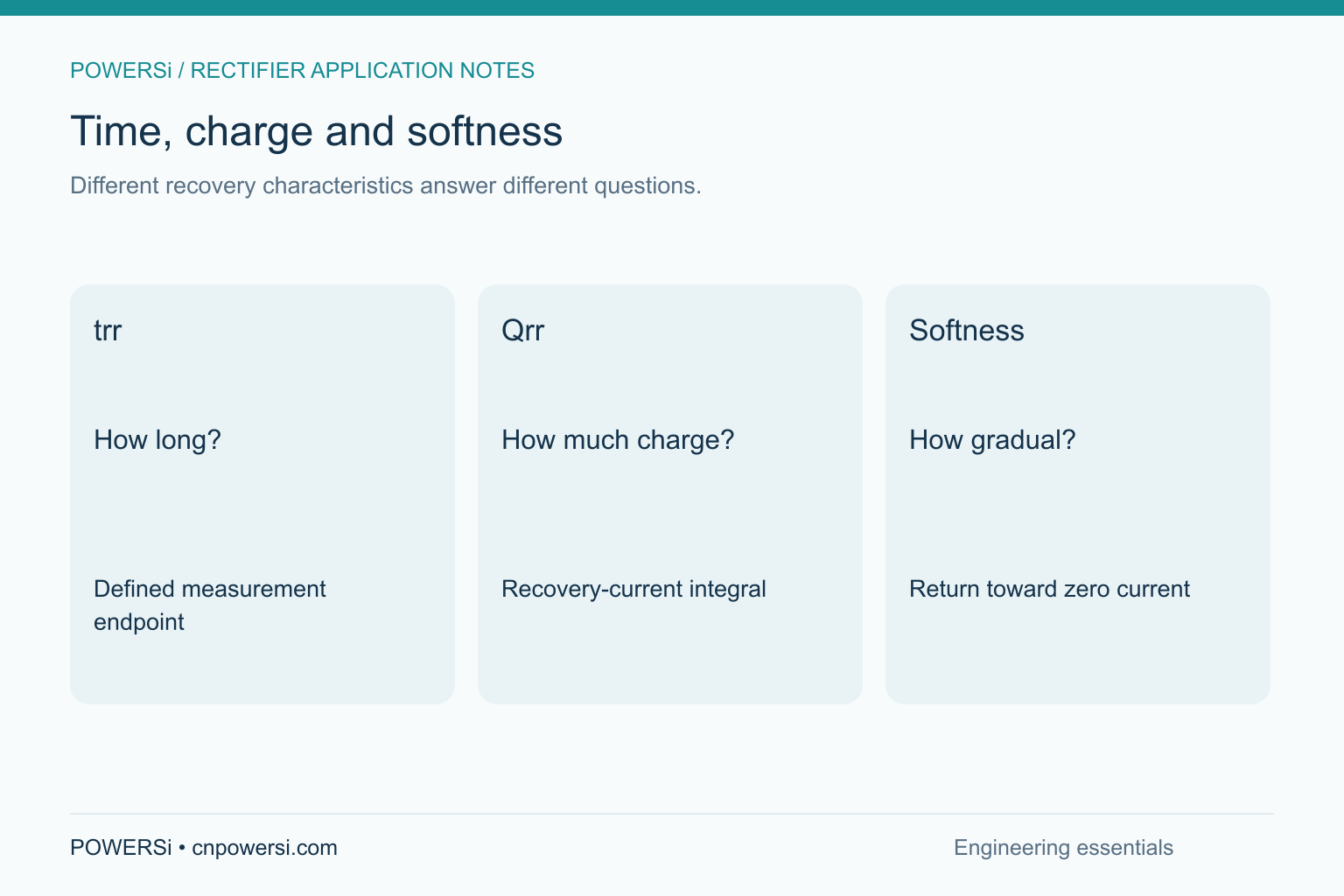
Time, Charge and Waveform Answer Different Questions
| Characteristic | What it helps explain |
|---|---|
| trr | Duration of recovery under stated conditions |
| Qrr | Charge associated with the reverse recovery current |
| Peak recovery current | Magnitude of the current excursion during commutation |
| Recovery softness | How gradually the recovery current returns toward zero |
| VF | Forward-conduction voltage and its contribution to loss |
Two devices can have a similar recovery time and different current-waveform shapes. Looking only at the duration discards that information. Where a parameter is not specified, do not fill the comparison cell by inference from the product name.
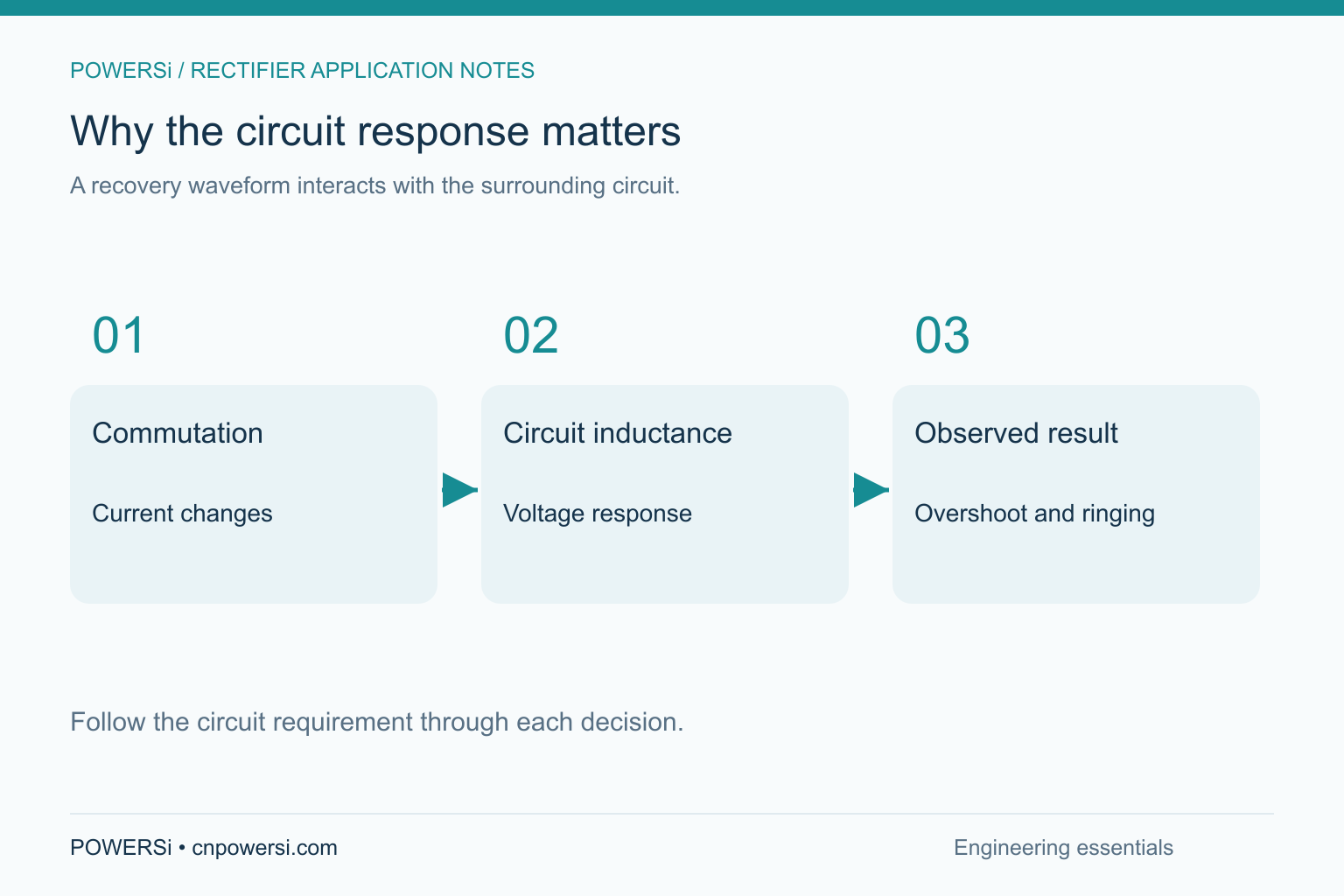
Why a Shorter Recovery Is Not the Only Goal
In a hard-switched circuit, reverse recovery interacts with the switching device and circuit inductance. A rapid change in current can contribute to voltage overshoot and ringing. A softer recovery can help control the transition, but its benefit depends on the circuit and operating point.
This is why an ultrafast part is not a universal cure for noise or temperature. Layout, switching speed and any damping network also influence the observed result. Selection should connect the diode behavior to those circuit conditions.
Include Conduction and Temperature
A device spends part of its cycle conducting as well as switching. Compare VF at the intended current and temperature, and estimate the effect of both conduction and dynamic behavior on the thermal design.
Keep typical values separate from maximum values. A typical room-temperature recovery curve is not a guaranteed hot-operating limit. Package and mounting conditions complete the comparison because the resulting heat must leave the device.
Define What an Improvement Means
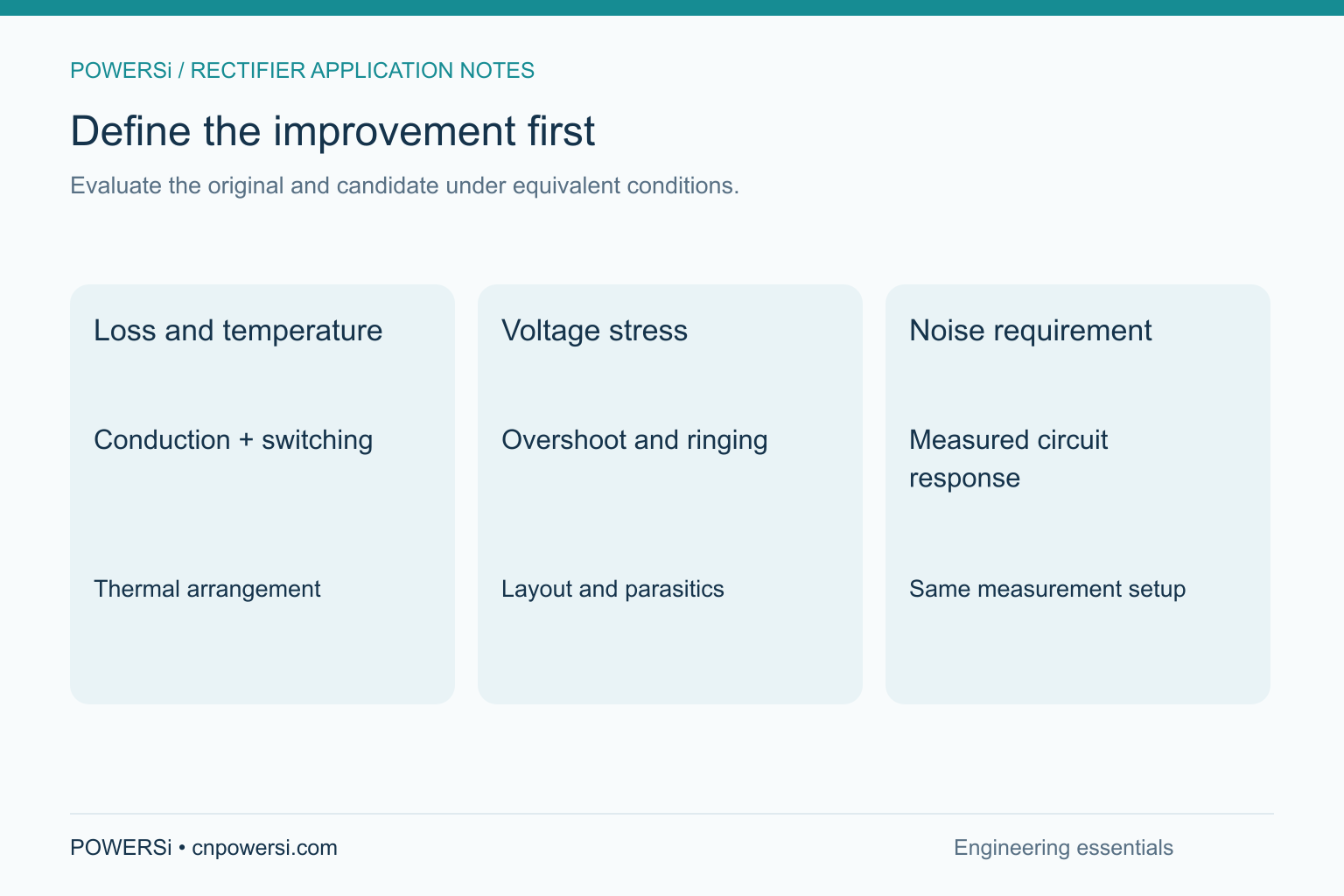
Before evaluating an alternative, state the objective: lower measured loss, reduced overshoot, lower temperature or acceptable noise with the intended layout. Run the original and candidate under equivalent circuit and measurement conditions.
Record both the result and the configuration used to obtain it. This gives procurement an approved alternate for a defined assembly rather than a broad rule that every 'ultrafast' part can replace every 'fast' one.
Conclusion
The best comparison combines recovery time with charge, waveform, conduction behavior and temperature. It turns a speed label into a decision based on the finished circuit.
For recovery-rectifier product options, visit the POWERSi catalog or send your original part, switching conditions and design objective to [email protected].
FAQs
Is the shortest trr always the best choice?
No. Recovery current, charge, conduction loss and the circuit's response also affect the result.
Can two trr values be compared without test conditions?
They are incomplete comparison inputs. Establish equivalent conditions and measurement definitions first.
Does 'soft recovery' mean the diode has no recovery current?
No. It describes the recovery waveform's return toward zero, not the absence of current.
Will an ultrafast diode automatically solve EMI problems?
No. The layout, switching transitions and circuit parasitics also affect noise.
What should a replacement evaluation report include?
Record both exact parts, circuit configuration, operating and measurement conditions, the design objective and the observed results.